Queen of Pentacles: upright, reversed, love & yes or no
Practical warmth can include the person doing the caring.
If this feels familiar
Maybe you know how to make an ordinary place feel easier to be in. The chair you offer, the remembered meal and the practical help count. You might be the person who notices when someone is cold or hungry, or who quietly keeps things running. There should also be a comfortable place for you. Recognising your own care does not mean you must always provide it. You are allowed to receive the same warmth you give.
A line to keep
The care I offer can include me.
- Upright meaning
- Nourishment · practical care · grounded generosity · a welcoming space · self-inclusion
- Queen of Pentacles reversed
- Neglected personal needs · overgiving · care measured by usefulness · depleted resources
Upright meaning
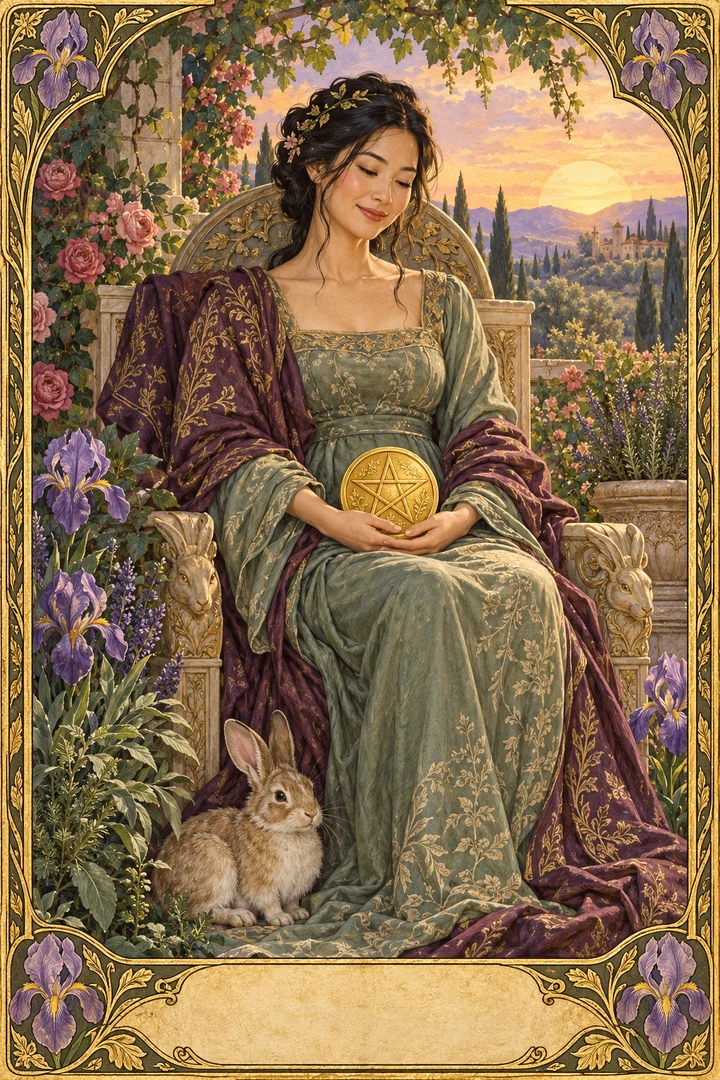
The Queen of Pentacles is often read as practical warmth: care that takes form through food, comfort, attention and arrangements that fit real needs. She holds a coin gently within a living garden, suggesting that resources and tenderness can belong together. This is not about doing everything for everyone. It is about making a space where people can rest, including you. Your own time, rest and pleasure belong in the circle of care you offer. The card invites you to notice how you sustain others and whether you are also sustained.
You invite a friend for a simple shared meal. You cook something you both enjoy, set two places, and agree beforehand that they will wash up. The welcome is real, and it does not require you to do all the work or to perform a perfect host. You also sit down and eat.
Queen of Pentacles reversed
Reversed, the Queen of Pentacles can point to care that has become one-sided. You may be maintaining comfort for everyone while your own needs stay off the list. Perhaps you measure your worth by how useful you are, or you give until your resources run low. Ask what can be simplified, shared or received. A less elaborate form of care can be more sustainable. The reversal is not a failure; it is an invitation to rebalance. Notice where you can let someone else contribute.
You have been the one who remembers birthdays, brings soup and checks in. This week you are tired and keep saying yes. You might tell a friend, ‘I am low on energy. Could you bring something next time?’ Letting one person help is a way to refill the garden.
Queen of Pentacles in love and relationships
In love, the Queen of Pentacles asks whether care reaches both people through actions and attention. Domestic competence does not create an obligation to carry all the work or to prove that somebody will commit. Practical love can be beautiful, but it needs to be mutual. Notice who remembers the small things and who assumes they will be done. A healthy bond includes room for your needs, not just your reliability. The card does not promise a particular outcome; it invites you to look at the balance of giving and receiving.
You have been the one planning meals and managing the household. You say, ‘I would like us to share the planning. Can we take turns?’ The response will show whether care can flow both ways. You are not asking for too much; you are asking for a partnership.
Queen of Pentacles: yes or no?
In a yes/no convention, the Queen of Pentacles often leans toward a conditional yes: yes to an act of care that fits your capacity and includes you. Pause when the request relies on neglecting your own needs or buying more than you can manage. The card does not guarantee a specific outcome, and tarot readers do not share one universal yes/no rule. Let your actual resources and limits guide the answer. A smaller yes may be more honest than a grand one.
For ‘Should I host the family dinner?’, an upright yes might mean yes if you simplify the menu and ask for help. For ‘Will they appreciate it?’, the card cannot promise that. Reversed, you might say no this time and offer a smaller alternative later.
A yes/no lean is a storytelling convention, not a probability or reliable prediction. Check real information before acting, especially about safety, money or another person's intentions.
Work, study and creative life
At work, the Queen of Pentacles highlights practical work that makes a team function: arranging, checking in, remembering details and creating a humane atmosphere. This labour is often invisible and can become permanent unpaid availability. Make its time and ownership visible. If you are the one who always organises the social events or supports colleagues, consider whether that role is recognised and sustainable. The card supports grounded generosity, but not at the cost of your own resources. You can care about your work without carrying everything alone.
You notice you are the only one who orders supplies and remembers deadlines. In a team meeting, you say, ‘I am happy to keep doing this, but I would like it to be a shared task. Can we rotate?’ This makes the work visible and opens a conversation about fairness.
How this card differs from nearby cards
The Queen of Cups attends to feeling; the Queen of Wands supports expression; the Queen of Pentacles gives practical care a shape. These approaches are not assigned to a gender or family role. The Queen of Pentacles differs from the Empress, who represents abundance and creation more broadly, and from the Page of Pentacles, who is learning practical skills. Each card offers a different question about how care, resources and presence show up in your life.
Common misreadings
The rabbit does not predict pregnancy or fertility. The Queen cannot guarantee wealth, a mother figure or a nurturing partner, and caring is not restricted to women. The coin is not a promise of money or a purchase recommendation. The card describes a quality of practical care, not a fixed identity or a future event. Keep the interpretation close to what you can actually observe and choose.
Reading lens, not a verdict
These readings use symbols to reflect on experiences you recognise. They cannot establish events, financial outcomes or another person's private feelings. Reversed meanings explore how a theme may be internal, blocked or overused; they are a separate reference, since the one-card draw uses upright cards. Yes/no interpretations are conditional editorial conventions, not guarantees or a universal rule.
Traditional symbolism
The traditional Queen of Pentacles sits on a throne carved with plants and animals, holding a single coin and looking at it calmly. In Selfetti's garden adaptation, an adult woman with East Asian features rests in an ornate throne among roses, irises and greenery, one golden five-pointed-star coin held gently in her lap. A small rabbit rests near her feet. Sage and plum fabrics frame a caring face. The garden and flowers belong to our setting; they do not add a separate prediction. The coin and the rabbit are recognisable traditional details, and we read them as symbols of practical care and quiet watchfulness rather than literal wealth or fertility.
A question to keep
What would practical care look like if my own needs were included?
One small experiment
Choose one small act of care and simplify or share its work. Include one comfort, meal or rest you can receive yourself.
Questions worth asking
Does Queen of Pentacles predict pregnancy?
No. The rabbit and garden are symbolic, not evidence of pregnancy or fertility. For that question, use real-world information and medical care. The card speaks to practical care and nourishment, not a literal prediction.
Does it represent a mother or a woman?
The Queen of Pentacles is traditionally depicted as a woman, but the card's qualities of practical care and grounded generosity are available to any gender. It does not have to represent a mother figure or a specific person in your life.
How is it different from Queen of Cups?
Queen of Cups focuses on emotional attunement and feeling. Queen of Pentacles focuses on practical care, resources and tangible support. Both are valuable, and you might recognise one or both in yourself or others.
Can simplifying be a form of care?
Yes. Simplifying can make care more sustainable and inclusive. A smaller meal, a shared task or a clear boundary can be a kinder form of care than an exhausting performance. It allows you to keep giving without depleting yourself.
How to use this interpretation
These are symbolic prompts, not measured personality traits or predictions. Keep a real example beside any interpretation; you can disagree. Do not infer another person's feelings, health or financial outcomes from a card or sign.
Sources and method
V&A · Tarot · Selfetti · A. E. Waite · 1910
Historical image reference: A. E. Waite, The Pictorial Key to the Tarot (1910), illustrated by Pamela Colman Smith. The contemporary readings, life examples, recognition passages and keepsake lines are Selfetti's own editorial interpretation, including the conditional yes/no and reversed themes. Our original celestial garden illustrations adapt the traditional scenes with inclusive figures; ornamental flowers and frames do not add predictions. The one-card draw uses upright cards; reversed meanings are a separate reference.
Selfetti ·
Keep exploring
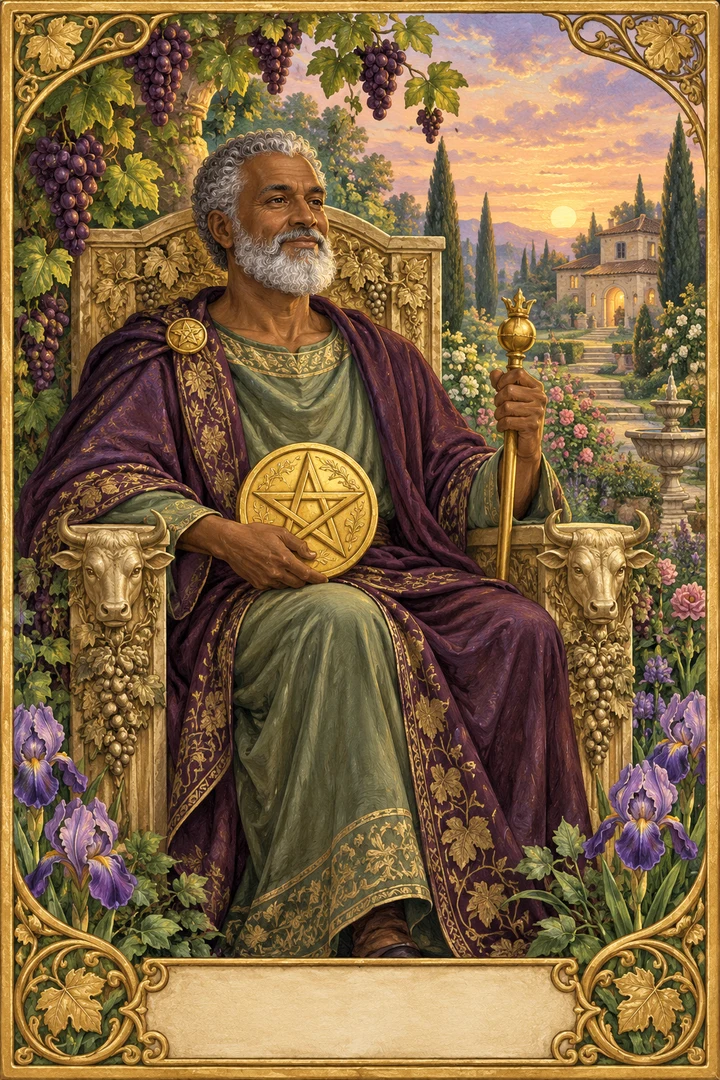
King of Pentacles
Resources become trustworthy through clear terms, care and responsibility for their effects.
Read the full guide ↗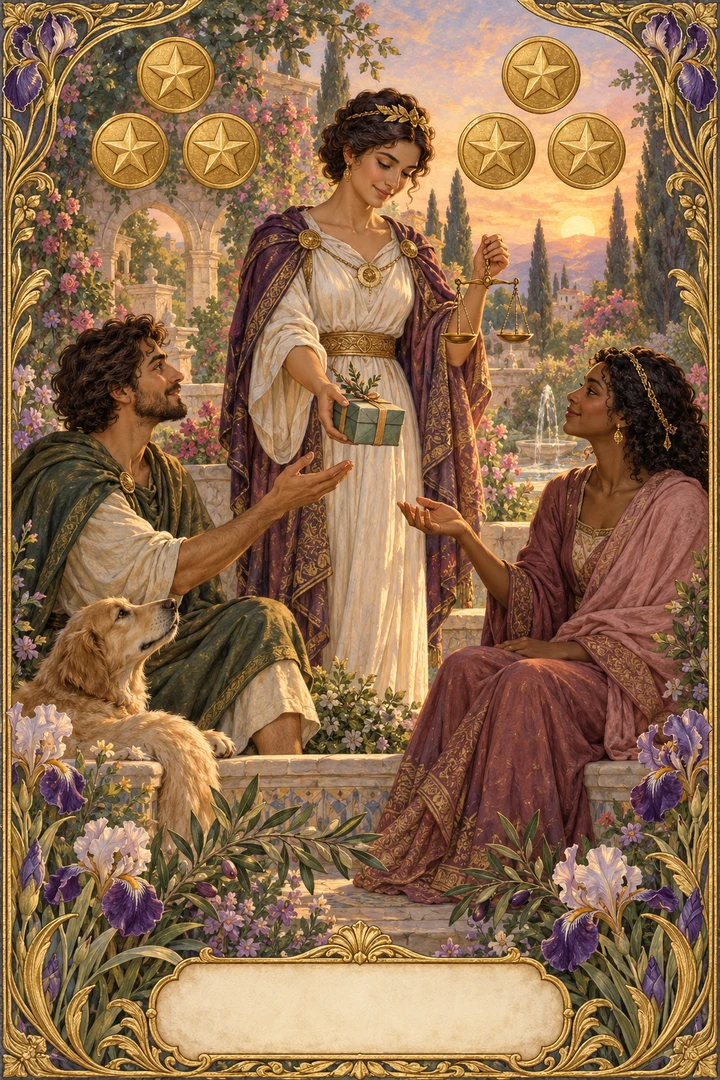
Six of Pentacles
Care becomes fairer when giving and receiving both leave room for choice.
Read the full guide ↗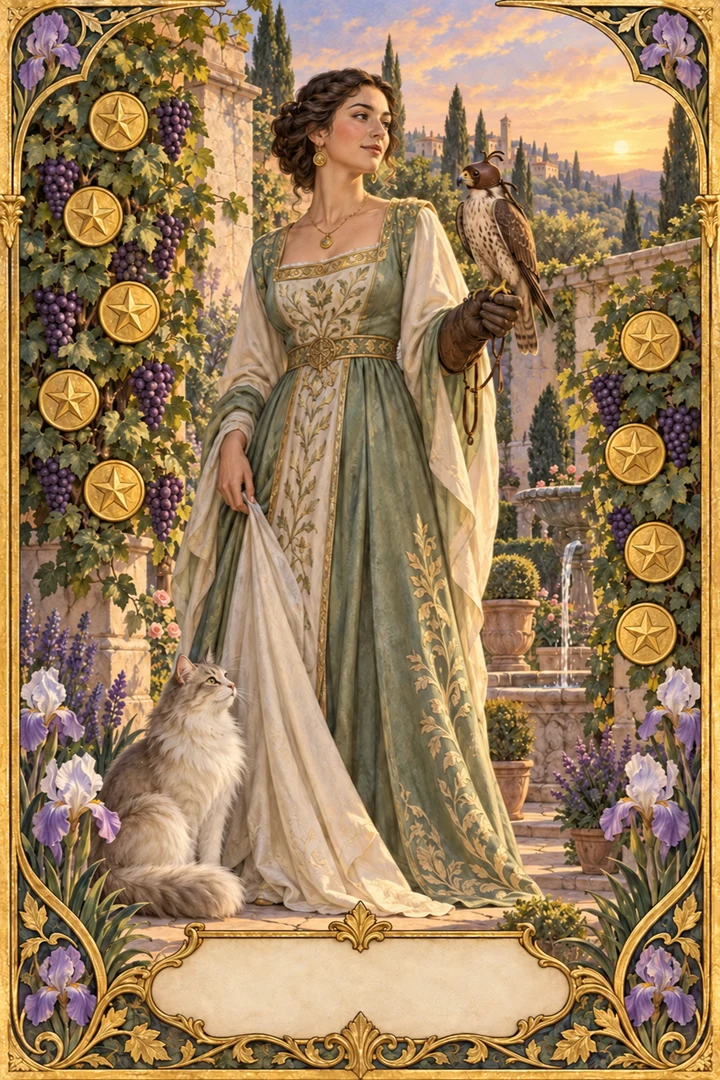
Nine of Pentacles
Enjoying space you have helped make, without needing to earn every moment again.
Read the full guide ↗