Six of Pentacles: upright, reversed, love & yes or no
Care becomes fairer when giving and receiving both leave room for choice.
If this feels familiar
Maybe it feels easier to be needed than to need something. You can accept a well-matched offer without becoming smaller. Your gratitude can be sincere while your choices stay your own. Perhaps you have been the one holding the scales, giving carefully, and you are tired. Or you have received help and quietly wondered what it costs. The Six invites you to bring the terms into the open, with dignity for everyone involved.
A line to keep
I can receive care and keep my own choices.
- Upright meaning
- Generosity · reciprocity · resources · fair terms · dignity in receiving
- Six of Pentacles reversed
- Uneven exchange · hidden conditions · help used as control · overgiving
Upright meaning
The Six of Pentacles often points to an exchange of resources: time, money, help, attention or skill. The scales ask who can choose the terms, who can say no and who can name a need without fear. Giving can be kind without requiring gratitude on demand. Receiving need not create unlimited obligation. This card invites you to look at the practical shape of care, not just its warm feeling. Fairness here is not identical shares; it is clear terms that both people can freely accept or decline.
A friend offers to help with a move. You agree the time and task, and ask what is manageable for them. You accept the help without promising more in return than you can offer. The exchange stays warm because both people know what is being given and what is not.
Six of Pentacles reversed
Reversed, the Six can point to an uneven exchange, hidden conditions or help used as control. An offer may come with unspoken expectations, or your giving may have exceeded your capacity. Clarify what is a gift, a loan or a shared responsibility. A warm tone cannot replace clear terms. Notice if you are overgiving to keep peace or if someone is using resources to influence your choices. The reversal may also be internal: difficulty receiving, or guilt about needing support.
You realise you have been covering a colleague's tasks for weeks without discussion. Before offering again, name what you can realistically do. You might say, ‘I can help with this part, but I cannot take on the whole project.’ The conversation may feel awkward, yet it returns the exchange to fair terms.
Six of Pentacles in love and relationships
In love, notice whether both people can ask, receive and decline. Gifts do not compensate for disrespect, and care should not be used to control someone else's decisions. The Six asks you to look at the practical balance of giving and receiving in the relationship. Are needs named openly? Can either person say no without punishment? Reversed, watch for hidden conditions or overgiving that leaves you resentful. Fairness in love is not a ledger; it is a shared willingness to keep the exchange honest.
You have been planning every date and covering most costs. Instead of silently keeping score, you say, ‘I would like us to share the planning more. Could you choose what we do next weekend?’ The request is specific, leaves room for their answer and makes the imbalance visible without accusation.
Six of Pentacles: yes or no?
In a yes/no convention, upright leans toward a conditional yes: an offer with clear, freely accepted terms. Pause if it creates dependency, pressure or an obligation you do not understand. Reversed, the answer is more likely no or not yet until the terms are clarified. Neither orientation guarantees a gift, a loan or equal power. Tarot readers do not share one universal yes/no rule, so treat this as an editorial convention for reflection rather than a prediction.
For ‘Should I accept my friend's offer to pay for the course?’, an upright yes can support accepting if you know what the gift includes and what it does not. For ‘Will this loan be fair?’, the card asks you to read the actual agreement. Reversed, you may need to decline or renegotiate before saying yes.
A yes/no lean is a storytelling convention, not a probability or reliable prediction. Check real information before acting, especially about safety, money or another person's intentions.
Work, study and creative life
At work, make resources, credit and unpaid coordination visible. If money is exchanged, review the actual terms rather than treating the symbolic scales as proof of fairness. The Six can highlight mentoring, training or support that flows in one direction. Ask whether recognition matches contribution. Reversed, check for hidden expectations around favours or extra hours. Clear agreements protect both the person giving and the person receiving. This is not a purchase or investment recommendation; it is a prompt to look at the real information in front of you.
A senior colleague offers to mentor you. You clarify how often you will meet, what they expect from you and whether the arrangement is formal or informal. You also ask what happens if either of you needs to stop. The clarity helps you accept support without guessing at unspoken obligations.
How this card differs from nearby cards
Five of Pentacles asks what support is needed; Six examines its exchange; Three of Pentacles coordinates skills. Two of Cups concerns mutual attention rather than access to practical resources. The Six is not about whether help exists, but about the terms on which it moves. It also differs from the Four of Pentacles, which focuses on holding and control. Here the question is circulation: who gives, who receives and who can choose.
Common misreadings
Six does not guarantee a gift, a loan, charity or equal power. The giver is not automatically benevolent and the recipient is not less capable or worthy. The scales are a symbol of weighing, not a certificate of fairness. Reversed does not mean someone is secretly malicious; it may simply show an imbalance that needs a conversation. Keep the interpretation close to what you can actually observe about the exchange.
Reading lens, not a verdict
These readings use symbols to reflect on experiences you recognise. They cannot establish events, financial outcomes or another person's private feelings. Reversed meanings explore how a theme may be internal, blocked or overused; they are a separate reference, since the one-card draw uses upright cards. Yes/no interpretations are conditional editorial conventions, not guarantees or a universal rule.
Traditional symbolism
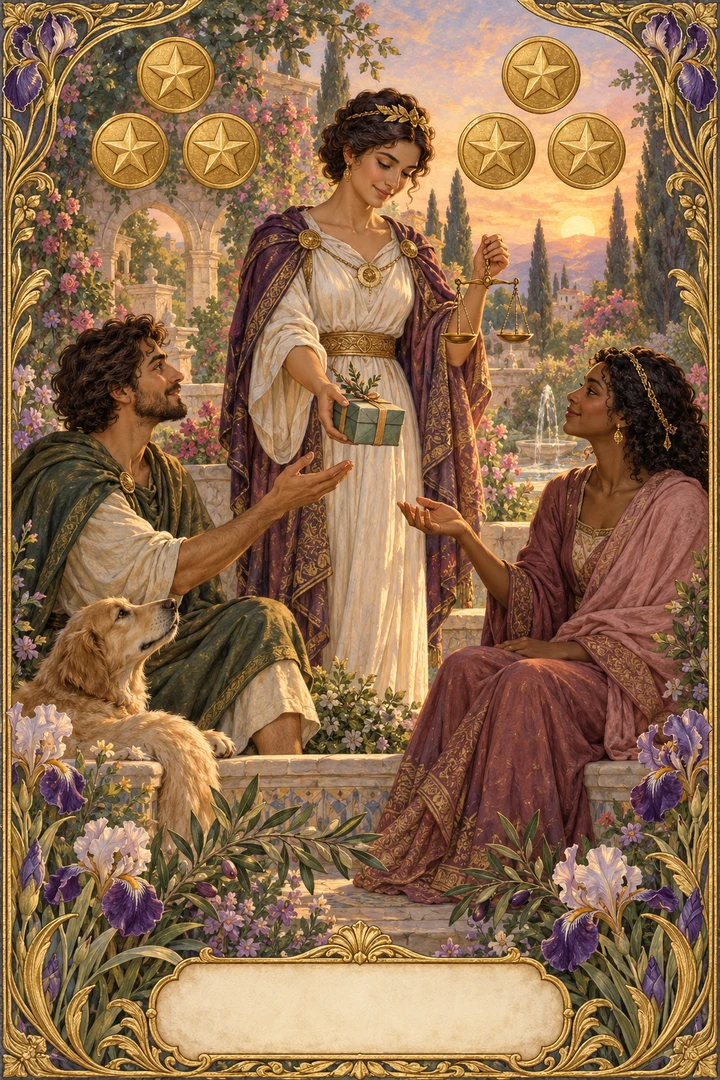
The traditional Six shows a merchant with scales, giving coins to two kneeling figures. Selfetti keeps the scales and the exchange but sets it in a flowering garden courtyard. Three adults meet respectfully: one standing holds the scales and offers a useful gift to two seated comfortably. Six golden star coins float above in two groups of three. We read the scales as a question about fair terms, not a verdict. The garden, flowers and warm eye contact belong to our original setting; they add dignity and choice rather than a hidden symbol.
A question to keep
Are the terms of this exchange clear and freely chosen?
One small experiment
Clarify one offer: what is being given, its limits and any expectations. Make room for either person to decline.
Questions worth asking
Does Six guarantee a gift?
No. The Six of Pentacles is a symbolic image of exchange, not a promise of money or help. It asks you to look at the actual terms and whether both people can choose freely.
How can generosity have unequal power?
When help comes with hidden conditions, strings or control over the receiver's choices, the exchange is not equal. The card invites clear terms, not just a warm gesture.
Is receiving help an obligation?
Receiving can include gratitude, but it does not automatically create unlimited debt. You can accept a well-matched offer and still keep your own choices. Clear terms protect both people.
What does reversed Six ask me to check?
Check for uneven exchange, hidden expectations, overgiving or help used as control. Clarify what is a gift, a loan or a shared responsibility. A warm tone cannot replace clear terms.
How to use this interpretation
These are symbolic prompts, not measured personality traits or predictions. Keep a real example beside any interpretation; you can disagree. Do not infer another person's feelings, health or financial outcomes from a card or sign.
Sources and method
V&A · Tarot · Selfetti · A. E. Waite · 1910
Historical image reference: A. E. Waite, The Pictorial Key to the Tarot (1910), illustrated by Pamela Colman Smith. The contemporary readings, life examples, recognition passages and keepsake lines are Selfetti's own editorial interpretation, including the conditional yes/no and reversed themes. Our original celestial garden illustrations adapt the traditional scenes with inclusive figures; ornamental flowers and frames do not add predictions. The one-card draw uses upright cards; reversed meanings are a separate reference.
Selfetti ·
Keep exploring

Five of Pentacles
Difficulty deserves practical support, rather than a verdict on your worth.
Read the full guide ↗
Three of Pentacles
Good work grows when different skills can speak to one another.
Read the full guide ↗
Four of Pentacles
Protecting what supports you, while noticing when protection leaves too little room to live.
Read the full guide ↗