Tarot for decisions: make room for a choice you can own
A beautiful image can help a question take shape. It cannot remove every cost of choosing. This guide gives uncertainty somewhere to sit while you look at what is possible.
Selfetti ·

Begin with the decision that actually belongs to you
A question such as ‘Will this work?’ mixes many things: another person's response, chance, preparation and your own action. Separate what you can decide now from what remains unknown. A usable question contains a real choice and a time frame. You can ask whether to send a proposal this week; you cannot decide in advance whether everyone will love it.
Write: ‘By Friday, I need to decide whether to join this course.’ Under it, list the fee, the weekly hours and the kind of work involved. In a separate line, name what you cannot know yet, such as whether you will become close to the other students.

Two of Swords: name both needs fairly
The crossed blades hold a tension still. Try writing the best honest reason for each option without making one side sound foolish. You may want closeness and quiet, a secure routine and a new experience. A decision is easier to examine when both needs have names. Your own need counts even if other people have understandable expectations.
For an invitation, one side might say ‘I want to see my friends’; the other ‘I need an unhurried evening.’ Ask whether a shorter visit would fit. If it would not, you can still make a clear choice between imperfect options.

Seven of Cups: give imagination a small test
The Seven holds attractive and unsettling possibilities above the ground. Let each appealing option describe an ordinary day rather than an ideal photograph. Which parts are known? Which parts are assumptions? A trial can reveal whether you enjoy the activity itself. It cannot eliminate all uncertainty, but it can replace one imagined detail with experience.
If you are considering two creative projects, spend a short session on a representative task from each. Notice the practical demands and what draws your attention. Keep the trial small enough that it does not become a hidden commitment.
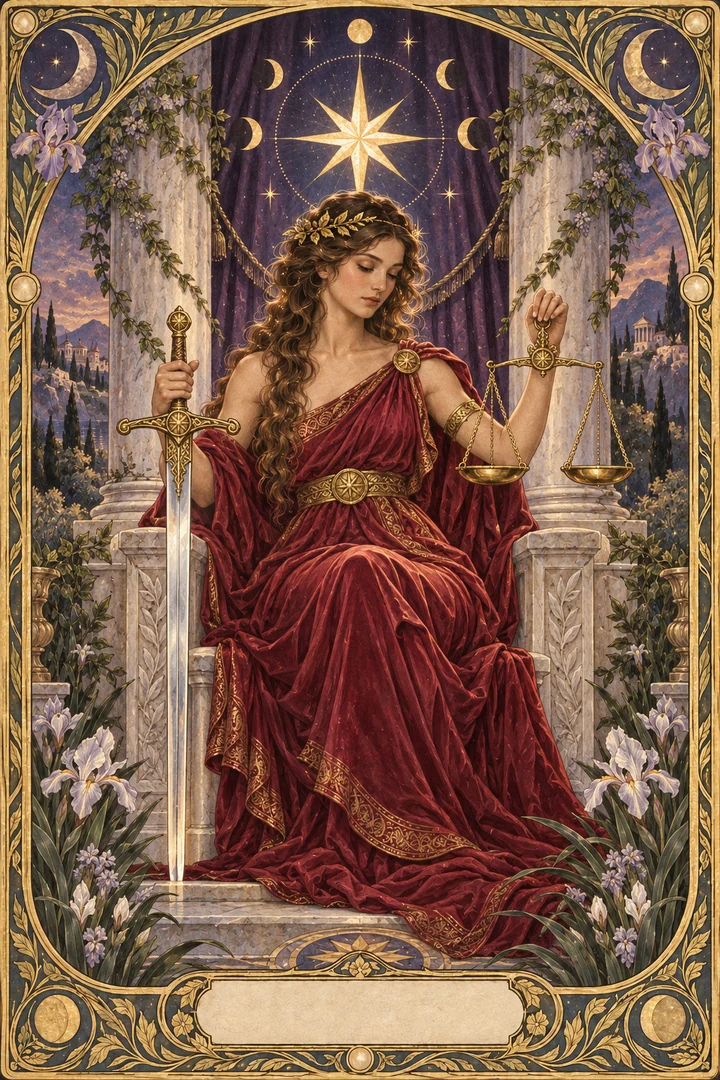
Justice: choose a standard you can explain
The scales invite a fair measure. Decide which criteria matter before you use them to defend a favourite answer. Include effects on other people, promises already made and limits you need to respect. Fairness does not always give everybody what they want; it asks whether the reasons can be stated honestly and applied consistently.
When sharing a limited budget, agree whether to prioritise urgent needs, equal amounts or a rotating arrangement before discussing individual requests. If you make an exception, explain the reason rather than pretending the rule never changed.
Eight of Cups: something can matter and still no longer fit
The Eight leaves standing cups behind. Its image can help when staying has become an automatic answer because much of the situation still looks good. Name what no longer fits, what you would lose by leaving and what a responsible transition requires. A symbolic reading cannot establish that departure is the right choice; it can make the question easier to face.
For a volunteer role, you might reduce your hours, hand over a responsibility or set a review date before leaving completely. Check whether that smaller change addresses the mismatch. If it does not, you have learned something useful without dismissing what the role once meant.

A careful choice can still feel uncertain
You may understand the trade-offs well and still wish for a sign that nobody will be disappointed. That wish can come from caring about the people and possibilities involved. Some decisions remain uncomfortable after they become clear. Give yourself permission to choose by reasons you can own, then observe the result and revise what can reasonably be revised.
Write a short decision note: ‘I chose this because…; I still do not know…; I will review it when…’. A review point is especially useful for choices that can be changed. For major commitments, gather the practical advice the situation needs.
A line to keep
I can choose with care while some uncertainty remains.
A question for you
Which need, fact or cost have I left unnamed?
One small next step
Make three short columns: what I know, what I need, and what I can test. Choose one next step from the third column.
Questions you may have
Can tarot make a decision for me?
It can offer images and questions, but it cannot assess all the facts or carry the consequences. Keep your decision connected to real circumstances, your values and any practical advice needed.
What tarot question is better than yes or no?
Try ‘What information would help me choose?’ or ‘Which need am I protecting?’ These questions point toward something you can examine. A yes/no convention can be conditional, but it never guarantees the result.
What is the difference between the Two of Swords and Seven of Cups?
The Two holds a tension between positions. The Seven explores several imagined possibilities. Ask whether your difficulty is choosing between known options or learning what the attractive options would actually involve.
Should I keep drawing until I feel certain?
Repeated draws can add competing stories to the same uncertainty. Keep one useful question, gather the missing information and choose a review point. Certainty is not something a random image can supply.
Background and our interpretation
Historical imagery reference: A. E. Waite, The Pictorial Key to the Tarot (1910), illustrated by Pamela Colman Smith. The life examples, letters, comparisons, keepsake lines and interpretations here are original Selfetti editorial content. Our illustrations adapt traditional arrangements with a celestial garden setting and inclusive adult figures; they are described separately from the historical images.
A. E. Waite · 1910 ↗