Seven of Cups: upright, reversed, love & yes or no
Many beautiful possibilities in view; choose one small way to meet reality.
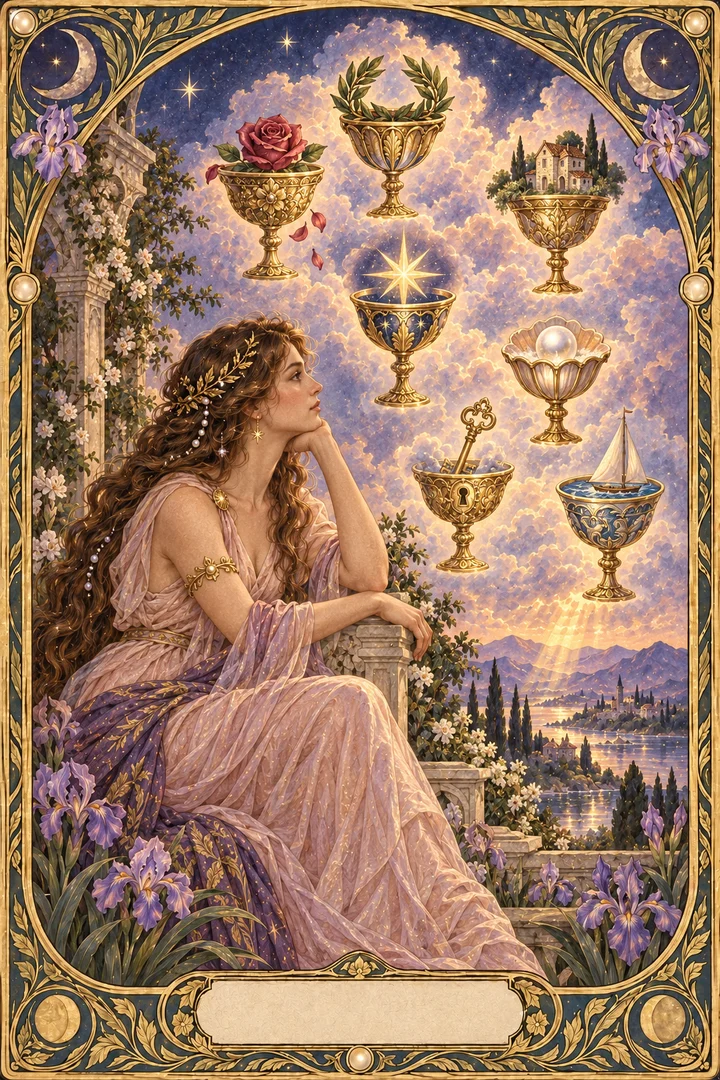
If this feels familiar
You may see several beautiful futures where another person sees only a practical list. That imagination can give an idea its first life. Choosing one trial does not make the others worthless. Let one possibility become real enough to discover, without asking it to fulfil every wish at once.
A line to keep
I can give one beautiful possibility a real beginning.
- Upright meaning
- Possibility · imagination · desire · many options · an untested picture
- Seven of Cups reversed
- Priorities clarifying · a grounded choice · options narrowing · a reality check
Upright meaning
Upright, the Seven of Cups often concerns imagination and the difficulty of choosing among appealing possibilities. Each option may hold a feeling you want: freedom, admiration, closeness or room to create. Name that desire, then ask what the option would involve on an ordinary day. Imagination can begin useful exploration. It becomes harder to use when every idea stays polished and untested above the ground.
Three project ideas all look exciting. Choose a representative task from one and try it briefly. Notice whether the actual work interests you, what resources it needs and what you would have to set aside to continue.
Seven of Cups reversed
Reversed, priorities may be becoming clearer, or options may have narrowed before you examined them. Check what changed: new information, a practical limit or a decision made under pressure. A grounded choice should be explainable beyond ‘this one feels destined’. You can choose an imperfect option that fits your current needs while leaving other ideas for another time.
After comparing time and costs, you choose the smaller course rather than the most impressive one. Write the reasons while they are clear. If the choice came mainly from somebody else's urgency, ask whether you have space to check the terms first.
Seven of Cups in love and relationships
In love, the Seven can invite a distinction between the person you know and the relationship you imagine. Enjoy hope while noticing what the actual exchange contains. Reversed, ask whether expectations are becoming clearer or whether you have narrowed your view to one reassuring story. The seven cups do not count possible partners or reveal private intentions.
You imagine a future after one good meeting. Bring attention back to what you know: you enjoyed the conversation and may want another. A specific invitation gives the next exchange room to happen without carrying the whole imagined future.
Seven of Cups: yes or no?
Upright usually invites pause and verification rather than a firm yes: the picture may contain more imagined detail than confirmed information. Reversed may lean yes when the choice has become grounded, or pause when options were narrowed under pressure. State what evidence or small trial would support proceeding.
For ‘Should I enrol?’, review a lesson, the schedule and the full commitment first. A reversed reading can support a considered yes once those fit. The beauty of the course description alone does not establish the answer.
A yes/no lean is a storytelling convention, not a probability or reliable prediction. Check real information before acting, especially about safety, money or another person's intentions.
Work, study and creative life
For work and study, compare appealing paths with their daily tasks, requirements and practical costs. A polished description can leave out repetitive or difficult work. Reversed, select a priority you can test or check whether a decision has excluded a useful alternative too quickly.
Before changing fields, speak with somebody about a normal working day and try one realistic task. Record which parts you enjoyed and which needs the path might meet. A small piece of experience can sharpen the next question.
How this card differs from nearby cards
The Two of Swords holds a tension between positions. The Seven of Cups opens many imagined possibilities. The Page of Cups gives one small feeling expression; the Eight considers leaving something already known. Ask whether you need information about an option or a decision about an experience you already have.
Common misreadings
Many cups do not prove many lovers, deception or foolishness. The image also does not require choosing the least imaginative option. The useful distinction is between a possibility worth exploring and a story treated as already true.
Reading lens, not a verdict
These readings use symbols to reflect on experiences you recognise. They cannot establish events or another person’s private feelings. Reversed meanings explore different ways a theme may be held, blocked or overused; they need not be a simple opposite. Yes/no readings are conditional conventions rather than guarantees.
Traditional symbolism
The traditional Seven of Cups places fantastic objects in seven cups among clouds: a face, a veiled shape, a snake, a castle, jewels, a wreath and a dragon. Selfetti keeps these distinct possibilities against a luminous garden sky. Their variety gives imagination many places to go. The picture cannot tell us which attractive option is real or suitable in a particular situation.
A question to keep
Which imagined detail could I replace with experience?
One small experiment
Choose one option and one small representative task. Try it within a limit of time or money you can comfortably set.
Questions worth asking
Is the Seven of Cups a yes or no card?
Upright often reads as pause and verify. Reversed can fit a clearer priority. Ask what is confirmed and what is still imagined; no convention guarantees an outcome.
Does the Seven of Cups mean many romantic options?
Romantic possibilities are one possible context, but the number cannot establish how many people are involved. Read the difference between known interactions and imagined futures.
Is imagination a problem in this card?
Imagination can begin a worthwhile idea. The question is whether you can bring one option into contact with real tasks, information or conversation. You do not have to discard beauty to make a grounded choice.
How is it different from the Two of Swords?
The Two highlights a held tension between positions. The Seven highlights multiple imagined possibilities. One asks how you will choose; the other often asks what the options really contain.
How to use this interpretation
These are symbolic prompts, not measured personality traits or predictions. Keep a real example beside any interpretation; you can disagree. Do not infer another person's feelings, health or financial outcomes from a card or sign.
Sources and method
V&A · Tarot · Selfetti · A. E. Waite · 1910
Historical image reference: A. E. Waite, The Pictorial Key to the Tarot (1910), illustrated by Pamela Colman Smith. Selfetti uses the traditional image as a starting point. The contemporary interpretations, including reversed and conditional yes/no readings, life examples, recognition passage and keepsake line are our own editorial treatment. Our original illustrations adapt the scenes with a celestial garden setting and inclusive adult figures.
Selfetti ·
Keep exploring
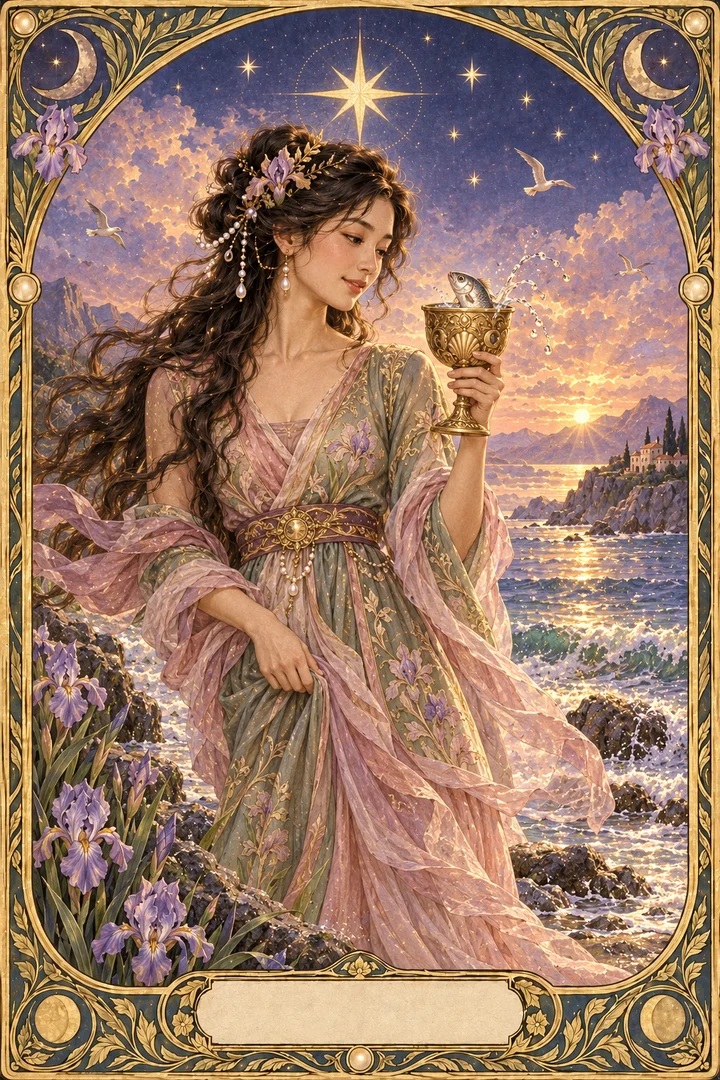
Page of Cups
A small feeling catches your attention. Give its first expression a gentle place to begin.
Read the full guide ↗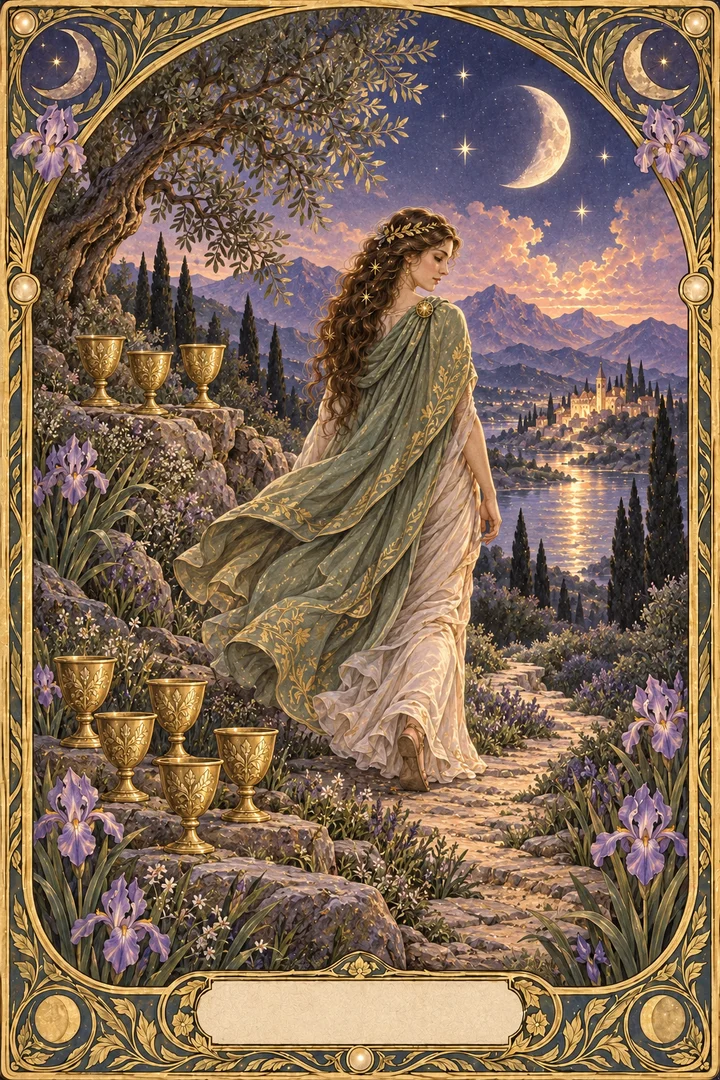
Eight of Cups
Something can have mattered and still no longer fit. Leaving can make room for care as well as change.
Read the full guide ↗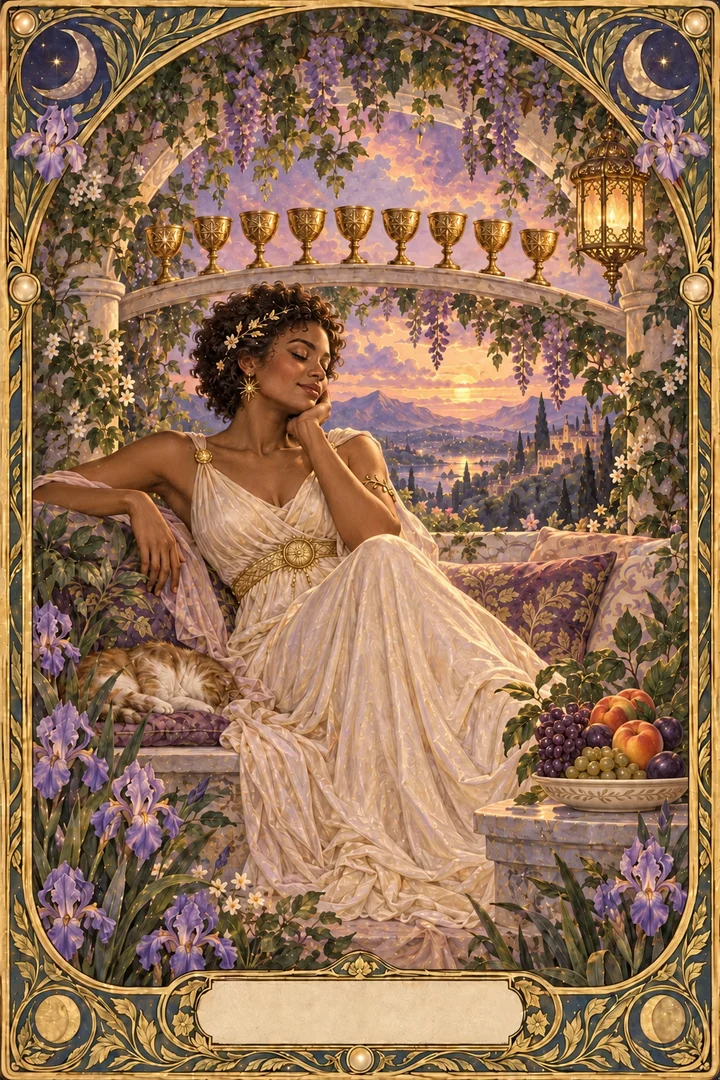
Nine of Cups
An ordinary good moment can be enough. Let pleasure have a little time of its own.
Read the full guide ↗