Eight of Wands: upright, reversed, love & yes or no
When things move quickly, choose a clear direction and a pace you can follow.
If this feels familiar
You do not have to answer at the speed a notification arrives. Clear attention is also a contribution. A short pause may help your response go where you intend. If you often feel behind, the Eight of Wands can be a reminder that momentum is not the same as urgency. You can choose one next step and let the rest wait. When several people need something from you, a brief, honest reply about when you will respond can be kinder than silence or a rushed answer.
A line to keep
I can move clearly without rushing myself.
- Upright meaning
- Momentum · a timely message · coordination · movement · a clear next step
- Eight of Wands reversed
- Delay · crossed messages · rushed action · too much arriving at once
Upright meaning
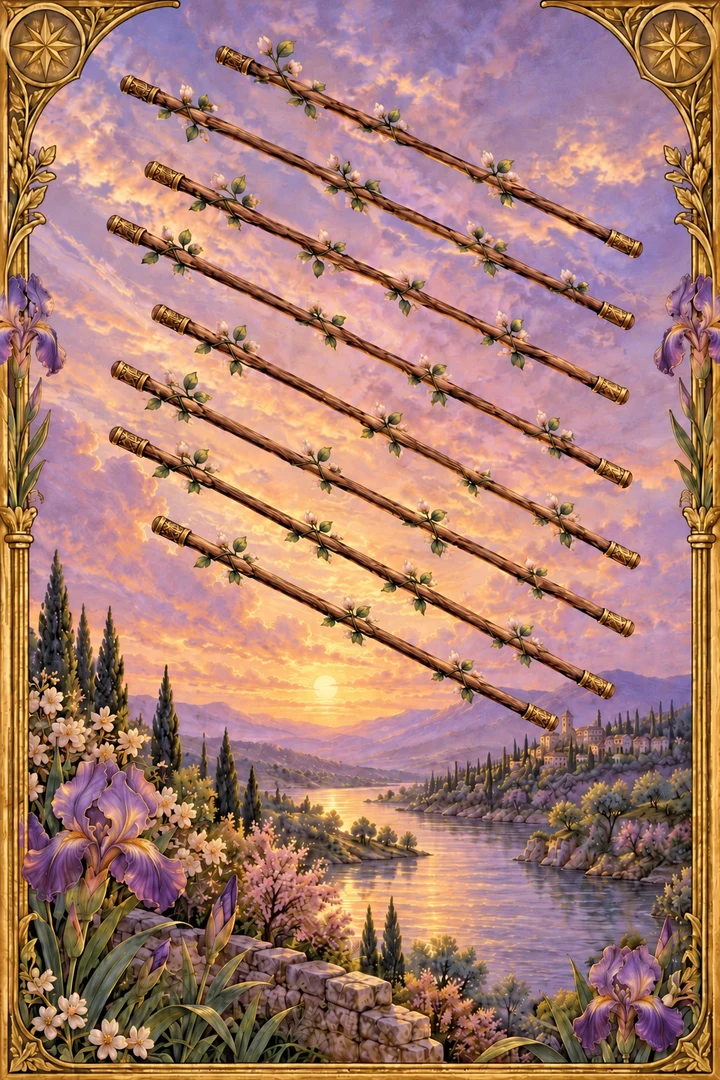
Eight parallel staffs cross open sky without a person holding them. A sequence may now move quickly. Keep your next response clear; speed becomes useful when the direction and recipient are understood. You might feel pulled to answer every notification at once, but momentum does not require you to abandon your own pace. A single clear message can coordinate more than a flurry of rushed replies. Notice what actually needs to move today and what can wait without harm.
Several replies arrive about a gathering. Send one message with the agreed date and place so everyone is acting on the same information. You do not need to keep checking for more responses once the essential details are confirmed.
Eight of Wands reversed
A delay or a rush can both create confusion. Check whether a message was received, which deadline is real and what can wait. Do not keep drawing cards to obtain a date. Reversed, the Eight may describe crossed wires, a pause you did not choose or the feeling of too much arriving at once. Slow down enough to confirm what is actually happening. A brief check-in can be more useful than guessing what someone else intends.
You have sent three follow-up emails about a project and heard nothing. Instead of sending a fourth, check whether the original message reached the right person. A short call or a single clarifying note may resolve more than another round of urgent messages.
Eight of Wands in love and relationships
A timely, direct message may help, but repeated contact cannot create another person's willingness. Give a clear invitation room to receive a response. In love, the Eight of Wands can describe a quick exchange, a plan coming together or the impulse to say something before you have thought it through. You can be honest without demanding an immediate answer. If you are waiting to hear back, notice whether you are filling the silence with assumptions. The other person's feelings remain theirs to share or not.
You want to make a plan for the weekend. Send one message: ‘I would like to see you Saturday afternoon. Does that work for you?’ Then let the reply come without sending a second message to check.
Eight of Wands: yes or no?
A conditional yes to a timely action with clear information and capacity. Pause when haste is substituting for consent or checking details. In a yes/no reading, the Eight of Wands often leans toward movement, but the condition matters: is the message clear, is the recipient known and do you have the capacity to follow through? Reversed, it may suggest a delay or crossed wires, so a yes may depend on confirming the facts first. Tarot readers do not share one universal yes/no rule, and no card can guarantee another person's response.
For ‘Should I send this message now?’, an upright yes can support a clear, concise note. For ‘Will they reply quickly?’, the card cannot promise a timeline. Reversed, you might wait until you have confirmed the right contact or gathered the missing detail.
A yes/no lean is a storytelling convention, not a probability or reliable prediction. Check real information before acting, especially about safety, money or another person's intentions.
Work, study and creative life
Confirm a handoff before accelerating a task. One short summary of owner, date and next step can prevent several urgent messages from pulling people in different directions. At work or in study, the Eight often appears when several threads are moving at once. You may be coordinating with others, waiting on a reply or trying to meet a deadline that keeps shifting. A clear summary can reduce the noise. If you are the one waiting, ask for a realistic update rather than assuming the worst.
A project has three people waiting on one another. Before sending another round of reminders, write a single message: who owns the next step, when it is due and what information is still missing. That one note can replace several urgent threads.
How this card differs from nearby cards
Three watches a first initiative; Eight emphasises movement and messages; Knight of Wands describes how energy is directed by a person. None gives a timetable. The Three of Wands looks outward at a longer view, while the Eight of Wands focuses on the speed of exchange. The Knight of Wands brings a personal, sometimes impulsive, drive. The Eight is more about the flow of information and coordination between people. These are different angles on momentum, not guaranteed stages.
Common misreadings
Eight does not mean eight days, eight weeks or a guaranteed incoming message. Movement in an image cannot establish travel or a person's intention to contact you. The number eight is symbolic, not a countdown. The staffs in the sky suggest speed and direction, but they do not tell you who is sending what or when it will arrive. Keep the interpretation close to what you can actually verify, and avoid turning a hopeful image into a promise.
Reading lens, not a verdict
These readings use symbols to reflect on experiences you recognise. They cannot establish events, financial outcomes or another person's private feelings. Reversed meanings explore how a theme may be internal, blocked or overused; they are a separate reference, since the one-card draw uses upright cards. Yes/no interpretations are conditional editorial conventions, not guarantees or a universal rule.
Traditional symbolism
The traditional Eight of Wands shows eight parallel staffs flying through open sky, with no person holding them. Selfetti keeps that sense of momentum in an original scene: eight long wooden wands, each with tiny budding leaves, travel diagonally above a flowing river and a peaceful flowering landscape. The lavender-gold sky and garden belong to our setting. We read the space between the staffs as a reminder that speed still needs direction and a recipient.
A question to keep
What needs a timely response, and what only feels urgent?
One small experiment
Check one message or handoff. Send one concise next step with the information the recipient needs.
Questions worth asking
Does Eight promise a message?
No. The Eight of Wands often symbolises communication and movement, but it cannot guarantee that a specific message will arrive. It can invite you to send a clear note or check that your own message was received.
Does the number give a date?
No. The number eight is symbolic, not a countdown. Tarot does not provide reliable dates, and the Eight of Wands should not be read as eight days or eight weeks. Use real-world information for timing.
How can reversed Eight describe both delay and haste?
Reversed, the card can point to a pause you did not choose or to the feeling of too much happening at once. Both are forms of disrupted momentum. Check what is actually moving and what needs a slower, clearer approach.
What is a useful next step?
Choose one message or handoff that matters today. Send a concise note with the information the other person needs, then pause before sending more. Clear direction is more useful than speed alone.
How to use this interpretation
These are symbolic prompts, not measured personality traits or predictions. Keep a real example beside any interpretation; you can disagree. Do not infer another person's feelings, health or financial outcomes from a card or sign.
Sources and method
V&A · Tarot · Selfetti · A. E. Waite · 1910
Historical image reference: A. E. Waite, The Pictorial Key to the Tarot (1910), illustrated by Pamela Colman Smith. The contemporary readings, life examples, recognition passages and keepsake lines are Selfetti's own editorial interpretation, including the conditional yes/no and reversed themes. Our original celestial garden illustrations adapt the traditional scenes with inclusive figures; ornamental flowers and frames do not add predictions. The one-card draw uses upright cards; reversed meanings are a separate reference.
Selfetti ·
Keep exploring
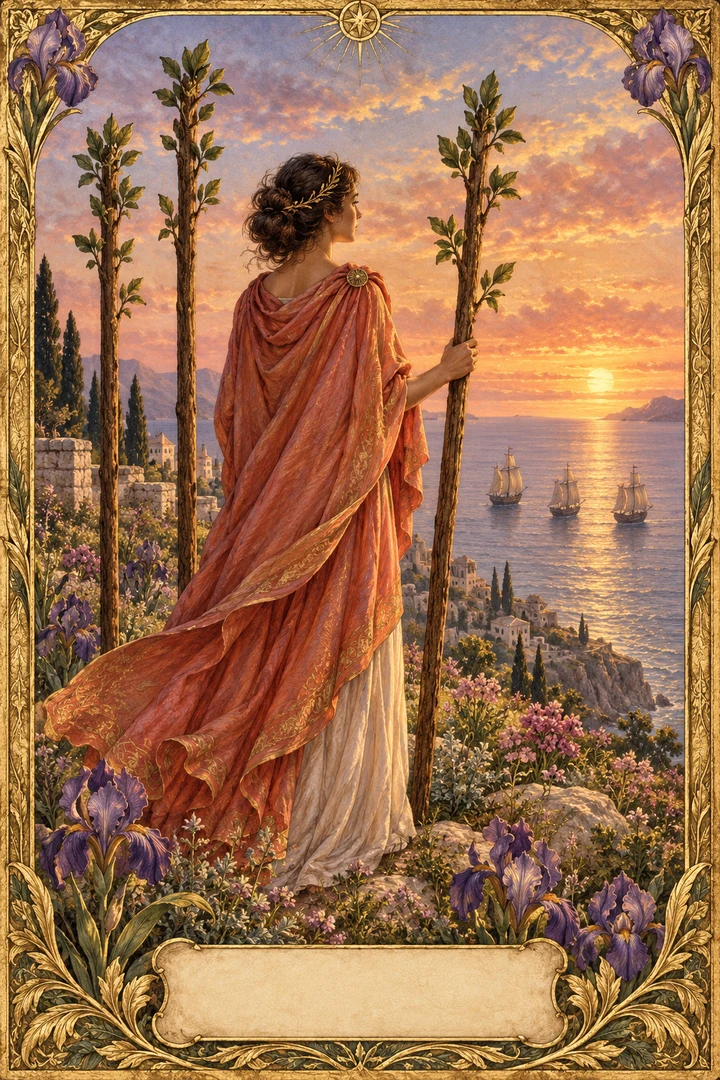
Three of Wands
Letting a first effort meet the world, and noticing what comes back.
Read the full guide ↗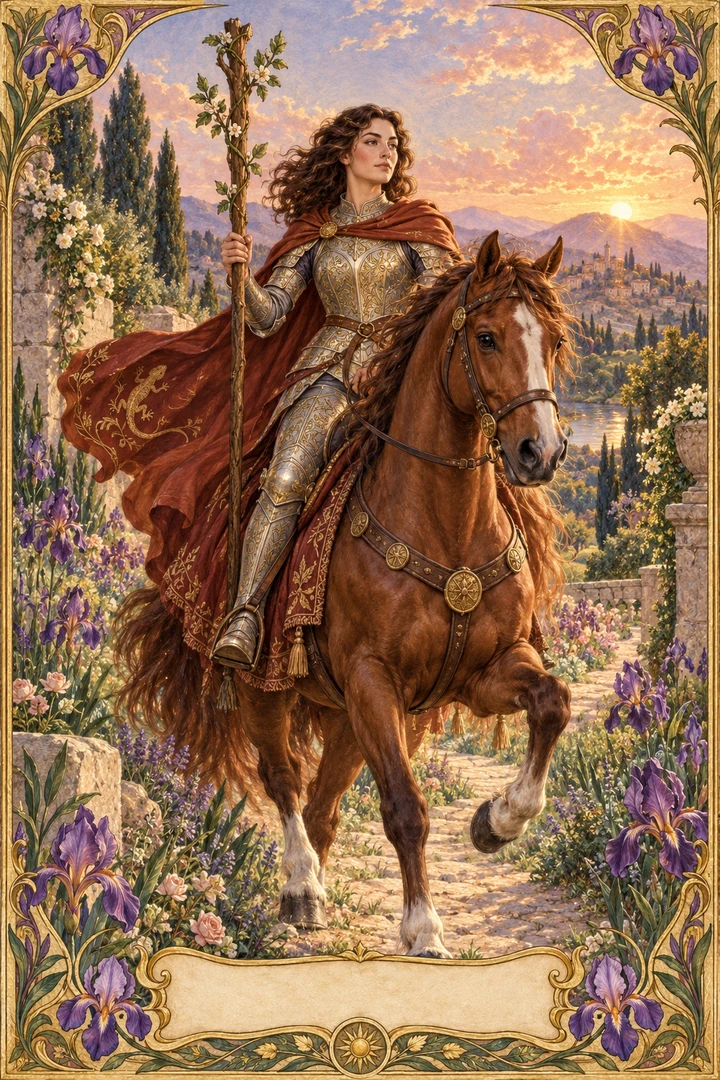
Knight of Wands
Enthusiasm becomes useful when it has a direction and a place to slow down.
Read the full guide ↗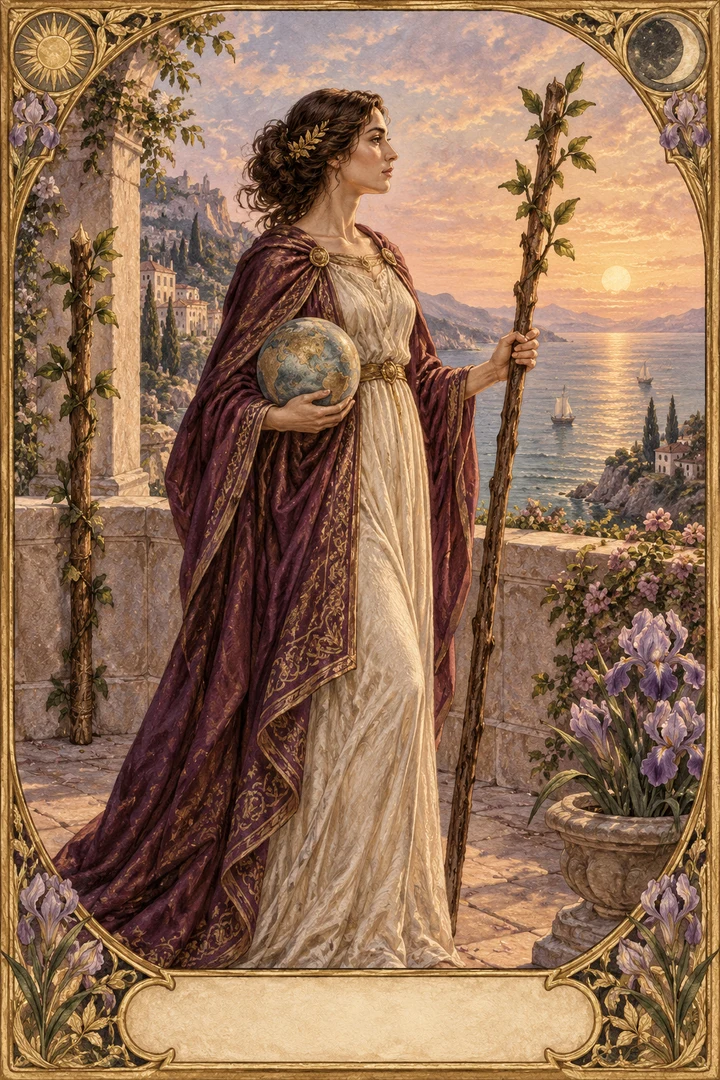
Two of Wands
Choosing a horizon while keeping one foot in the life you have.
Read the full guide ↗