Four of Pentacles: upright, reversed, love & yes or no
Protecting what supports you, while noticing when protection leaves too little room to live.
If this feels familiar
If security has taken effort to build, it makes sense to value it. You may have learned to keep reserves, stay private or handle things yourself because that once helped. You can respect that work without having to guard every part of life equally. Some room can be yours to enjoy. Notice where a boundary still protects something real, and where it has quietly become a way of avoiding exchange, rest or pleasure.
A line to keep
What protects me can also leave room to live.
- Upright meaning
- Security · stewardship · a resource boundary · conservation · control to examine
- Four of Pentacles reversed
- A grip being loosened · fear of loss · unclear limits · a resource pattern to review
Upright meaning
The Four of Pentacles often speaks to the instinct to hold on: saving, keeping private, setting a limit or guarding something that took effort to build. That impulse can be wise. A boundary around time, money or personal information may protect real needs. The question is what the boundary supports and what it costs. Does it create enough stability to live from, or has protection become the whole posture? Notice whether you can still enjoy ordinary things, share what matters or exchange support without feeling diminished. Security is not the same as rigidity.
You reserve one evening each week for yourself and decline most invitations. The boundary protects your rest, but a friend keeps reaching out. You could say, ‘I keep Thursdays quiet, but I would genuinely like to see you on Saturday.’ The limit stays; the connection gets a real opening.
Four of Pentacles reversed
Reversed, the Four can suggest a grip loosening, a fear of losing control or a resource pattern that needs review. You might be releasing something you once guarded, or you might be holding tighter because uncertainty feels close. Neither is automatically right. Look at the actual need before deciding how much to keep or let go. In a money context, use real figures, terms and advice rather than treating the card as a signal to spend or save. The reversal asks for honest review, not a dramatic swing.
You notice you have been vague about splitting a shared bill because you fear seeming petty. Instead of avoiding it again, you look at the actual amounts and say, ‘I would like to settle this clearly. Here is what I think is fair.’ The conversation is about facts, not generosity or stinginess.
Four of Pentacles in love and relationships
In love, the Four asks you to discuss privacy, time and material boundaries without using control as evidence of care. Wanting space or keeping some things private can be healthy. It becomes a problem when a boundary is enforced over another person rather than agreed with them. Nobody's attention, body or independence is a resource another person owns. Reversed, notice whether fear of loss is tightening your grip or whether you are finally loosening a limit that no longer fits. Speak about the boundary directly.
You prefer not to share your phone password, and your partner reads that as distance. You could say, ‘I need some privacy, and it is not about hiding you. I want us to talk about what would help you feel secure without me giving up every private space.’
Four of Pentacles: yes or no?
In a yes/no convention, the Four leans toward pause rather than a quick answer. Examine what you are protecting and the cost of holding it so tightly. A clear boundary may deserve a yes, while an unnecessary restriction may need revision. The card does not guarantee a financial outcome or reveal another person's motives. Reversed, the pause may concern a grip loosening or a fear growing. Use the facts you can observe and decide what the situation actually asks of you.
For ‘Should I lend money to a friend?’, the Four suggests checking real figures, terms and your own capacity before answering. A clear yes with a written agreement may fit; so may a no that protects a necessary limit. The card does not predict repayment.
A yes/no lean is a storytelling convention, not a probability or reliable prediction. Check real information before acting, especially about safety, money or another person's intentions.
Work, study and creative life
At work, the Four can support protecting useful resources, keeping confidences and making access rules clear. It can also show where guarding a method, contact or piece of information prevents the collaboration you actually need. Notice whether caution is serving the work or only serving control. Avoid interpreting a cautious feeling as guaranteed financial wisdom. Reversed, review a resource pattern: what you share, what you keep and whether the current arrangement still matches the task.
You have been the only person with access to a shared project file, saying it keeps things safe. A colleague asks to help. You could set a clear rule: ‘You can edit this section; I will review changes on Fridays.’ The resource stays protected and the work can move.
How this card differs from nearby cards
The Two of Pentacles adjusts demands and juggles priorities. The Four of Pentacles protects resources and sets limits. The Six of Pentacles asks about fair exchange and giving or receiving help. The Four of Cups considers emotional receptivity rather than material or practical control. These are different questions, not stages of one story. Reading them together can show whether a difficulty is about balance, protection, exchange or openness.
Common misreadings
The Four of Pentacles cannot prove greed, predict a future financial loss or show that someone is possessive. A useful limit and controlling another person are different behaviours to examine. The card also does not say that saving, privacy or caution is wrong. It asks what a protective habit is doing now. Keep the reading close to behaviour you can observe rather than turning an image into a verdict about character or money.
Reading lens, not a verdict
These readings use symbols to reflect on experiences you recognise. They cannot establish events, financial outcomes or another person's private feelings. Reversed meanings explore how a theme may be internal, blocked or overused; they are a separate reference, since the one-card draw uses upright cards. Yes/no interpretations are conditional editorial conventions, not guarantees or a universal rule.
Traditional symbolism
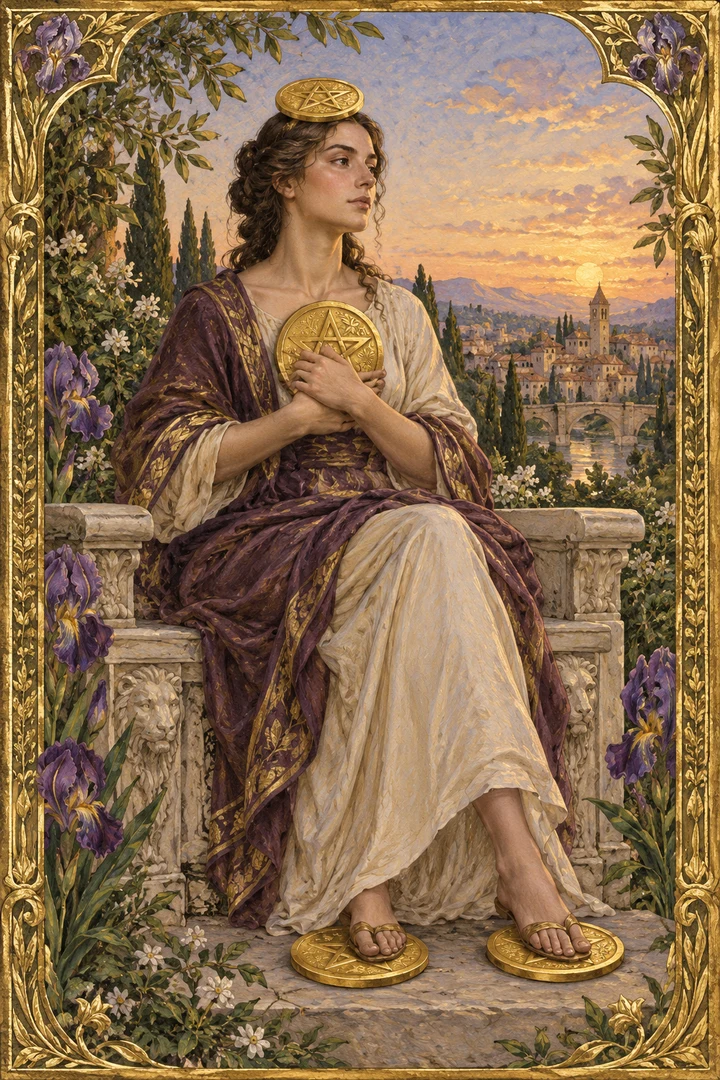
The traditional Four of Pentacles shows a figure clutching one coin to the chest, one balanced on the head and two beneath the feet, often seated against a city skyline. Selfetti keeps that recognisable posture in an original garden scene: an adult woman on a carved seat, a small town in the distance, four gold five-pointed-star coins placed as described. The garden, flowers and her thoughtful expression belong to our adaptation, which values dignity and choice rather than a greedy caricature. The coins mark what she protects; the open space around her asks whether protection still leaves room to breathe.
A question to keep
What is this boundary protecting, and what is it costing?
One small experiment
Name one resource boundary and its purpose. Keep, adjust or explain it using the situation you can actually observe.
Questions worth asking
Does Four of Pentacles mean greed?
No. It can describe saving, privacy or a necessary limit as easily as hoarding. The card asks what the protection is for and what it costs. Greed is a judgement, not something an image can prove.
How is a boundary different from control?
A boundary concerns your own time, body, money or information. Control tries to decide what another adult may do. The first can be stated and negotiated; the second is enforced over someone rather than agreed with them.
Does reversed Four of Pentacles mean losing money?
Not automatically. Reversed can show a grip loosening, a fear of loss or a resource pattern to review. Use real figures and terms for money questions. The card does not predict a financial outcome.
How does it differ from Four of Cups?
Four of Pentacles concerns material and practical protection: resources, limits and security. Four of Cups concerns emotional receptivity and what you are willing to receive. One is about holding; the other is about openness.
How to use this interpretation
These are symbolic prompts, not measured personality traits or predictions. Keep a real example beside any interpretation; you can disagree. Do not infer another person's feelings, health or financial outcomes from a card or sign.
Sources and method
V&A · Tarot · Selfetti · A. E. Waite · 1910
Historical image reference: A. E. Waite, The Pictorial Key to the Tarot (1910), illustrated by Pamela Colman Smith. The contemporary readings, life examples, recognition passages and keepsake lines are Selfetti's own editorial interpretation, including the conditional yes/no and reversed themes. Our original celestial garden illustrations adapt the traditional scenes with inclusive figures; ornamental flowers and frames do not add predictions. The one-card draw uses upright cards; reversed meanings are a separate reference.
Selfetti ·
Keep exploring
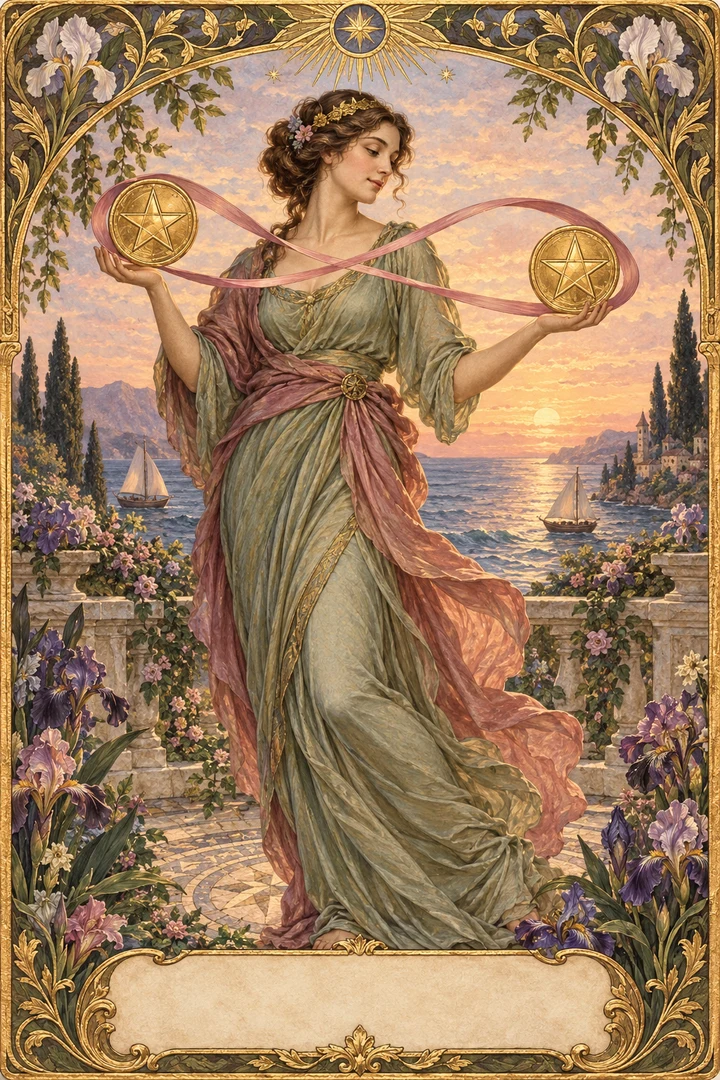
Two of Pentacles
Making a rhythm for real demands, with permission to put something down.
Read the full guide ↗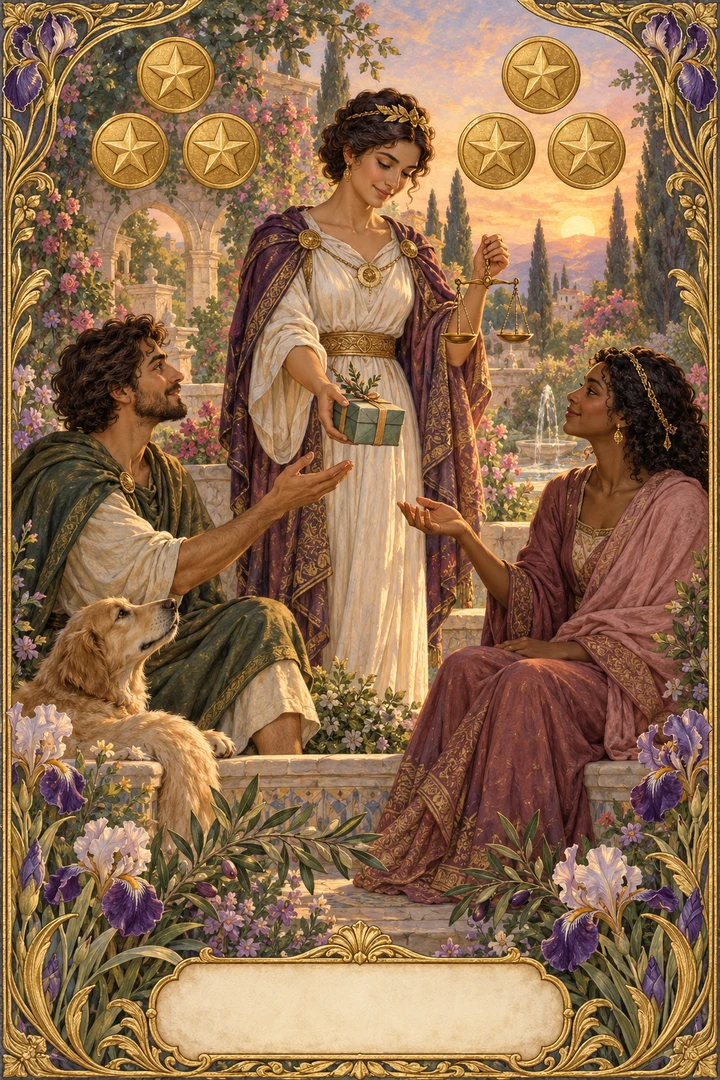
Six of Pentacles
Care becomes fairer when giving and receiving both leave room for choice.
Read the full guide ↗
Nine of Pentacles
Enjoying space you have helped make, without needing to earn every moment again.
Read the full guide ↗