Two of Pentacles: upright, reversed, love & yes or no
Making a rhythm for real demands, with permission to put something down.
If this feels familiar
Perhaps what looks effortless from outside takes a great deal of remembering, switching and preparing. That effort counts. A workable life can include fewer things, rather than a more impressive performance of balance. You may be the person who keeps track of everyone’s needs and forgets your own. The card invites you to treat your capacity as real information, not a limitation to hide.
A line to keep
My rhythm can make room for my limits.
- Upright meaning
- Adjustment · changing priorities · finite capacity · a workable rhythm · flexibility
- Two of Pentacles reversed
- Too much to juggle · uneven attention · missed practical needs · a simpler arrangement
Upright meaning
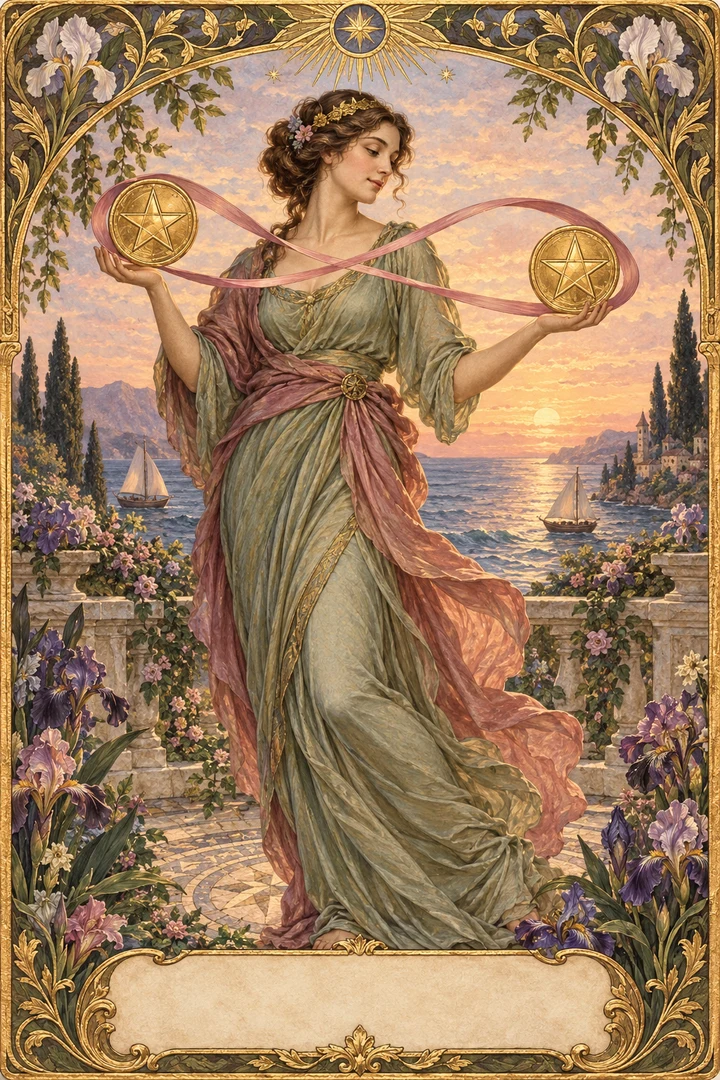
Two coins move within a continuous loop while boats rise and fall behind. Flexibility helps with recurring demands, but balance is an adjustment rather than a permanent pose. Include rest and the work of keeping track. You may be managing several real responsibilities, and the card recognises that effort. It does not ask you to juggle more elegantly; it asks you to notice what the rhythm actually costs and whether it can hold your finite capacity.
Study and household tasks compete on weekday evenings. Give each a smaller slot and leave one evening unassigned instead of filling every gap. The adjustment is not a failure of time management; it is a practical way to keep both demands honest and leave room for rest or change.
Two of Pentacles reversed
The total may exceed your time, or constant switching may be costing more than you notice. Reduce, postpone or redistribute a demand before asking yourself to manage it more elegantly. Reversed does not mean the opposite of balance; it can point to internal overload, blocked priorities or a pattern of overuse. A simpler arrangement may be the most useful next step, even if it means letting something wait or asking for help.
You keep saying yes to extra shifts while your sleep and meals suffer. Before optimising your calendar, look at one commitment you could pause or share. Saying, ‘I cannot take this on right now’ may be the practical repair that makes the rest workable.
Two of Pentacles in love and relationships
Discuss availability plainly. Caring about someone and being able to respond constantly are different things; an agreed rhythm is more useful than guessing how much contact means love. You might name when you are free and when you are not, without turning the conversation into a test. Reversed, uneven attention or missed practical needs can strain a bond. A smaller, honest agreement about time and energy can protect the connection better than promising more than you can give.
You and your partner both work late. Instead of assuming the other knows, you say, ‘I want to see you, and I am out of energy on Wednesdays. Could we plan for Friday?’ The conversation is about a real schedule, not a measure of affection.
Two of Pentacles: yes or no?
Only if it fits a realistic schedule or replaces another demand. A conditional no can be the fair answer when adding it would hide the cost elsewhere. In a yes/no convention, upright may lean yes when you can adjust without overloading yourself. Reversed, pause and check whether the total is already too high. Tarot readers do not share one universal yes/no rule, and the card cannot guarantee an outcome or tell you what someone else will do.
For ‘Should I take on the extra course?’, an upright yes might depend on dropping another commitment. For ‘Will I manage everything?’, the card points to capacity, not certainty. Reversed, a conditional no may be the honest answer if your week is already full.
A yes/no lean is a storytelling convention, not a probability or reliable prediction. Check real information before acting, especially about safety, money or another person's intentions.
Work, study and creative life
Compare deadlines and capacity with the people assigning work. If money is the context, use an actual budget; the card cannot tell you how to invest or borrow. At work or study, flexibility may help you meet changing priorities, but it does not erase finite hours. Reversed, check whether switching between tasks is costing more than it saves. A clear conversation about what can move, wait or be shared is often more useful than private overextension.
Two projects land in the same week. You ask your manager which one takes priority and what can shift. If the answer is ‘both’, you name the trade-off: ‘I can do both if the report moves to Monday.’ This is not refusal; it is making the real cost visible.
How this card differs from nearby cards
Two adjusts ongoing demands; Four protects resources; Ten of Wands asks whether the total load is too large. Two of Wands chooses a future direction rather than a present rhythm. The Two of Pentacles is about the daily work of keeping things moving, not about deciding which distant goal matters most. It also differs from the Four of Pentacles, which focuses on holding and conserving what you have.
Common misreadings
Two coins are not evidence of two partners, two jobs or a specific financial event. Flexibility does not require doing everything indefinitely. The card does not diagnose you or reveal hidden motives in others. It also does not promise that a juggling act will succeed if you simply try harder. A workable rhythm may include fewer things, not a more impressive performance of balance.
Reading lens, not a verdict
These readings use symbols to reflect on experiences you recognise. They cannot establish events, financial outcomes or another person's private feelings. Reversed meanings explore how a theme may be internal, blocked or overused; they are a separate reference, since the one-card draw uses upright cards. Yes/no interpretations are conditional editorial conventions, not guarantees or a universal rule.
Traditional symbolism
The traditional Two of Pentacles shows a figure juggling two coins within an infinity loop, ships riding waves behind. Selfetti keeps that recognisable loop and the rising and falling boats, but sets the scene in a garden terrace with an adult woman in a sage and rose dress. The two golden star coins and the single flowing ribbon are our adaptation; they show balance as an active, graceful adjustment rather than a static pose. The garden and flowers belong to our original setting and do not add hidden symbols or predictions.
A question to keep
What could I reduce before trying to juggle better?
One small experiment
Map two recurring demands with their real time costs. Reduce or move one, and leave a margin for rest or change.
Questions worth asking
Does Two mean two partners?
No. The two coins are not evidence of two partners or two jobs. The card is about managing multiple demands, not about a specific relationship structure. Look at what you are actually balancing in your life.
Is balance a permanent state?
No. Balance is an ongoing adjustment, not a fixed pose. The card shows a continuous loop because demands change. A workable rhythm includes rest and the work of keeping track, not a perfect performance.
How is it different from Two of Wands?
Two of Wands is about choosing a future direction. Two of Pentacles is about managing present, recurring demands. One asks where you are going; the other asks how you are keeping things moving today.
What if I cannot fit everything in?
Then something needs to change. Reduce, postpone or redistribute a demand. A conditional no can be fair when adding more would hide the cost elsewhere. The card does not ask you to juggle indefinitely.
How to use this interpretation
These are symbolic prompts, not measured personality traits or predictions. Keep a real example beside any interpretation; you can disagree. Do not infer another person's feelings, health or financial outcomes from a card or sign.
Sources and method
V&A · Tarot · Selfetti · A. E. Waite · 1910
Historical image reference: A. E. Waite, The Pictorial Key to the Tarot (1910), illustrated by Pamela Colman Smith. The contemporary readings, life examples, recognition passages and keepsake lines are Selfetti's own editorial interpretation, including the conditional yes/no and reversed themes. Our original celestial garden illustrations adapt the traditional scenes with inclusive figures; ornamental flowers and frames do not add predictions. The one-card draw uses upright cards; reversed meanings are a separate reference.
Selfetti ·
Keep exploring
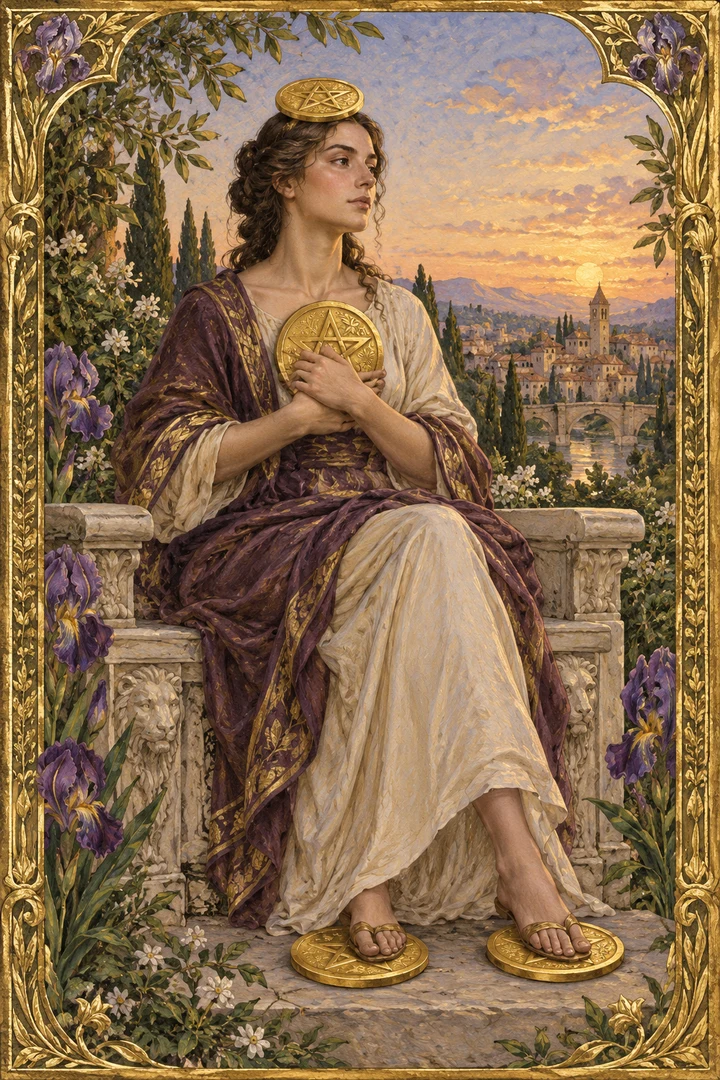
Four of Pentacles
Protecting what supports you, while noticing when protection leaves too little room to live.
Read the full guide ↗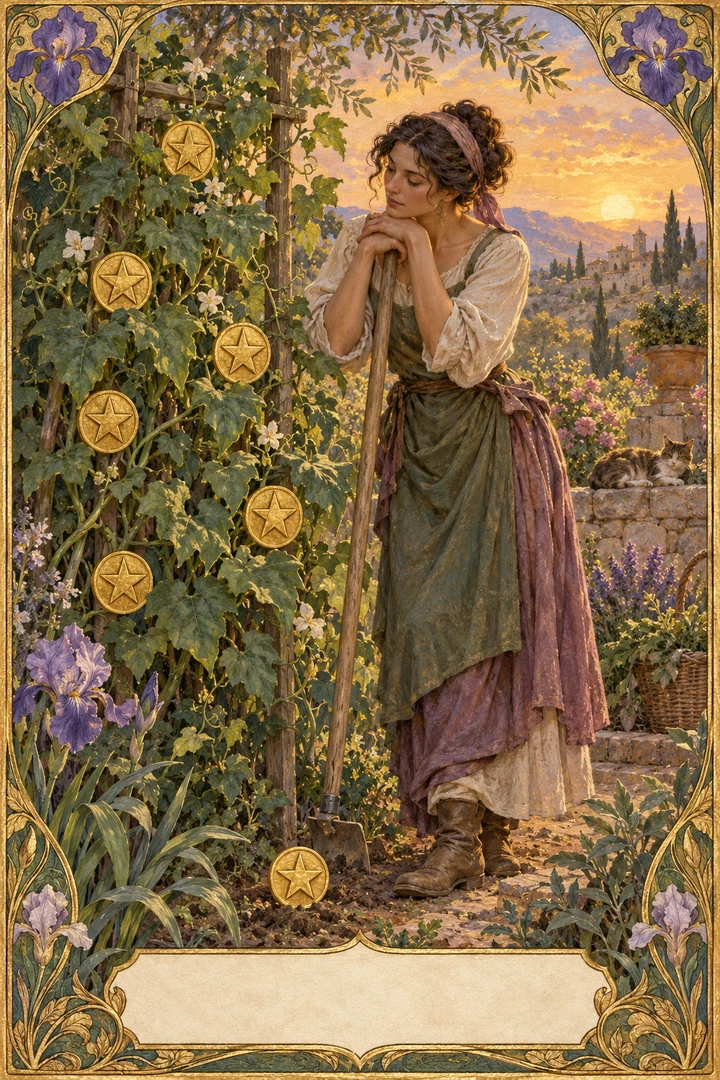
Seven of Pentacles
Pausing to examine what your effort is growing, before giving it more.
Read the full guide ↗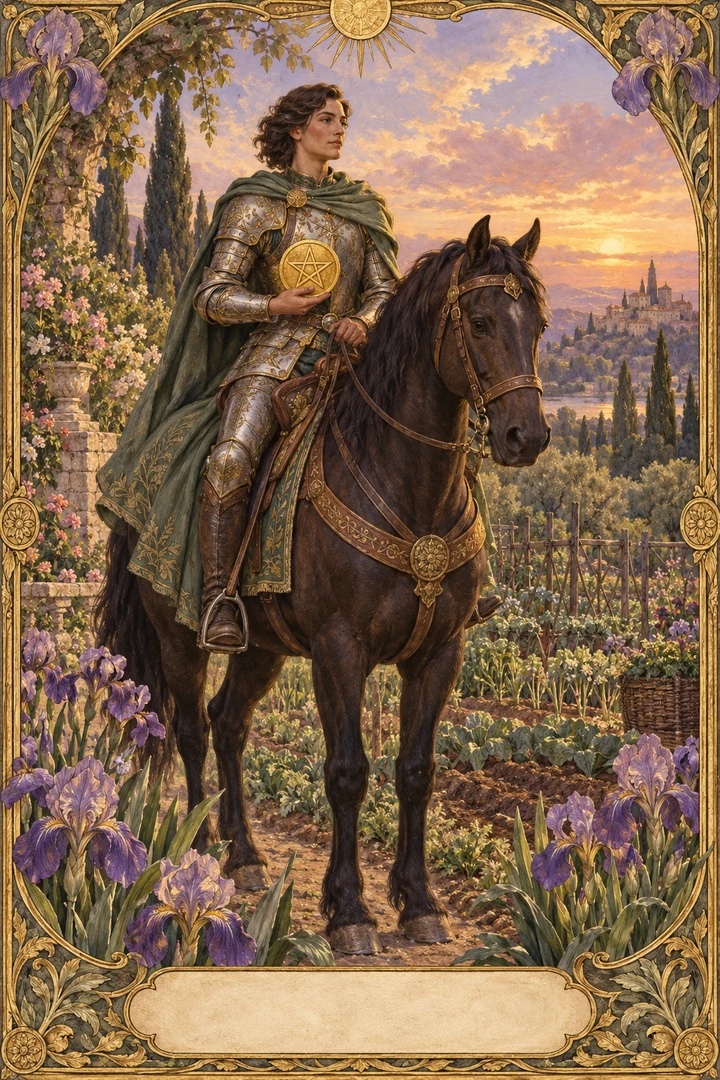
Knight of Pentacles
Care can be steady enough to trust, and flexible enough to keep living.
Read the full guide ↗