Knight of Pentacles: upright, reversed, love & yes or no
Care can be steady enough to trust, and flexible enough to keep living.
If this feels familiar
You may show care through what you remember and keep doing: the bills paid on time, the friend picked up from the airport, the small maintenance no one notices until it is missed. That quiet reliability can matter deeply. It deserves conditions that support you too, including a change when the old rhythm stops fitting. You are allowed to be dependable without becoming inflexible.
A line to keep
I can be dependable without becoming inflexible.
- Upright meaning
- Reliability · follow-through · a workable routine · patience · practical responsibility
- Knight of Pentacles reversed
- Rigidity · stalled routine · overwork · duty without room for change
Upright meaning
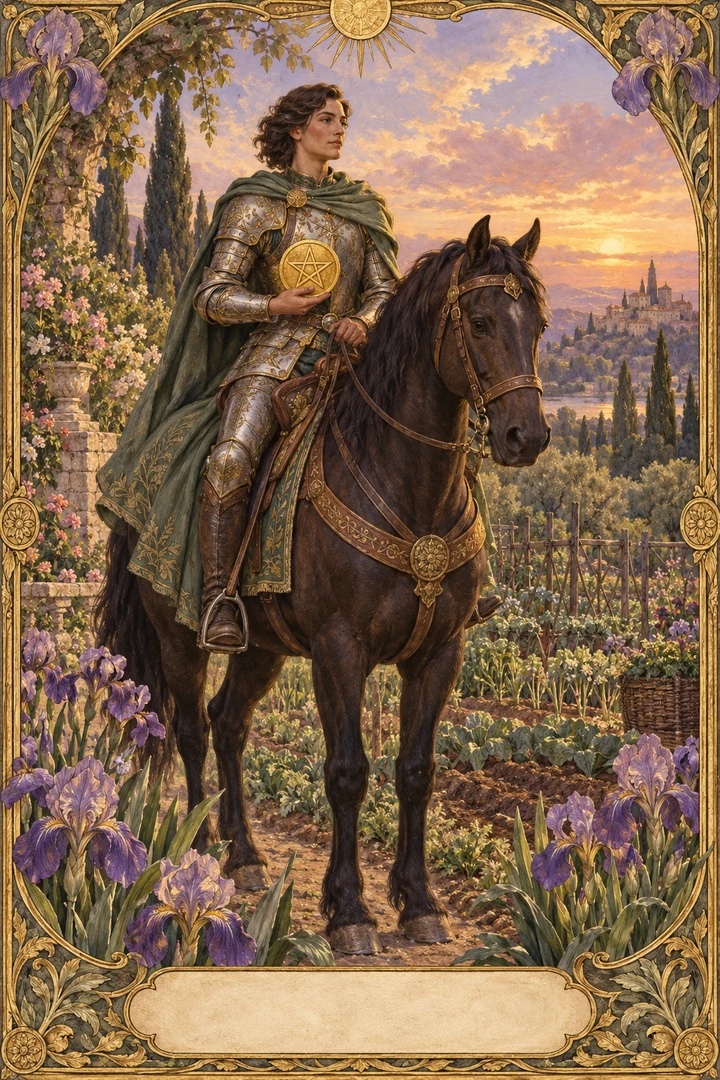
The Knight of Pentacles is often read as steady, patient care that shows up in repeated actions. A still horse and a held coin emphasise attention before movement. This knight does not rush; he checks the ground, keeps a modest promise, and returns to it. In your life, this can look like a routine that supports what matters, or a practical responsibility you carry without fanfare. The invitation is to keep the routine useful, not to let it replace the life it serves. Reliability here is a form of care, and it can be flexible enough to keep living.
Set one weekly time to review household tasks. Keep the list short enough to use, and adjust it when schedules change. You might notice that the same fifteen minutes each Sunday keeps the week calmer, and that dropping one item when a child is sick is not failure but good management.
Knight of Pentacles reversed
Reversed, the Knight of Pentacles can point to a routine that has become rigid, slow or too burdensome. The method may have outlived its purpose, or duty may be crowding out rest and change. This is not a literal opposite of reliability; it is reliability that has lost its flexibility. Ask whether the routine still works and what can change without abandoning the aim. Rest is part of a dependable rhythm, not a reward you must earn. A small adjustment may restore the care that the habit was meant to carry.
You have kept the same evening routine for years, but now it leaves you drained. Instead of pushing through, you move one task to the weekend and protect an earlier bedtime. The aim—caring for your home—stays, but the method changes to fit your actual energy.
Knight of Pentacles in love and relationships
In love, reliability appears in ordinary kept agreements: remembering what you said you would do, showing up when you said you would. A slower pace is not proof of commitment or disinterest; it is simply a pace. Discuss expectations and notice actual follow-through rather than reading meaning into stillness. If you are the one who keeps things steady, check that you also have room to receive care. If you are waiting for someone else's steadiness, ask for clarity instead of guessing.
You and your partner agree to a weekly check-in about chores and plans. When one week is too busy, you reschedule rather than cancel. The kept agreement matters more than the perfect timing, and you both get to say what feels sustainable.
Knight of Pentacles: yes or no?
In a yes/no convention, upright often leans toward a conditional yes to a feasible commitment you can follow through. The condition is that the routine is not already overcrowded and that you are keeping it for a living purpose, not just because it is familiar. Reversed, pause and check whether the commitment has become rigid or burdensome. Neither orientation guarantees a specific outcome; tarot readers do not share one universal yes/no rule.
For 'Should I take on this weekly volunteer shift?', an upright yes might come with the condition that you first check your current commitments. For 'Will this routine solve everything?', the card suggests a practical yes to the next step, not a promise of a perfect result.
A yes/no lean is a storytelling convention, not a probability or reliable prediction. Check real information before acting, especially about safety, money or another person's intentions.
Work, study and creative life
At work and in study, the Knight of Pentacles supports breaking a large task into a repeatable next step with a clear completion condition. This is the energy of a workable routine, not endless hours. Avoid equating long hours or resistance to change with professionalism. If a process has become rigid, ask what it was meant to protect and whether a simpler method would serve the same purpose. Practical responsibility includes knowing when to stop for the day.
You have a report due in two weeks. Instead of planning marathon sessions, you block thirty minutes each morning to draft one section. You define 'done' as a complete first draft, not perfection, and you stop when the timer ends.
How this card differs from nearby cards
The Page of Pentacles begins learning; the Knight sustains a routine; the King takes responsibility for wider foundations. The Knight of Wands emphasises movement and initiative rather than steadiness. The Knight of Pentacles is not about charging ahead or waiting passively; it is about the quiet, repeated action that builds trust over time. These are different approaches, not better or worse ones.
Common misreadings
A still horse is not proof of laziness, an impending offer or a slow but certain romantic outcome. The Knight of Pentacles does not establish another person's character or guarantee that patience will be rewarded. It describes a way of working, not a prediction about someone else's feelings. Keep the interpretation near your own experience of steadiness, duty and flexibility rather than turning the card into a promise about what others will do.
Reading lens, not a verdict
These readings use symbols to reflect on experiences you recognise. They cannot establish events, financial outcomes or another person's private feelings. Reversed meanings explore how a theme may be internal, blocked or overused; they are a separate reference, since the one-card draw uses upright cards. Yes/no interpretations are conditional editorial conventions, not guarantees or a universal rule.
Traditional symbolism
The traditional Knight of Pentacles shows a rider on a still horse, holding a single gold coin. In Selfetti's adaptation, an adult rider in finely engraved light armour sits upright on a calm dark horse beside a cultivated garden field. The rider holds exactly one golden five-pointed-star coin, clearly visible. A sage cape and patient, purposeful expression replace the armour's severity. Richly textured soil and irises frame the scene. This is steady care rather than charging speed; no extra coins or weapons appear. The garden and flowers belong to our original setting, emphasising dignity and choice in how care is offered.
A question to keep
Which routine supports my life, and which needs a small change?
One small experiment
Review one repeated commitment. Keep its useful purpose, adjust one unnecessary cost and define when it is done.
Questions worth asking
Does Knight mean a slow but certain outcome?
Not necessarily. The Knight of Pentacles describes a steady, methodical approach, not a guarantee of timing or results. It can suggest patience and follow-through, but the actual outcome depends on real-world factors and choices, not on the card alone.
How is it different from Knight of Wands?
Knight of Wands emphasises movement, initiative and bold action. Knight of Pentacles emphasises steadiness, routine and practical follow-through. One is about starting with fire; the other is about keeping a reliable pace. Both are valid approaches for different situations.
Can reliability include change?
Yes. Reliability is about keeping what matters, not about never changing. A routine that no longer serves its purpose can be adjusted while the underlying commitment stays. Flexibility is part of sustainable care, not a betrayal of it.
When does routine become rigidity?
Routine becomes rigidity when the method is defended even after it stops working, or when duty leaves no room for rest, change or new information. The sign is often exhaustion or resentment. A small adjustment can restore the care the routine was meant to carry.
How to use this interpretation
These are symbolic prompts, not measured personality traits or predictions. Keep a real example beside any interpretation; you can disagree. Do not infer another person's feelings, health or financial outcomes from a card or sign.
Sources and method
V&A · Tarot · Selfetti · A. E. Waite · 1910
Historical image reference: A. E. Waite, The Pictorial Key to the Tarot (1910), illustrated by Pamela Colman Smith. The contemporary readings, life examples, recognition passages and keepsake lines are Selfetti's own editorial interpretation, including the conditional yes/no and reversed themes. Our original celestial garden illustrations adapt the traditional scenes with inclusive figures; ornamental flowers and frames do not add predictions. The one-card draw uses upright cards; reversed meanings are a separate reference.
Selfetti ·
Keep exploring
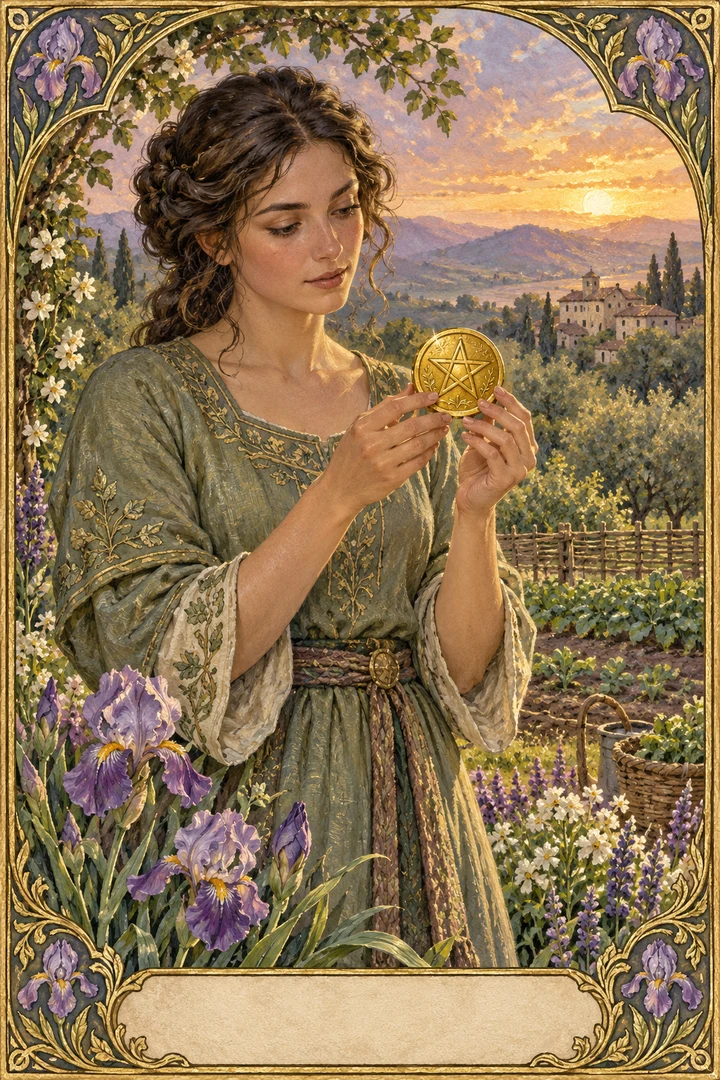
Page of Pentacles
A useful skill can begin with a learner's attention and a small piece of ground.
Read the full guide ↗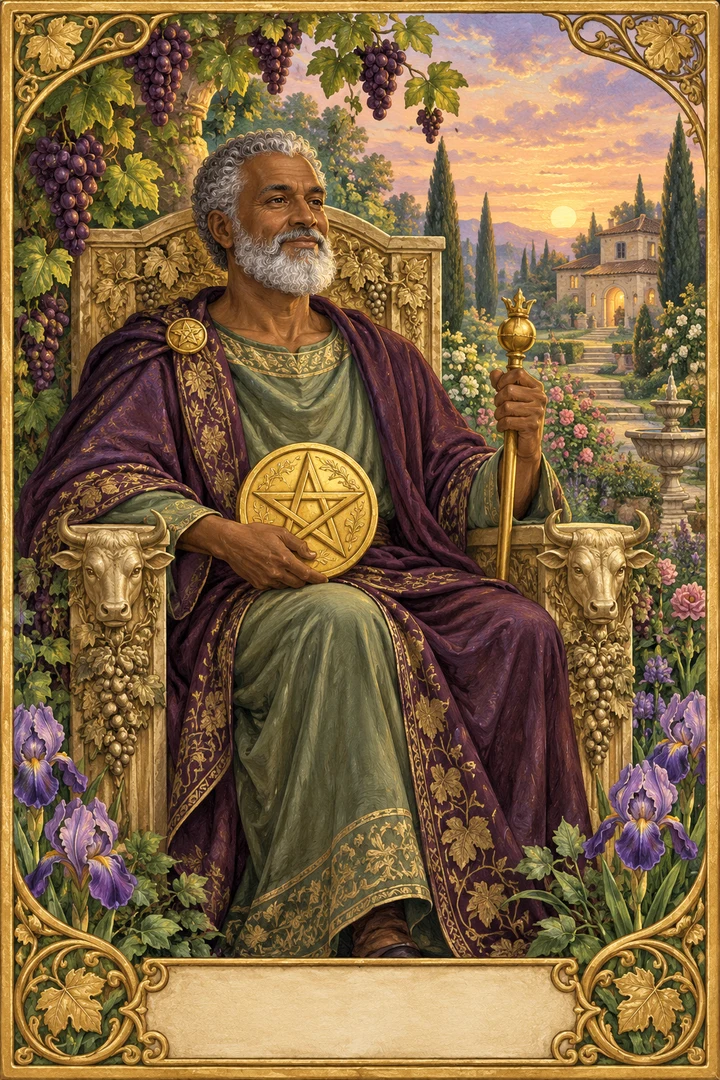
King of Pentacles
Resources become trustworthy through clear terms, care and responsibility for their effects.
Read the full guide ↗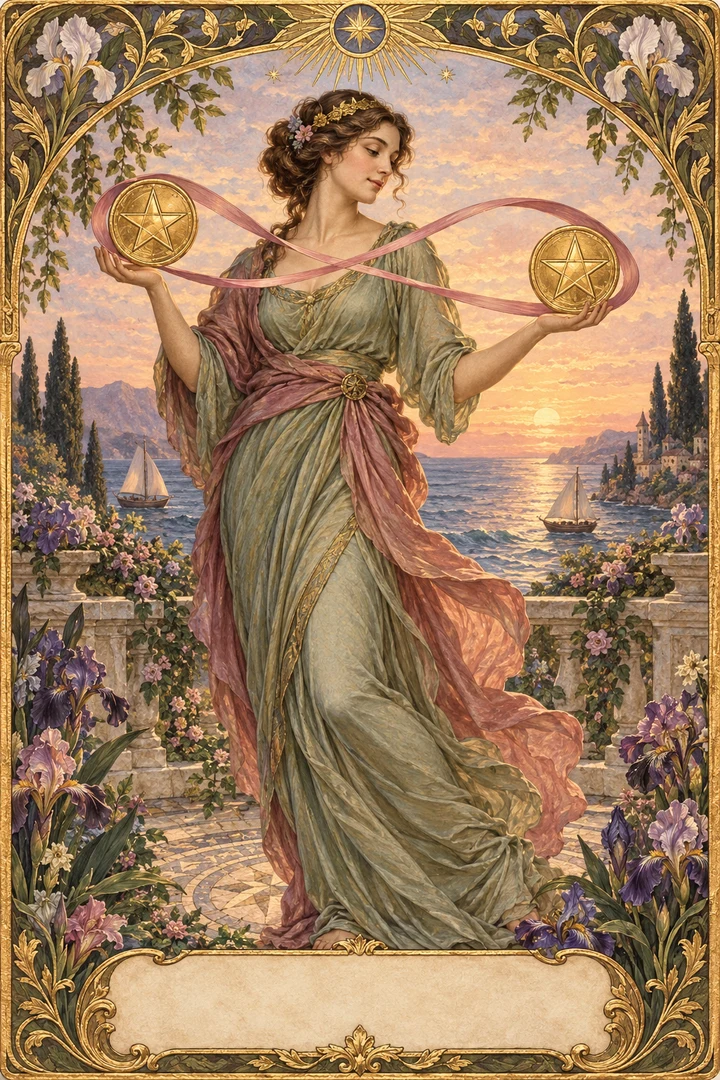
Two of Pentacles
Making a rhythm for real demands, with permission to put something down.
Read the full guide ↗