Page of Pentacles: upright, reversed, love & yes or no
A useful skill can begin with a learner's attention and a small piece of ground.
If this feels familiar
Perhaps you feel you should already know how to do this. Learning has a beginning for everyone, and that beginning can feel awkward. A thoughtful question and a small attempt are valid ways of taking yourself seriously. You do not have to wait until you feel ready or until you have the perfect setup. The ground you tend now is enough for the next step.
A line to keep
I can take my learning seriously while I am still beginning.
- Upright meaning
- Practical curiosity · learning · a workable beginning · attention · a small commitment
- Page of Pentacles reversed
- Planning without practice · fear of being new · an unworkable routine · missing feedback
Upright meaning
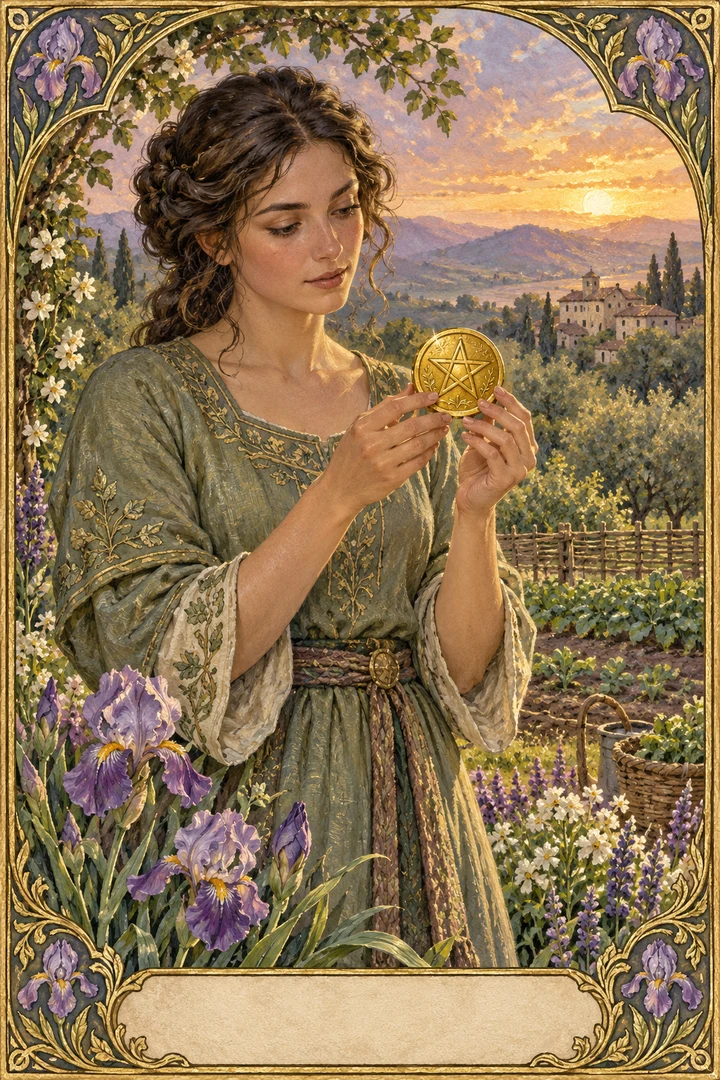
The Page of Pentacles is often read as a practical beginning: learning a skill, starting a small project or giving steady attention to something concrete. The Page studies the coin with both hands near cultivated ground, suggesting that curiosity becomes useful when it meets a patch of real life. You do not need a complete plan or a grand transformation. A modest commitment—one lesson, one practice slot, one repair—can be serious without becoming your whole identity. The card invites you to choose something tangible to learn and a place to try it.
You want to learn basic bicycle maintenance. Instead of buying a full tool kit, you watch one safe video, use the adjustable wrench you already own, and practice fixing a loose brake. The attempt teaches you more than another hour of browsing.
Page of Pentacles reversed
Reversed, the Page can point to planning or buying supplies as a substitute for practice, or to a schedule that does not fit the learning you want. Fear of being new may keep you researching instead of trying. The card does not say you are lazy or incapable; it asks you to choose a smaller exercise and seek useful feedback. Being a beginner is not a character flaw. Adjust the scope until the first step is possible, and let one honest attempt show you what to learn next.
You have read three books on gardening but have not planted a seed. You feel behind. Instead of another book, you fill one small pot with soil and sow a single herb. The pot sits on your windowsill, and you note what happens.
Page of Pentacles in love and relationships
In love, the Page of Pentacles suggests making an ordinary intention visible through a small kept agreement. Learning to discuss a practical need—time, space, a shared task—can matter more than performing certainty about the future. A modest, consistent gesture often speaks louder than a grand promise. Reversed, check whether you are planning the relationship instead of participating in it, or whether your routine leaves no room for the connection you say you want. The other person's feelings remain their own to express.
You tell your partner, ‘I would like us to have one evening a week without screens.’ You pick a day and try it for a month. The agreement is small, specific and easy to revisit if it does not work.
Page of Pentacles: yes or no?
In a yes/no convention, upright often leans yes to a practical learning step when time, access and scope are clear. The condition is your willingness to begin small and learn from feedback. Reversed, pause where preparation keeps replacing the first exercise. Neither orientation guarantees admission, a scholarship, a job or an incoming message. Tarot readers do not share one universal yes/no rule, and the cards do not override real-world requirements.
For ‘Should I sign up for that evening class?’, an upright yes can support it if the schedule and cost genuinely fit. For ‘Will this class get me promoted?’, the outcome depends on many factors the card cannot predict. Reversed, you might try one free lesson first.
A yes/no lean is a storytelling convention, not a probability or reliable prediction. Check real information before acting, especially about safety, money or another person's intentions.
Work, study and creative life
At work and in study, the Page of Pentacles supports defining one attainable learning outcome and what resources it needs. A course or certificate should be evaluated by real content, terms and suitability, not by the coin in a card. This is a good time to ask for feedback, practice a specific skill or start a small project that produces something you can see. Reversed, notice if you are collecting credentials without applying them, or if your routine leaves no time for the practice itself.
You want to improve your spreadsheet skills. You choose one function you actually need for your job, find a free tutorial, and use it in a real task this week. The result is a concrete improvement, not just a completed course.
How this card differs from nearby cards
The Ace of Pentacles offers a resource or opportunity; the Page starts learning to use it; the Eight of Pentacles builds skill through repeated practice. The Page of Wands centres exploratory excitement and inspiration rather than a concrete learning plan. These are different approaches, not guaranteed stages. The Page of Pentacles asks for attention and a small piece of ground, while the Page of Wands asks you to follow a spark.
Common misreadings
The Page of Pentacles does not guarantee admission, a scholarship, a job or an incoming message. It is not a promise of money or a sign that you should buy a particular course. Court cards do not prescribe age, gender or a person's intelligence; they describe approaches available to anyone. The card also does not mean you must already be skilled. It points to the value of beginning.
Reading lens, not a verdict
These readings use symbols to reflect on experiences you recognise. They cannot establish events, financial outcomes or another person's private feelings. Reversed meanings explore how a theme may be internal, blocked or overused; they are a separate reference, since the one-card draw uses upright cards. Yes/no interpretations are conditional editorial conventions, not guarantees or a universal rule.
Traditional symbolism
The traditional Page stands in a field, holding a single pentacle and studying it closely. Selfetti keeps that focused attention but sets it in a flowering meadow with a small cultivated field and gentle hills. Our adult woman in an embroidered sage tunic holds one golden five-pointed-star coin with both hands. The garden and flowers belong to our original setting; they frame learning as something that grows from ground you tend, not a promise of wealth.
A question to keep
What small skill would make an ordinary part of my life more workable?
One small experiment
Choose one small learning outcome and a short practice slot. Use one suitable resource and note the question your attempt raises.
Questions worth asking
Does Page predict a scholarship or job?
No. The Page of Pentacles supports learning and practical effort, but it cannot guarantee a scholarship, job offer or admission. Use real information about requirements, deadlines and suitability. The card can encourage you to prepare well and begin.
How is it different from Page of Wands?
Page of Wands centres exploratory excitement and inspiration. Page of Pentacles centres concrete learning and a workable beginning. Wands may spark an idea; Pentacles asks what small practice or resource will make it real. Both are valid, but they answer different questions.
What if I only keep researching?
Research can be useful, but it may become a way to avoid the vulnerability of trying. Choose one small exercise and a short practice slot. Notice what the attempt teaches you. Feedback from a real step is often more valuable than another hour of planning.
Can this apply to an experienced adult?
Yes. The Page of Pentacles is not about age or status; it is about a learner's attention. An experienced adult can apply it to a new skill, a different method or a fresh project. Beginning again does not erase your competence.
How to use this interpretation
These are symbolic prompts, not measured personality traits or predictions. Keep a real example beside any interpretation; you can disagree. Do not infer another person's feelings, health or financial outcomes from a card or sign.
Sources and method
V&A · Tarot · Selfetti · A. E. Waite · 1910
Historical image reference: A. E. Waite, The Pictorial Key to the Tarot (1910), illustrated by Pamela Colman Smith. The contemporary readings, life examples, recognition passages and keepsake lines are Selfetti's own editorial interpretation, including the conditional yes/no and reversed themes. Our original celestial garden illustrations adapt the traditional scenes with inclusive figures; ornamental flowers and frames do not add predictions. The one-card draw uses upright cards; reversed meanings are a separate reference.
Selfetti ·
Keep exploring
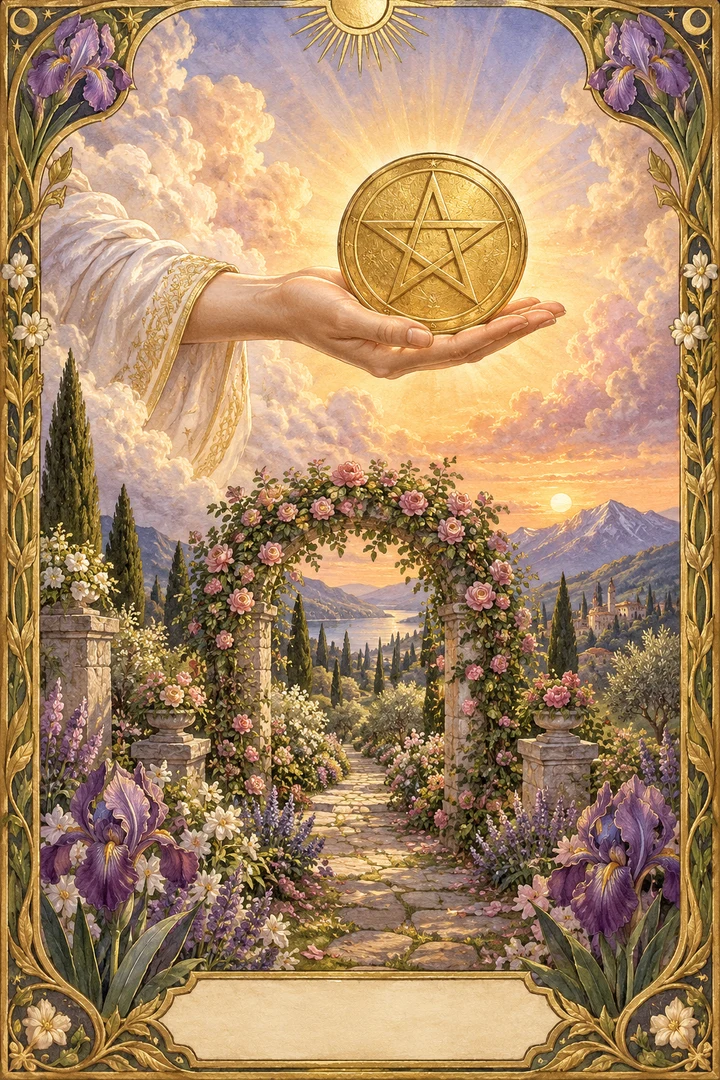
Ace of Pentacles
A possibility becomes tangible when you give it a place in ordinary life.
Read the full guide ↗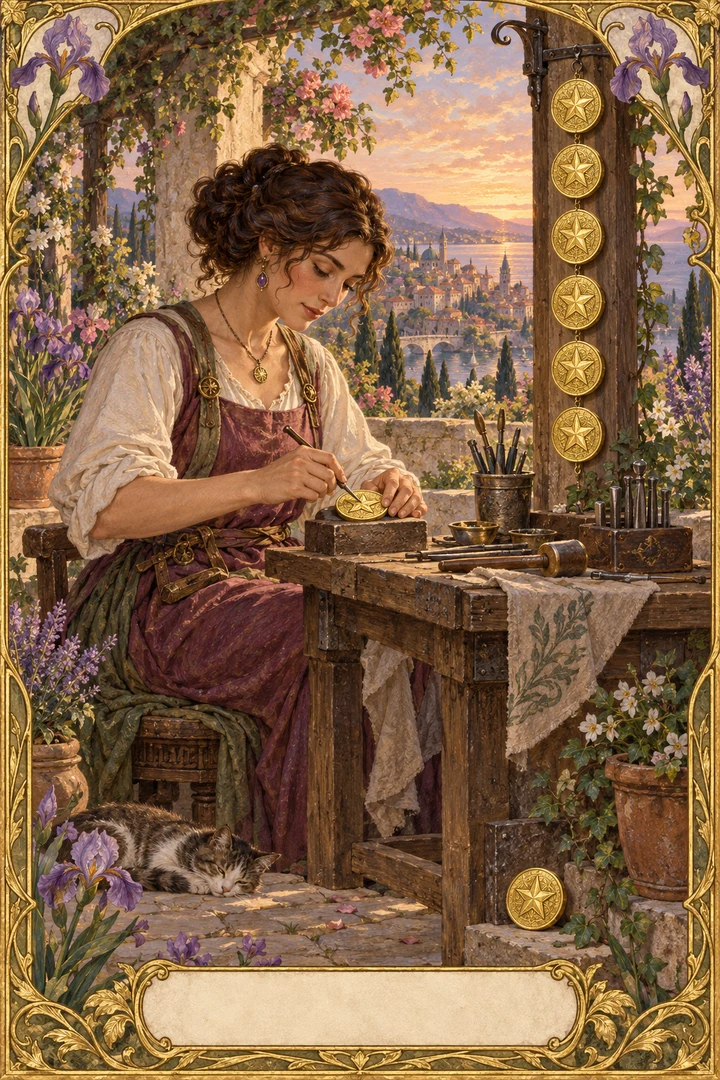
Eight of Pentacles
A skill becomes yours through attentive practice, with room for an imperfect version.
Read the full guide ↗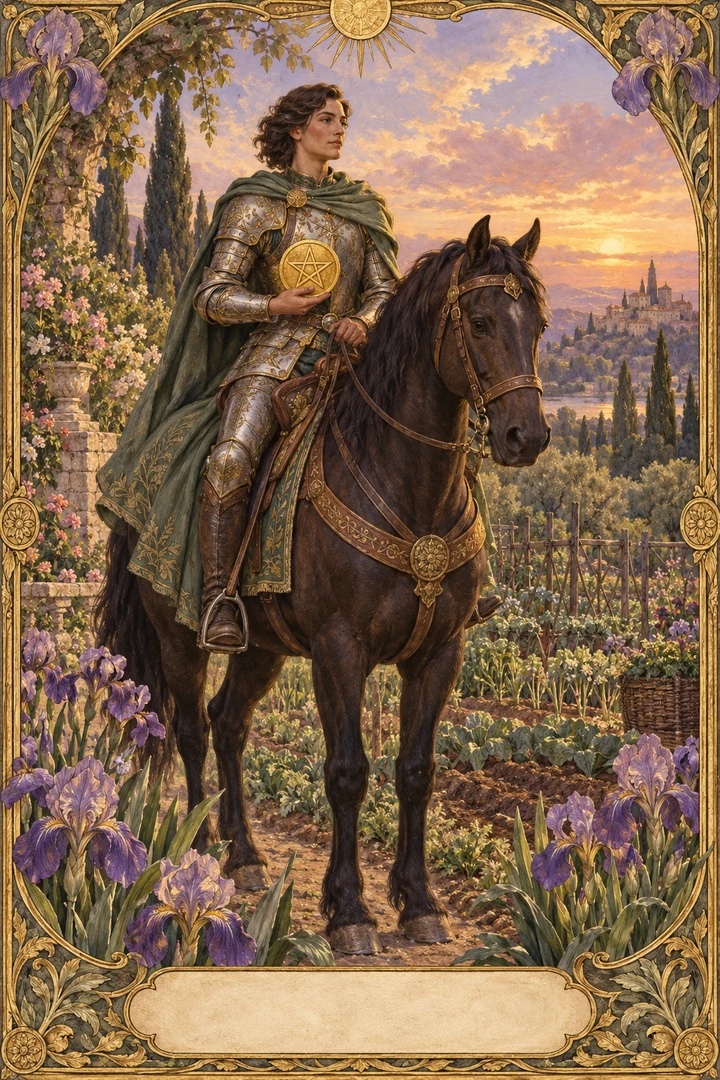
Knight of Pentacles
Care can be steady enough to trust, and flexible enough to keep living.
Read the full guide ↗