Nine of Cups: upright, reversed, love & yes or no
An ordinary good moment can be enough. Let pleasure have a little time of its own.

If this feels familiar
You may be learning to enjoy an ordinary good moment without asking whether you have earned enough to deserve it. Perhaps a quiet evening feels almost too small to mention. You can let it be good at its own scale. Unfinished questions elsewhere do not have to take every minute from it.
A line to keep
I am allowed to enjoy what is enough today.
- Upright meaning
- Contentment · enjoyment · enoughness · satisfaction · a welcome pleasure
- Nine of Cups reversed
- An unmet need · displayed satisfaction · pleasure that misses the point · a goal reconsidered
Upright meaning
Upright, the Nine of Cups is often associated with satisfaction, enjoyment and a wish fulfilled. Read that last phrase as a traditional association rather than a guarantee. Ask what feels welcome in an experience you already know. A comfortable meal or an unhurried evening can count. Enjoyment need not wait until every other part of life is settled or become proof that you made all the right choices.
You finish a simple meal in a room that feels comfortable. Pause long enough to notice what you like: warmth, flavour or having nowhere else to be. The pleasure does not need a photograph or a larger achievement attached.
Nine of Cups reversed
Reversed, the Nine can fit satisfaction that looks convincing from outside while missing the need underneath. A reward may be pleasant but fail to give the rest, company or freedom you hoped for. You may also have reached a goal that no longer feels like yours. Name the need before adding another reward. Enjoyment and dissatisfaction can be present in different parts of the same day.
You buy something after a hard week, but what you wanted was time without requests. Notice that difference without scolding yourself for the purchase. If possible, protect a short period of quiet instead of asking another object to provide it.
Nine of Cups in love and relationships
In love, the Nine can highlight enjoying company while keeping a sense of your own needs. Contentment alone does not establish mutual commitment. Reversed, ask whether the relationship looks pleasing while an important conversation remains missing, or whether you have been waiting for another person to make every part of life satisfying.
After a good evening, name the detail you enjoyed rather than immediately asking what the meeting means for the future. If a need remains unresolved, give it a separate conversation; pleasure does not require pretending it has vanished.
Nine of Cups: yes or no?
Upright often leans yes to a welcome pleasure or a goal that fits your needs, within practical limits. Reversed invites checking what the desired result would actually give you. The familiar ‘wish card’ name does not make a wished-for outcome certain or remove the costs of a decision.
For ‘Should I make time for a quiet meal?’, an upright yes may fit your capacity and budget. For ‘Will I get everything I want?’, the card cannot promise that. Reversed, clarify the need beneath the wish before proceeding.
A yes/no lean is a storytelling convention, not a probability or reliable prediction. Check real information before acting, especially about safety, money or another person's intentions.
Work, study and creative life
For work and study, the Nine gives a completed step or a satisfying practice room to be noticed. Reversed, check whether an impressive outcome actually meets the need that drew you toward it. Recognition, learning, security and creative freedom are different rewards.
After finishing a task, write one thing you are pleased with before opening the next one. If praise leaves you strangely unsatisfied, ask whether you were hoping for more autonomy or a less demanding workload instead.
How this card differs from nearby cards
The Seven of Cups imagines possibilities. The Eight notices a mismatch in something known. The Nine asks what feels satisfying or enough. The Ten adds shared belonging. Personal contentment can support a relationship, but it is not the same as an agreement between people.
Common misreadings
The Nine is often called the wish card, then treated as a guarantee or a reward for good behaviour. That makes an image do more than it can. Satisfaction can be ordinary and partial; it does not establish superiority, perfect happiness or certainty about the future.
Reading lens, not a verdict
These readings use symbols to reflect on experiences you recognise. They cannot establish events or another person’s private feelings. Reversed meanings explore different ways a theme may be held, blocked or overused; they need not be a simple opposite. Yes/no readings are conditional conventions rather than guarantees.
Traditional symbolism
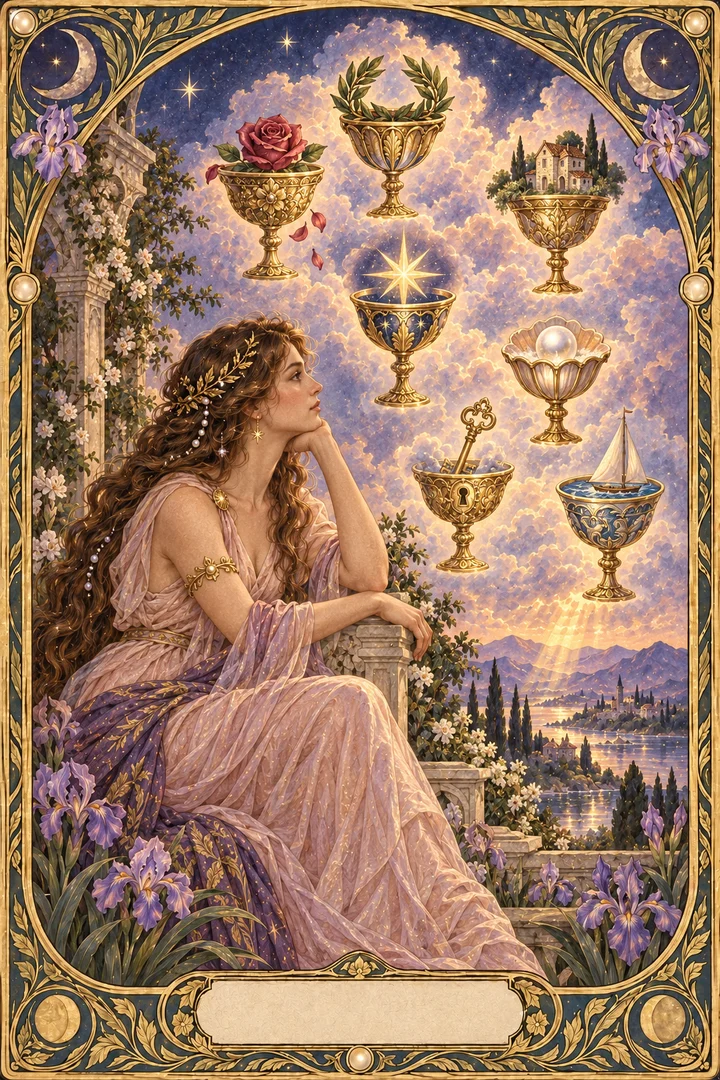
The traditional Nine of Cups shows a seated figure with nine cups arranged behind. Selfetti keeps nine gold cups on a curved shelf and a person sitting comfortably among flowers, with tea and fruit nearby. These added details give satisfaction an everyday scale. The arranged cups are a historical motif; our meal and garden are an original interpretation of modest pleasure.
A question to keep
What feels quietly satisfying at its own scale?
One small experiment
Name one detail you enjoy and give it a few unhurried minutes. Let it stay a pleasure rather than turning it into a task.
Questions worth asking
Does the Nine of Cups guarantee a wish will come true?
No. Wish fulfilment is a common association, not evidence about an outcome. Use it to clarify what you want and notice satisfaction that is actually present.
What does the reversed Nine of Cups mean?
Here it can fit an unmet need beneath pleasure or a goal that no longer feels yours. Ask what you hoped the reward would provide and whether it does.
How is it different from the Ten of Cups?
The Nine focuses on personal enjoyment and enoughness. The Ten focuses on shared belonging. Feeling satisfied alone and making a home together ask different questions.
Can this card fit a small ordinary pleasure?
Yes. A meal, a quiet room or an enjoyable activity can fit its theme. The scale of the occasion does not decide whether the pleasure matters to you.
How to use this interpretation
These are symbolic prompts, not measured personality traits or predictions. Keep a real example beside any interpretation; you can disagree. Do not infer another person's feelings, health or financial outcomes from a card or sign.
Sources and method
V&A · Tarot · Selfetti · A. E. Waite · 1910
Historical image reference: A. E. Waite, The Pictorial Key to the Tarot (1910), illustrated by Pamela Colman Smith. Selfetti uses the traditional image as a starting point. The contemporary interpretations, including reversed and conditional yes/no readings, life examples, recognition passage and keepsake line are our own editorial treatment. Our original illustrations adapt the scenes with a celestial garden setting and inclusive adult figures.
Selfetti ·
Keep exploring
Seven of Cups
Many beautiful possibilities in view; choose one small way to meet reality.
Read the full guide ↗
Eight of Cups
Something can have mattered and still no longer fit. Leaving can make room for care as well as change.
Read the full guide ↗
Ten of Cups
A place to belong as a whole person, with differences and difficult days allowed inside.
Read the full guide ↗