Ten of Cups: upright, reversed, love & yes or no
A place to belong as a whole person, with differences and difficult days allowed inside.

If this feels familiar
You may want a place where you do not have to arrive already cheerful, useful or easy to host. That wish can be modest: a chair kept for you, a question asked without hurry, somebody respecting your quiet. You can value the beautiful moments while wanting a home that also has room for the difficult days.
A line to keep
I can belong here as a whole person.
- Upright meaning
- Shared belonging · emotional harmony · home · chosen family · mutual care
- Ten of Cups reversed
- An ideal picture under strain · unmet needs · household tension · belonging redefined
Upright meaning
Upright, the Ten of Cups is commonly read through shared happiness, emotional harmony and belonging. Look at the ordinary arrangements that make a place feel inhabitable: people keeping agreements, noticing needs and allowing somebody to have a quiet day. A beautiful shared moment can matter without proving that the group is perfect. Belonging is easier to examine through actual care than through whether a household resembles an ideal picture.
At a shared dinner, somebody needs less noise. The group might make room for a quieter seat or accept an early departure. The care is in the adjustment, rather than requiring everyone to enjoy the evening in the same way.
Ten of Cups reversed
Reversed, the Ten can fit tension between an attractive family picture and the needs inside it. Some people may feel pressure to appear happy, or an old idea of home may no longer fit. Ask who can speak honestly and whose comfort determines the arrangement. Reconsidering belonging may involve clearer agreements, practical changes or finding company in a different circle.
Everybody calls a recurring gathering wonderful, but you leave exhausted from doing all the preparation. Name the work and ask how it can be shared. A pleasant picture is more useful when the people inside it can alter the arrangement.
Ten of Cups in love and relationships
In love, the Ten can frame building a shared life with room for each person's relationships and needs. Discuss the everyday meaning of home: time, tasks, money, privacy and company. Reversed, examine where the preferred picture has replaced an honest conversation. A ten-cup arc cannot establish marriage, children or a relationship's future.
Before living together, discuss a normal weekday rather than only the beautiful parts of sharing a home. Who needs quiet after work? How will chores be handled? What kind of company is welcome and when?
Ten of Cups: yes or no?
Upright often leans toward a conditional yes to an arrangement supported by mutual care and realistic agreements. Reversed invites checking the needs hidden by an ideal picture. A yes to discussing a shared life is different from certainty that the life will remain harmonious. No card can guarantee that.
For ‘Should we plan a regular meal together?’, check whether people want it and can share the work. Reversed, revise the arrangement before repeating it. The question is whether the plan is welcome, not whether the group looks like a perfect family.
A yes/no lean is a storytelling convention, not a probability or reliable prediction. Check real information before acting, especially about safety, money or another person's intentions.
Work, study and creative life
For work and study, the Ten can offer a question about belonging within a group. Can people ask for help, name a difficulty and be credited for their contribution? Reversed, slogans about being a family may be covering unequal work or limited room to disagree. Check actual agreements and expectations.
A team wants a shared celebration. Choose a time and arrangement people can join without pressure, and ask about access or scheduling needs. Inclusion involves those practical details as well as a warm invitation.
How this card differs from nearby cards
The Three of Cups highlights an occasion of shared delight. The Nine highlights personal contentment. The Ten widens the scene into ongoing belonging. The Two of Cups attends to mutual exchange within a relationship. A good gathering can contribute to a home, while the daily arrangements still need attention.
Common misreadings
The Ten does not require a spouse, children or an always-happy household. It also does not guarantee marriage or a permanent outcome. A chosen family, friendship circle or other shared arrangement can fit the theme when actual care is present.
Reading lens, not a verdict
These readings use symbols to reflect on experiences you recognise. They cannot establish events or another person’s private feelings. Reversed meanings explore different ways a theme may be held, blocked or overused; they need not be a simple opposite. Yes/no readings are conditional conventions rather than guarantees.
Traditional symbolism
The traditional Ten of Cups shows two adults and two children beneath an arc of ten cups, with a home and water nearby. Selfetti adapts the household into four adults as chosen family, with a dog and cat in a garden. Ten cups remain in the arc. The adult group is our original choice: shared belonging can be recognised in more than one family arrangement.
A question to keep
Which ordinary agreement would make belonging easier?
One small experiment
Name one form of care you already value and one practical need worth discussing with the people involved.
Questions worth asking
Does the Ten of Cups mean marriage?
Marriage is one possible context, but the card cannot establish that event. Its broader theme is shared belonging. Look at actual intentions and agreements when considering a commitment.
Can the Ten of Cups represent chosen family?
Yes. Friends, adult housemates and other caring circles can fit its theme. Selfetti's original illustration explicitly adapts the traditional household into adult chosen family.
Does the reversed Ten of Cups mean divorce?
No orientation establishes divorce. Here the reversal can fit unmet needs or an ideal picture under strain. Name the real tension and examine whether the arrangement can change.
How is it different from the Nine of Cups?
The Nine focuses on personal enjoyment. The Ten concerns shared belonging and care. Your own contentment matters, and a shared arrangement also needs other people's needs to have room.
How to use this interpretation
These are symbolic prompts, not measured personality traits or predictions. Keep a real example beside any interpretation; you can disagree. Do not infer another person's feelings, health or financial outcomes from a card or sign.
Sources and method
V&A · Tarot · Selfetti · A. E. Waite · 1910
Historical image reference: A. E. Waite, The Pictorial Key to the Tarot (1910), illustrated by Pamela Colman Smith. Selfetti uses the traditional image as a starting point. The contemporary interpretations, including reversed and conditional yes/no readings, life examples, recognition passage and keepsake line are our own editorial treatment. Our original illustrations adapt the scenes with a celestial garden setting and inclusive adult figures.
Selfetti ·
Keep exploring
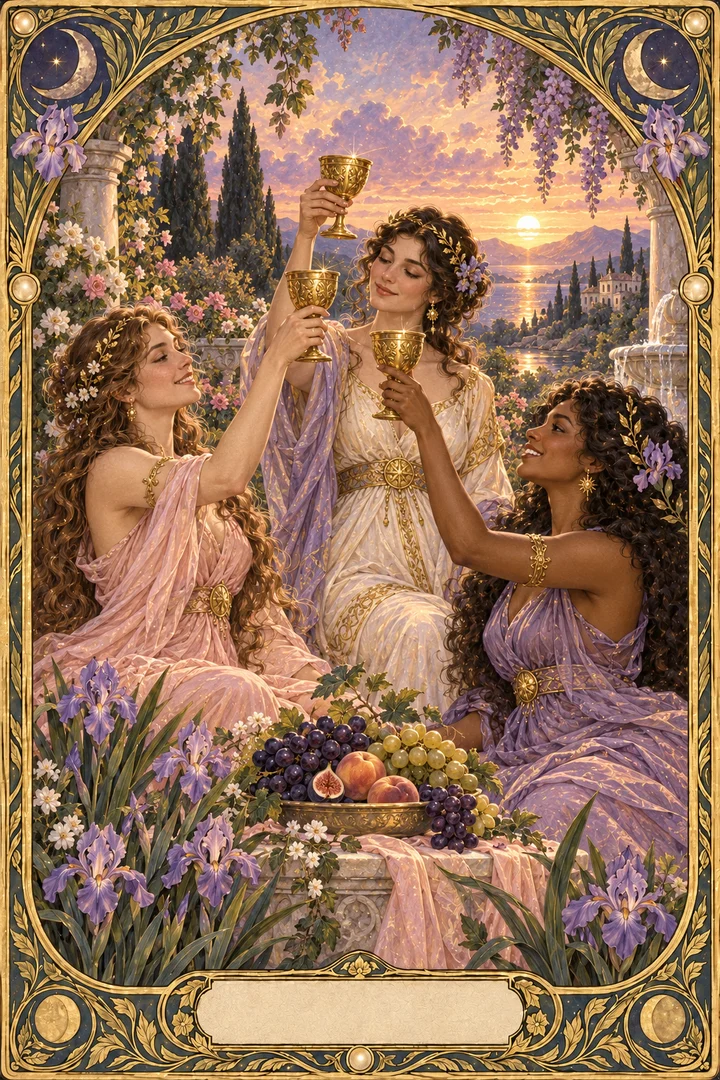
Three of Cups
A little shared delight: friendship, celebration and a place at the table without having to perform.
Read the full guide ↗
Nine of Cups
An ordinary good moment can be enough. Let pleasure have a little time of its own.
Read the full guide ↗
Two of Cups
Meeting at the same height: mutual attention, affection and enough room for two different people.
Read the full guide ↗