Eight of Pentacles: upright, reversed, love & yes or no
A skill becomes yours through attentive practice, with room for an imperfect version.
If this feels familiar
The quiet work nobody sees can still be shaping something real. You do not have to make every attempt display-ready. An unfinished exercise can belong to your learning without becoming a verdict on you. You may notice yourself repeating a task until it feels safe, or avoiding it because it is not yet good. Both are human responses to practice.
A line to keep
An imperfect version can still teach me something.
- Upright meaning
- Craft · practice · attention · specific feedback · gradual competence
- Eight of Pentacles reversed
- Perfectionism · repetitive work without learning · fatigue · a practice to adjust
Upright meaning
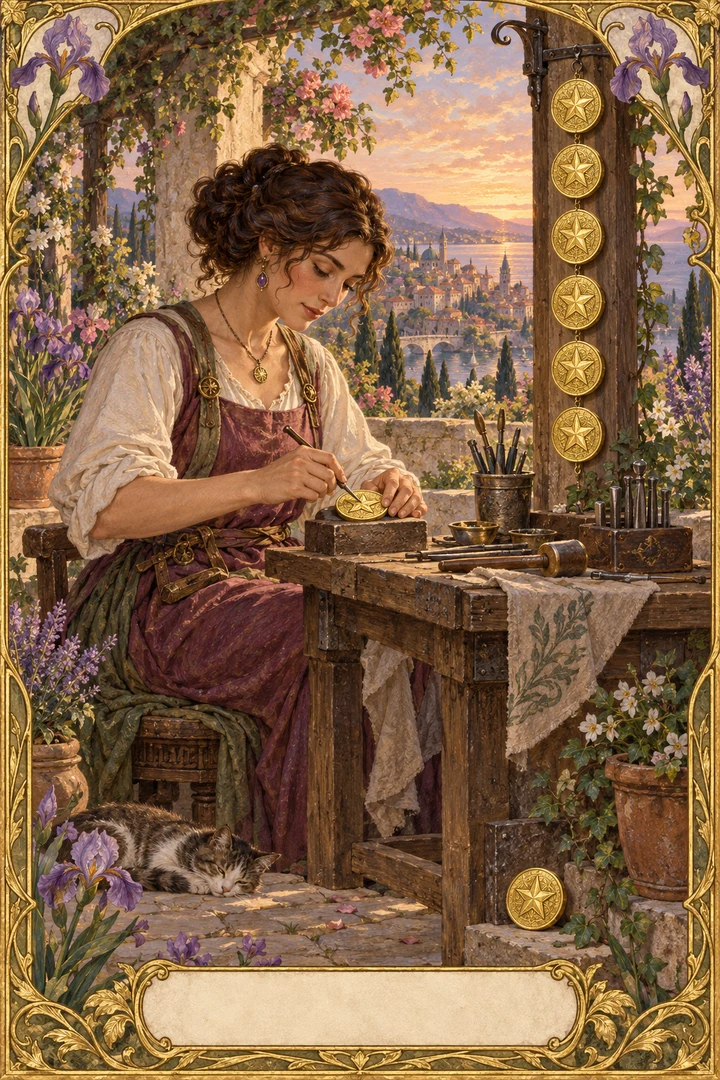
The Eight of Pentacles is often read as the patient work of getting better at something. A craftsperson works on one coin beside completed pieces, giving attention to a particular part of the task. Quality grows through repetition, but also through feedback and recovery. You may be quietly building competence that nobody sees yet. Let the work be specific and unfinished rather than a verdict on your worth.
Practise the opening paragraph of a story in three versions. Compare one concrete feature, such as clarity, rather than rewriting the entire story until it feels worthy. Then stop for today, even if the paragraph is not perfect.
Eight of Pentacles reversed
Reversed, the Eight can fit repetitive work without useful feedback, or perfectionism that keeps you revising beyond the task's needs. You may be tired from effort that no longer teaches you anything. Define what this version must do and where you will stop. Rest may restore the attention that more effort cannot. A practice can be adjusted rather than abandoned.
You have rewritten the same email five times, each version feeling less clear. Before a sixth attempt, decide what the message must accomplish and send it. If it still feels wrong, ask one trusted person for a single piece of feedback.
Eight of Pentacles in love and relationships
In love, the Eight asks you to practise a specific habit, such as listening through an answer or keeping an agreement. A relationship cannot be earned through flawless effort by one person alone. Notice whether your care is reciprocal or whether you are polishing a dynamic that needs a real conversation. Small, consistent attention matters more than a perfect performance.
You want to be more present when your partner talks about their day. For one week, put your phone in another room during that conversation. Afterward, ask whether it felt different for them, and listen to the answer without defending yourself.
Eight of Pentacles: yes or no?
In a yes/no convention, upright often leans yes to focused practice when it has a purpose and a reasonable stopping point. The condition is that the effort still serves your learning. Reversed, pause if more effort is only feeding perfectionism or fatigue. Neither orientation guarantees professional success or that practice will be rewarded; tarot readers do not share one universal yes/no rule.
For ‘Should I take the online course?’, an upright yes can support a short trial if you have the time. For ‘Will it get me promoted?’, the result depends on many factors. Reversed, you may need rest before deciding.
A yes/no lean is a storytelling convention, not a probability or reliable prediction. Check real information before acting, especially about safety, money or another person's intentions.
Work, study and creative life
At work and in study, the Eight supports choosing a skill, a short practice block and a source of useful feedback. Productive learning differs from endlessly polishing a detail no one needs. You may be building expertise through repetition, but check that the repetition still teaches you something. Ask for specific input rather than general praise or criticism.
If you want to improve your presentations, record a five-minute section and watch it once. Note one thing that worked and one thing to adjust next time. Then ask a colleague for one concrete suggestion, not a full review.
How this card differs from nearby cards
The Page begins practical learning; the Eight deepens a skill through repetition and feedback; the Three brings expertise into collaboration. The Seven asks whether the overall effort still fits. These are different questions rather than guaranteed stages of mastery. The Eight is about the work itself, not its recognition.
Common misreadings
Eight coins do not certify talent, predict a job or promise money for effort. Dedication does not require ignoring rest or becoming perfect. The card can describe a season of practice, not a permanent identity. Keep the interpretation near what you are actually learning rather than turning effort into a guarantee.
Reading lens, not a verdict
These readings use symbols to reflect on experiences you recognise. They cannot establish events, financial outcomes or another person's private feelings. Reversed meanings explore how a theme may be internal, blocked or overused; they are a separate reference, since the one-card draw uses upright cards. Yes/no interpretations are conditional editorial conventions, not guarantees or a universal rule.
Traditional symbolism
The traditional Eight shows a craftsman engraving a coin while finished coins hang nearby. Selfetti keeps that focused work in a garden, where an adult craftswoman engraves one golden five-pointed-star coin at a wooden workbench. Six finished star coins hang clearly spaced in a vertical display beside her, and one finished coin leans near the bench foot. The garden, flowers and warm light belong to our original setting; they do not add a separate prediction to the card.
A question to keep
Which small part of this skill would benefit from attention today?
One small experiment
Practise one specific part for a short set time. Ask for one piece of useful feedback, then stop or rest.
Questions worth asking
Does Eight mean working harder?
Not necessarily. It can mean working with more attention, not more hours. The card supports focused practice with feedback and rest. If effort is only feeding perfectionism or fatigue, the useful move may be to adjust the practice or stop for now.
How does practice differ from perfectionism?
Practice has a purpose and a stopping point; perfectionism keeps revising beyond what the task needs. Practice welcomes feedback and imperfect versions. Perfectionism treats every flaw as a verdict. The Eight can describe either, so check which one you recognise in your own effort.
How is it different from Three?
The Three of Pentacles is about collaboration and expertise shared with others. The Eight is about the private, repetitive work of building a skill. You might deepen a craft alone before bringing it to a team, or return to solo practice after a collaborative project.
Does it guarantee professional success?
No. The Eight describes dedication and gradual competence, not a promised outcome. Many factors affect work and money, including opportunity, timing and luck. Use the card to reflect on your practice, not as a prediction of a job, promotion or income.
How to use this interpretation
These are symbolic prompts, not measured personality traits or predictions. Keep a real example beside any interpretation; you can disagree. Do not infer another person's feelings, health or financial outcomes from a card or sign.
Sources and method
V&A · Tarot · Selfetti · A. E. Waite · 1910
Historical image reference: A. E. Waite, The Pictorial Key to the Tarot (1910), illustrated by Pamela Colman Smith. The contemporary readings, life examples, recognition passages and keepsake lines are Selfetti's own editorial interpretation, including the conditional yes/no and reversed themes. Our original celestial garden illustrations adapt the traditional scenes with inclusive figures; ornamental flowers and frames do not add predictions. The one-card draw uses upright cards; reversed meanings are a separate reference.
Selfetti ·
Keep exploring

Page of Pentacles
A useful skill can begin with a learner's attention and a small piece of ground.
Read the full guide ↗
Three of Pentacles
Good work grows when different skills can speak to one another.
Read the full guide ↗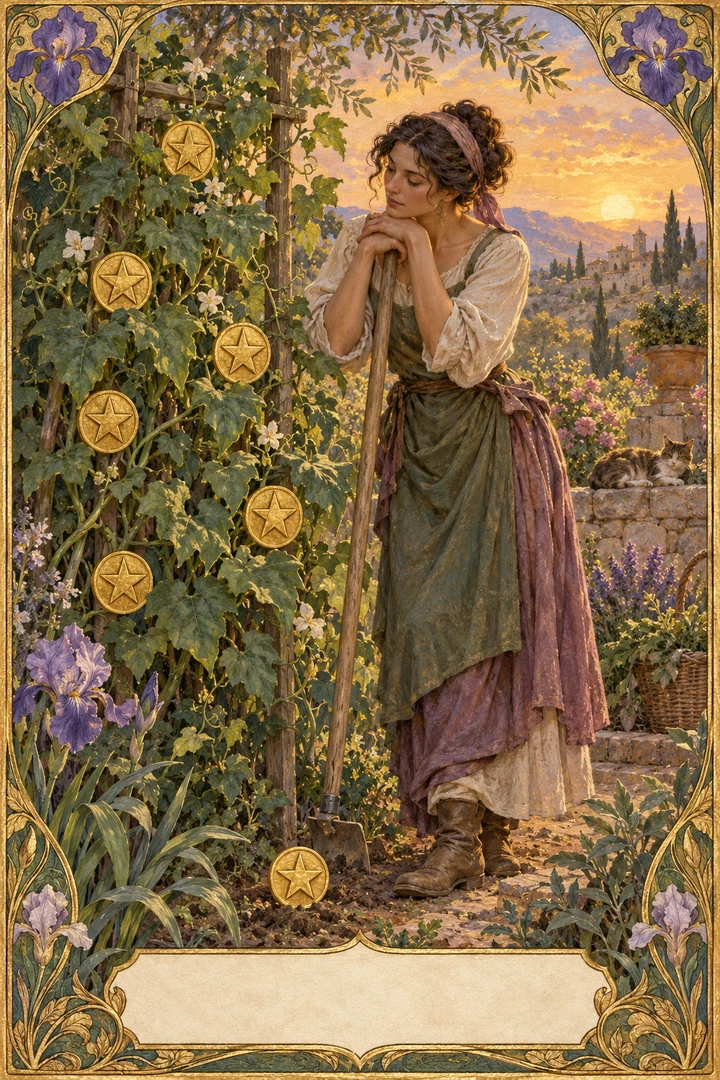
Seven of Pentacles
Pausing to examine what your effort is growing, before giving it more.
Read the full guide ↗