Page of Wands: upright, reversed, love & yes or no
Curiosity can be taken seriously before you become accomplished.
If this feels familiar
Perhaps being competent has become part of how you earn a place. Here there is room to ask, try and be new at something. Curiosity does not need an achievement attached to it. You might notice a quiet interest you have postponed because you were not already good at it. The Page invites you to give that interest one small, unpolished moment of your attention, without turning it into a performance or a test of your worth.
A line to keep
I am allowed to be new at something I care about.
- Upright meaning
- Exploration · a learner's courage · enthusiasm · a small trial · discovery
- Page of Wands reversed
- Fear of looking inexperienced · scattered starts · borrowed excitement · a trial to revise
Upright meaning
The Page studies the living staff instead of directing a whole journey. Notice what you want to learn through doing. A first experiment can be honest, unfinished and worth your attention. You do not need a five-year plan to justify one beginner class or a single afternoon of trying something new. The Page's courage is not mastery; it is the willingness to be seen as a learner. Let your curiosity have a small, real place in your week, and let that be enough for now.
Try one beginner dance class without deciding whether you are a dancer. Afterwards, notice which movement you wanted to try again. The point is not to grade your performance but to gather one honest piece of information about what holds your interest.
Page of Wands reversed
Enthusiasm may scatter across many starts, or embarrassment may keep a first attempt private. Choose one short trial and a question it can answer. Learning is allowed to reveal that an interest is not for you. You might also be carrying excitement that belongs to someone else, following a path because it looks good rather than because it genuinely pulls you. Reversed, the invitation is to slow down, pick one thread and let it be imperfect while you find out what is actually yours.
You have signed up for three courses this month and finished none. Instead of adding a fourth, pick the one that still makes you curious and give it one focused hour. Notice whether the interest is yours or borrowed from someone else's expectations.
Page of Wands in love and relationships
Express curiosity without performing certainty. A playful invitation should leave the other person free to choose, and cannot supply their private feelings. You might be interested in someone and want to learn more about them through honest conversation rather than assumption. Reversed, check whether you are scattering attention or hiding your beginner's uncertainty behind a confident act. The other person's feelings still belong to their own words and behaviour.
After a pleasant first date, you might say, ‘I enjoyed talking with you and would like to learn more about what you care about.’ This expresses interest without demanding a particular outcome or pretending you already know where it will lead.
Page of Wands: yes or no?
A conditional yes to exploration when its scope and cost are small. Wait if the invitation requires more commitment than you actually want. In a yes/no convention, upright often leans toward trying the beginner version, while reversed suggests pausing to check whether your enthusiasm is scattered or borrowed. Neither orientation guarantees success, a message or a particular outcome; tarot readers do not share one universal yes/no rule.
For ‘Should I sign up for that workshop?’, an upright yes can support a low-cost trial. For ‘Will this become my new career?’, the card cannot promise that. Reversed, you might wait until you have finished one small experiment first.
A yes/no lean is a storytelling convention, not a probability or reliable prediction. Check real information before acting, especially about safety, money or another person's intentions.
Work, study and creative life
Ask a useful beginner question and test a small skill. You do not have to promise a new career in order to learn something that interests you. At work or in study, the Page supports exploratory projects, short courses and honest questions that make you look like a learner rather than an expert. Reversed, notice whether you are starting many things to avoid the vulnerability of getting better at one. Choose a single trial that can give you real feedback.
If a new software tool interests you, spend one hour on a tutorial and try a small task. You are not committing to a new profession; you are gathering evidence about whether this skill is worth more of your time.
How this card differs from nearby cards
Ace is the spark; Page learns from it; Knight acts with momentum. Page of Pentacles emphasises a concrete skill or practice rather than exploratory enthusiasm. The Page of Wands is about the courage to begin without mastery, while the Knight of Wands is about charging forward with confidence. These are different approaches to the same element, not guaranteed stages of a journey.
Common misreadings
A Page is a symbolic way of approaching a situation, not a prediction of a child, a message or an immature person. Court cards need not represent a particular age or gender. The Page of Wands does not guarantee that a new opportunity will arrive or that your enthusiasm will last. It describes a stance you can take: curious, willing to be a beginner and open to learning through direct experience.
Reading lens, not a verdict
These readings use symbols to reflect on experiences you recognise. They cannot establish events, financial outcomes or another person's private feelings. Reversed meanings explore how a theme may be internal, blocked or overused; they are a separate reference, since the one-card draw uses upright cards. Yes/no interpretations are conditional editorial conventions, not guarantees or a universal rule.
Traditional symbolism
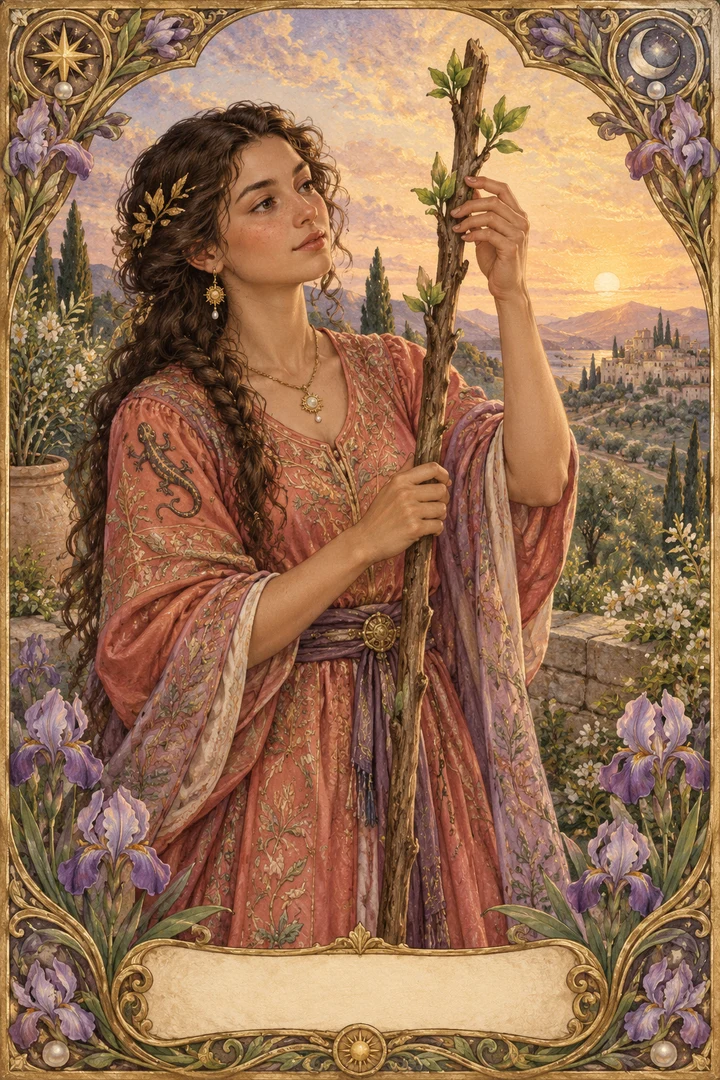
The traditional Page holds a staff and studies its budding leaves, a young figure in a barren landscape. Selfetti keeps the single upright staff and the salamander motif on the tunic, but sets the scene in a sunlit garden beside warm sandy hills. The figure is a young adult woman, not a child, and her embroidered coral tunic and attentive expression frame curiosity as a dignified adult choice. The garden and flowers belong to our original setting; they do not add a separate prediction to the card.
A question to keep
What would I like to learn by trying, rather than by proving myself?
One small experiment
Choose a short beginner experiment. Record one thing you noticed, without grading your whole ability.
Questions worth asking
Does the Page represent a young person?
No. A Page is a symbolic approach, not a prediction of age or gender. It can describe anyone who is learning, asking beginner questions or bringing fresh curiosity to a situation. The figure in our illustration is an adult woman.
How is it different from the Ace?
The Ace is the initial spark of inspiration. The Page takes that spark and begins to study it through small, concrete experiments. The Ace offers the impulse; the Page asks what you will actually do with it.
What if my enthusiasm changes?
That is allowed. The Page supports honest exploration, including discovering that an interest is not for you. A short trial can answer a real question without committing you to a long path. You can revise or stop without treating it as failure.
Does it guarantee a message?
No. The Page of Wands is not a promise of news, an invitation or a particular outcome. It describes a curious, exploratory stance you can take. Any actual message depends on real people and real circumstances, not on the card.
How to use this interpretation
These are symbolic prompts, not measured personality traits or predictions. Keep a real example beside any interpretation; you can disagree. Do not infer another person's feelings, health or financial outcomes from a card or sign.
Sources and method
V&A · Tarot · Selfetti · A. E. Waite · 1910
Historical image reference: A. E. Waite, The Pictorial Key to the Tarot (1910), illustrated by Pamela Colman Smith. The contemporary readings, life examples, recognition passages and keepsake lines are Selfetti's own editorial interpretation, including the conditional yes/no and reversed themes. Our original celestial garden illustrations adapt the traditional scenes with inclusive figures; ornamental flowers and frames do not add predictions. The one-card draw uses upright cards; reversed meanings are a separate reference.
Selfetti ·
Keep exploring
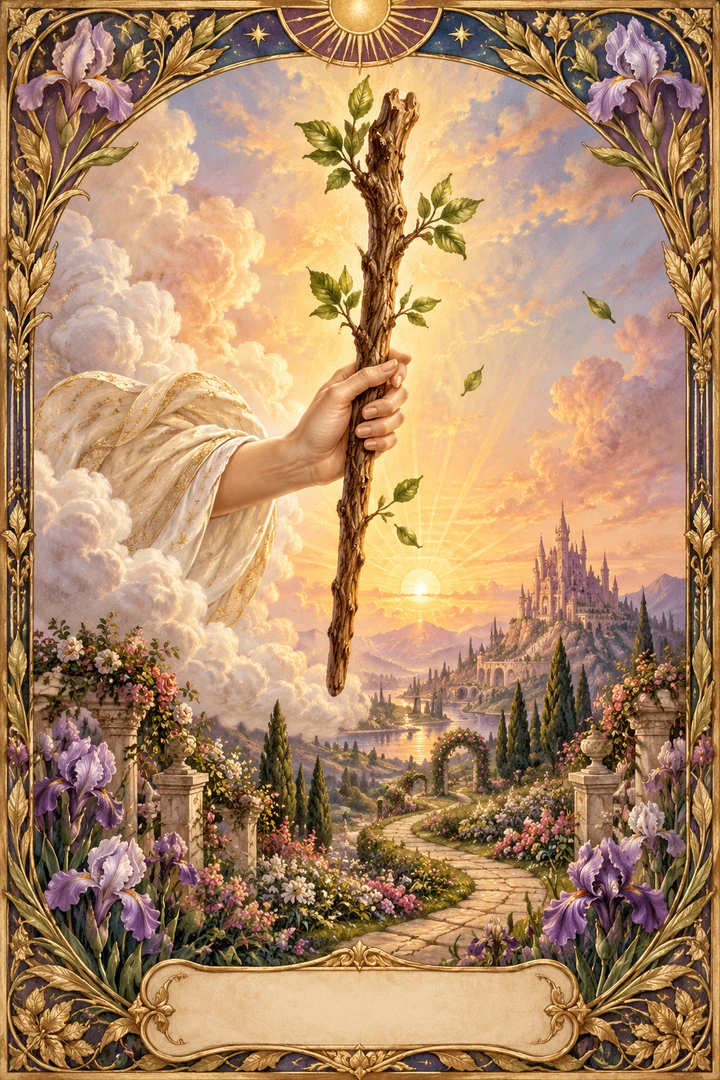
Ace of Wands
A spark deserves a small beginning, before it becomes a promise.
Read the full guide ↗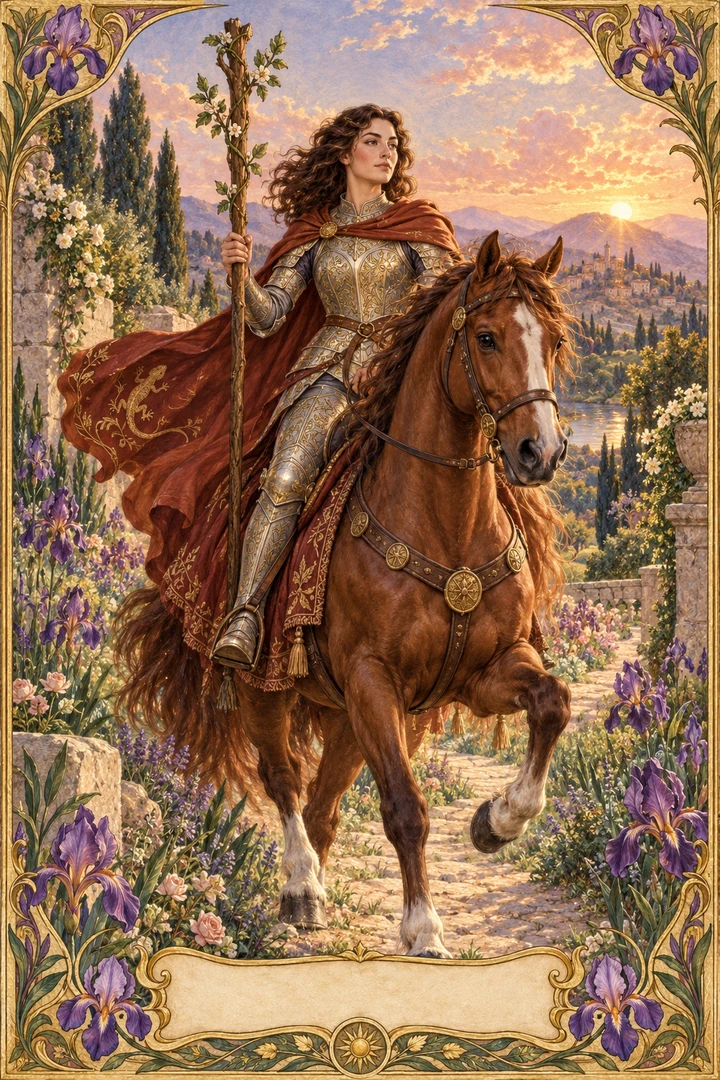
Knight of Wands
Enthusiasm becomes useful when it has a direction and a place to slow down.
Read the full guide ↗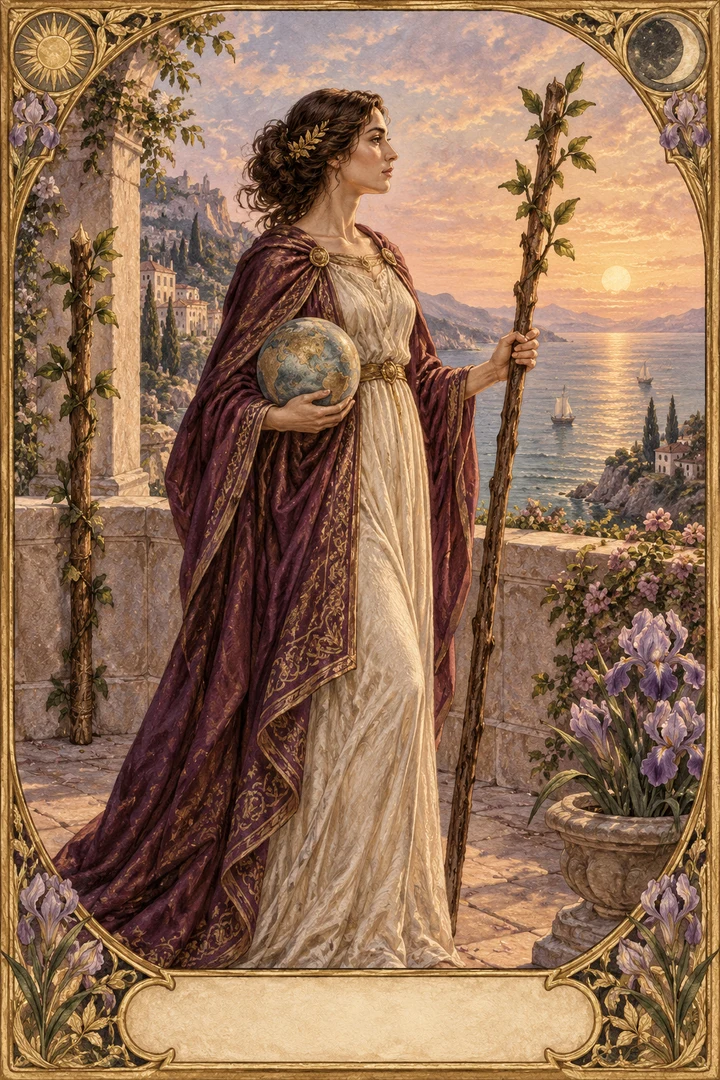
Two of Wands
Choosing a horizon while keeping one foot in the life you have.
Read the full guide ↗