Seven of Pentacles: upright, reversed, love & yes or no
Pausing to examine what your effort is growing, before giving it more.
If this feels familiar
You may have put care into something that still looks unfinished. That care matters without obliging you to continue forever. You are allowed to ask whether the way forward still fits, and to name what you would need to see before giving more. A pause to look clearly is not a failure of commitment; it is how you keep your effort honest.
A line to keep
I can value my effort and still revise the plan.
- Upright meaning
- Review · patient effort · a checkpoint · progress to observe · a considered adjustment
- Seven of Pentacles reversed
- Frustration with slow change · effort without feedback · sunk-cost pressure · a method to revise
Upright meaning
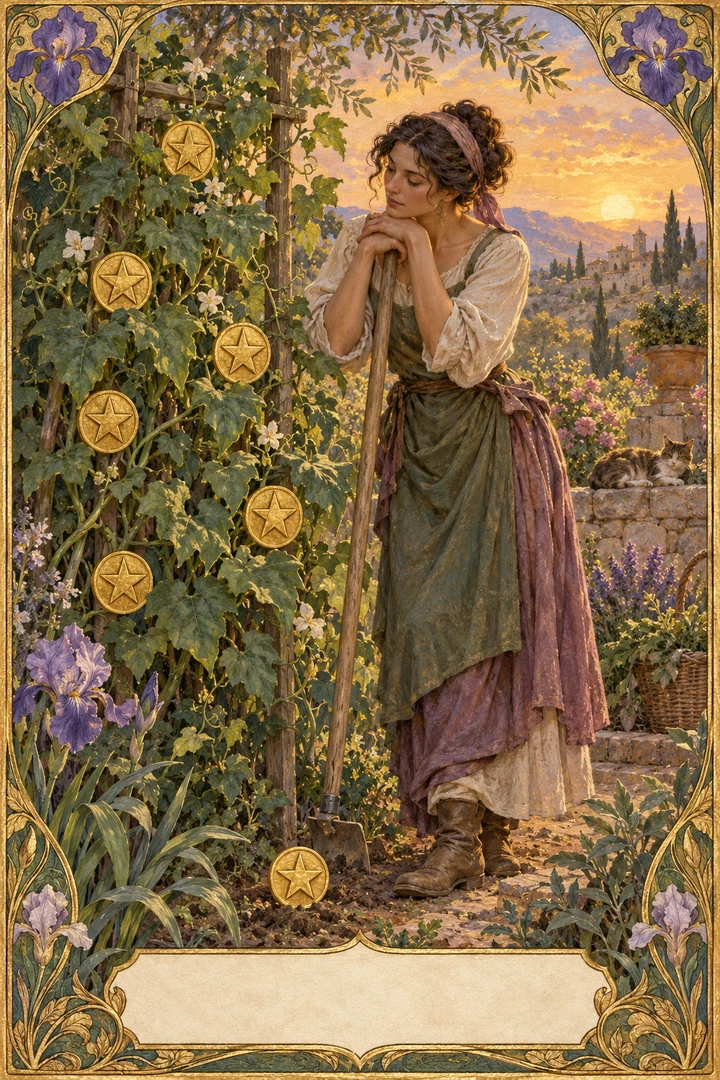
The Seven of Pentacles is often read as a pause to look at what your effort is actually growing. You may have tended something for a while and now want to know whether it is worth continuing. Patience here is not passive waiting; it is deliberate when you know what you are observing and when you will review it again. The gardener rests on the hoe, not because the work is finished, but because looking clearly is part of the work. You can value what you have done and still adjust the plan.
After several weeks learning a skill, compare one early exercise with a recent one. Choose a particular difficulty to practise rather than deciding whether you are talented. Set a date to look again, and let that review be the next step instead of a verdict on your worth.
Seven of Pentacles reversed
Reversed, the Seven can fit frustration with slow change, effort that receives no feedback or pressure to continue because of what you have already spent. Continuing may be driven by previous effort instead of present fit. A slow result may need a different method, clearer feedback or an end. What you have already spent does not require you to spend more. Ending an unsuitable effort can be a thoughtful decision, not a failure of patience.
You have been editing a project for months with no clear improvement. Instead of pushing through another late night, ask a trusted colleague for one specific piece of feedback. If the method still does not fit, you can stop or redesign it without treating the time already spent as a debt.
Seven of Pentacles in love and relationships
In love, the Seven asks you to consider whether effort leads to a more workable exchange. Patience cannot create another person's willingness. You might notice a pattern of you initiating and them responding vaguely, or of both of you trying without a shared direction. Discuss an observable pattern and listen to what they want. The card does not tell you what they feel; it asks you to review what is actually happening between you.
You have been the one suggesting plans for weeks. Instead of waiting longer, say, ‘I notice I am usually the one asking. I would like to know what you want.’ Their answer, not the card, is the information you need.
Seven of Pentacles: yes or no?
In a yes/no convention, upright often leans toward pause and review before adding resources. A conditional yes needs a reason grounded in current evidence, rather than time already spent. Reversed, the answer may be a clearer no to continuing as before, or a yes to revising the method. Neither orientation guarantees a return, a harvest or a fixed waiting period; tarot readers do not share one universal yes/no rule.
For ‘Should I keep going with this project?’, an upright yes might mean yes to one more round with a defined checkpoint. For ‘Will it pay off?’, the card cannot say. Reversed, you may prefer to stop, or to change the approach before deciding.
A yes/no lean is a storytelling convention, not a probability or reliable prediction. Check real information before acting, especially about safety, money or another person's intentions.
Work, study and creative life
At work and in study, the Seven supports setting a review point with evidence relevant to the project. Look at what has changed since you began, what has not, and what you would need to see to continue. The card does not tell you whether an investment will pay off; use actual data and appropriate advice for financial decisions. A considered adjustment may be more useful than either stubborn persistence or abrupt abandonment.
Before renewing a course or subscription, list two observable signs of progress and one sign that is missing. If the missing sign matters, change the method or stop. If it does not, name a next checkpoint and continue with clearer eyes.
How this card differs from nearby cards
The Ace of Pentacles begins a foundation; the Seven reviews it; the Eight refines a skill. The Three of Wands looks outward for a response, while the Seven inspects ongoing effort. The Five of Pentacles concerns hardship and support, not patient review. These are different questions rather than guaranteed stages of a project.
Common misreadings
Coins on a plant do not guarantee profit, a harvest, seven months or a reward for patience. The number seven is symbolic, not a waiting period. The card does not tell you whether an investment will succeed or whether someone else will change. Ending an unsuitable effort can be a thoughtful decision, and patience is not the same as staying indefinitely.
Reading lens, not a verdict
These readings use symbols to reflect on experiences you recognise. They cannot establish events, financial outcomes or another person's private feelings. Reversed meanings explore how a theme may be internal, blocked or overused; they are a separate reference, since the one-card draw uses upright cards. Yes/no interpretations are conditional editorial conventions, not guarantees or a universal rule.
Traditional symbolism
The traditional Seven shows a gardener leaning on a hoe, gazing at a vine where coins grow among the leaves. Selfetti keeps that pause in an original garden scene: an adult gardener rests on a plain wooden hoe beside a healthy leafy vine, with six golden star-coins growing among the leaves and one resting low near their foot. The golden quiet afternoon and the gardener's thoughtful posture belong to our adaptation. We read the scene as a deliberate checkpoint rather than a promise of harvest. The seven coins are clearly countable, and no other round gold ornaments appear.
A question to keep
What has changed, and what evidence would justify another round of effort?
One small experiment
Review one ongoing effort using two observable signs. Choose to continue, change or stop, and name a next checkpoint if you continue.
Questions worth asking
Does Seven promise a return on investment?
No. The card shows a pause to review effort, not a guarantee of profit or harvest. For financial decisions, use actual data and appropriate advice rather than the card as evidence.
Does the number give a waiting period?
No. Seven is symbolic, not a fixed number of days, weeks or months. The card invites you to set your own review point based on what you can observe.
Is stopping a waste of effort?
Not necessarily. What you have already spent does not require you to spend more. Ending an unsuitable effort can be a thoughtful decision, and the care you gave still mattered.
How is it different from Eight?
The Seven reviews whether and how to continue. The Eight refines a skill through repeated practice. One is a checkpoint about direction; the other is about deliberate improvement.
How to use this interpretation
These are symbolic prompts, not measured personality traits or predictions. Keep a real example beside any interpretation; you can disagree. Do not infer another person's feelings, health or financial outcomes from a card or sign.
Sources and method
V&A · Tarot · Selfetti · A. E. Waite · 1910
Historical image reference: A. E. Waite, The Pictorial Key to the Tarot (1910), illustrated by Pamela Colman Smith. The contemporary readings, life examples, recognition passages and keepsake lines are Selfetti's own editorial interpretation, including the conditional yes/no and reversed themes. Our original celestial garden illustrations adapt the traditional scenes with inclusive figures; ornamental flowers and frames do not add predictions. The one-card draw uses upright cards; reversed meanings are a separate reference.
Selfetti ·
Keep exploring

Ace of Pentacles
A possibility becomes tangible when you give it a place in ordinary life.
Read the full guide ↗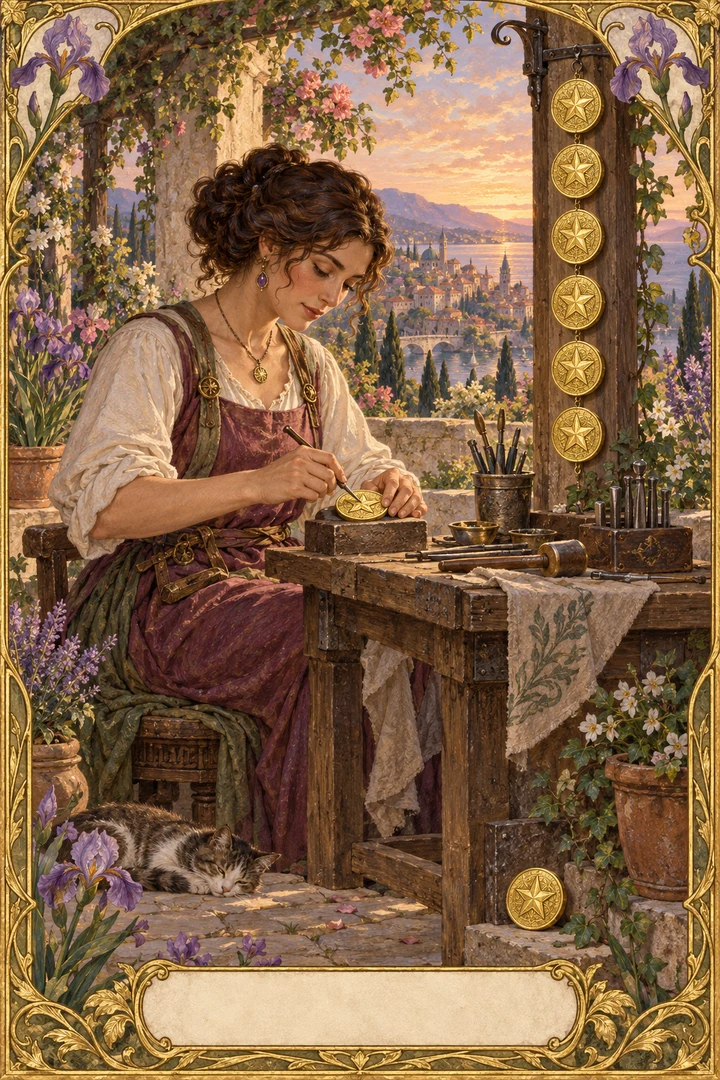
Eight of Pentacles
A skill becomes yours through attentive practice, with room for an imperfect version.
Read the full guide ↗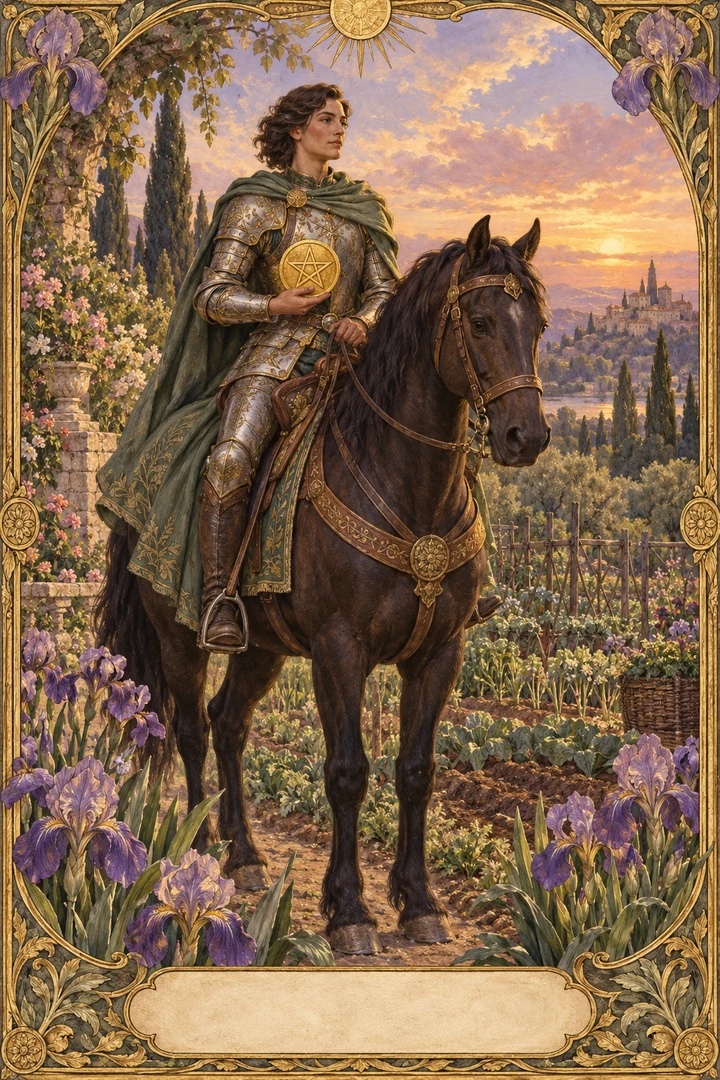
Knight of Pentacles
Care can be steady enough to trust, and flexible enough to keep living.
Read the full guide ↗