Ten of Wands: upright, reversed, love & yes or no
What you carry can be important and still be too much for one person.
If this feels familiar
You may be good at noticing what would go undone and doing it before anyone asks. That care deserves to be seen. You can ask for a fairer arrangement without first reaching a breaking point. Perhaps you are the one who remembers the appointments, the allergies, the deadlines, the mood in the room. That labour is real even when it is invisible. Naming it is not complaining; it is the first step toward sharing it.
A line to keep
I can care without carrying everything.
- Upright meaning
- Overload · responsibility · hidden labour · a near completion · redistribution
- Ten of Wands reversed
- A burden being released · difficulty delegating · a commitment to end · unspoken strain
Upright meaning
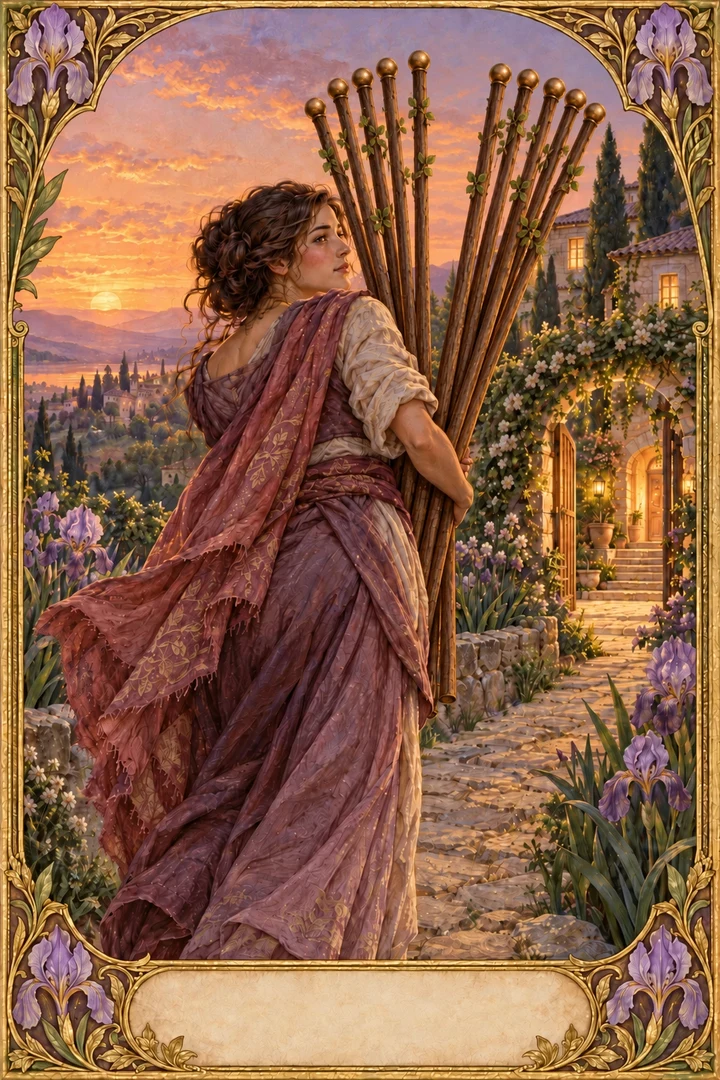
Ten bundled staffs narrow the carrier's view of the destination. This card often points to overload, responsibility and hidden labour — the remembering, organising and anticipating that rarely appear on a shared list. List the work you are carrying, including the invisible parts. A task's importance does not establish that all of it belongs to you. Near completion, the temptation is to push through alone. Redistribution is not failure; it is how a load becomes sustainable.
You organise a family gathering and also buy, prepare and clean. Put each job on a shared list and ask others to own whole tasks, including their planning. You might say, ‘I can host, but I need someone else to handle drinks and setup.’ The action is naming the total load and handing over complete pieces, not just the visible chores.
Ten of Wands reversed
A load may be starting to lift, or you may be unable to let others carry a part differently. Distinguish releasing responsibility from silently dropping a commitment that affects someone else. Make the handoff explicit where possible. Reversed themes may be internal, blocked or overused, not a literal opposite. You might be holding on because you doubt others will do it well, or because being needed feels like belonging. Notice what makes delegation difficult, and whether an unspoken strain has been growing.
You keep saying you will ask for help, but the week passes and you do it all again. Before the next commitment, tell one person what you are dropping and who owns the next step. A clear sentence — ‘I can't take this on this month’ — is a handoff, not a silent disappearance.
Ten of Wands in love and relationships
Talk about invisible work as well as visible chores. Being indispensable can make you tired and lonely; an agreement must be shared through action, not only appreciation. In love, the Ten of Wands can show up as one person carrying the emotional logistics — remembering birthdays, planning time together, noticing when something is off. Name what you are holding and ask what your partner can own. Reversed, notice whether you are releasing a burden or quietly resenting a load you never named.
You realise you are always the one suggesting plans and checking in. Instead of waiting to feel resentful, say, ‘I would like us to take turns planning our weekends.’ The request is specific, shared and possible to answer.
Ten of Wands: yes or no?
Usually pause before adding another obligation. A conditional yes needs a clear trade-off, support or an end to something already on your list. In a yes/no convention, the Ten of Wands leans toward no or not yet — not because the goal is unworthy, but because the current load is already full. If you say yes, name what you will drop or who will help. Reversed, the answer may be yes to releasing something, provided the handoff is explicit. No orientation guarantees an outcome; tarot readers do not share one universal yes/no rule.
For ‘Should I take on this extra project?’, an upright Ten suggests pausing until you can name what leaves your list. For ‘Can I let go of this commitment?’, a reversed Ten may support an honest conversation about ending or sharing it.
A yes/no lean is a storytelling convention, not a probability or reliable prediction. Check real information before acting, especially about safety, money or another person's intentions.
Work, study and creative life
Name competing responsibilities and ask which can be delayed, reassigned or removed. Before the last push, include the cost of completion and the recovery time afterwards. At work, the Ten of Wands often appears near the end of a long project, when the finish line is visible but the load is heaviest. Hidden labour — coordinating, reminding, tracking — may be yours without recognition. Reversed, check whether you are delegating clearly or hoping someone will notice and step in.
Before a deadline, list every task you are holding. Ask your manager which two can move to next week, and tell a colleague which whole piece you need them to own. Include the recovery time after launch in the plan, not as an afterthought.
How this card differs from nearby cards
Nine of Wands concerns guarded endurance; Ten is the load itself. Two of Pentacles adjusts recurring demands; Ten asks whether the total should be reduced. The Eight of Wands is swift movement; the Ten is the slow, heavy final stretch. These are different questions rather than guaranteed stages of a project. The Ten of Wands is not simply ‘more’ of the Nine — it is the point at which the whole bundle becomes visible and asks for redistribution.
Common misreadings
Ten does not mean a burden will automatically end soon, or that you are nobler for carrying it alone. Delegation is not proof that you have failed. The card does not diagnose burnout or predict a collapse. It also does not mean you should abandon every responsibility; it asks which parts genuinely belong to you and which can be shared, delayed or released. Reversed is not a literal opposite — it may show a load lifting, a difficulty delegating or an unspoken strain.
Reading lens, not a verdict
These readings use symbols to reflect on experiences you recognise. They cannot establish events, financial outcomes or another person's private feelings. Reversed meanings explore how a theme may be internal, blocked or overused; they are a separate reference, since the one-card draw uses upright cards. Yes/no interpretations are conditional editorial conventions, not guarantees or a universal rule.
Traditional symbolism
The traditional Ten of Wands shows a figure carrying ten heavy staffs toward a distant town, the bundle obscuring the path ahead. Selfetti keeps the countable staffs and the visible effort, but sets the scene at dusk in a celestial garden. An adult woman walks toward a welcoming garden home, her face partly visible as she looks for a place to put the bundle down. The ten separated tips and shafts remain countable. Tired effort is shown with dignity, not exaggerated suffering. The garden, flowers and home belong to our original setting; they do not add a separate prediction to the card.
A question to keep
Which part of this load does not need to be mine?
One small experiment
List your commitments. Hand off, reduce or decline one item, naming who owns the next step and when.
Questions worth asking
Does Ten guarantee a burden will end?
No. The Ten of Wands describes a heavy load near completion, not a guaranteed ending. It asks you to redistribute or release what you can. The timing and outcome depend on real-world actions, support and circumstances, not on the card alone.
How is it different from Nine?
Nine of Wands concerns guarded endurance — you are tired but still defending a position. Ten is the load itself, visible and countable. Nine asks whether you can keep going; Ten asks whether the total should be reduced, shared or set down.
What counts as invisible work?
Invisible work is the remembering, organising, anticipating and noticing that keeps things running — appointments, moods, supplies, deadlines. It is often unpaid and unacknowledged. Listing it makes it visible and possible to redistribute, rather than assuming it belongs to one person.
Is asking for help giving up?
No. Asking for help is a practical way to make a load sustainable. It can mean handing off a whole task, delaying something or declining a new commitment. It is not proof of failure or weakness; it is redistribution, which is often how important work continues.
How to use this interpretation
These are symbolic prompts, not measured personality traits or predictions. Keep a real example beside any interpretation; you can disagree. Do not infer another person's feelings, health or financial outcomes from a card or sign.
Sources and method
V&A · Tarot · Selfetti · A. E. Waite · 1910
Historical image reference: A. E. Waite, The Pictorial Key to the Tarot (1910), illustrated by Pamela Colman Smith. The contemporary readings, life examples, recognition passages and keepsake lines are Selfetti's own editorial interpretation, including the conditional yes/no and reversed themes. Our original celestial garden illustrations adapt the traditional scenes with inclusive figures; ornamental flowers and frames do not add predictions. The one-card draw uses upright cards; reversed meanings are a separate reference.
Selfetti ·
Keep exploring
Nine of Wands
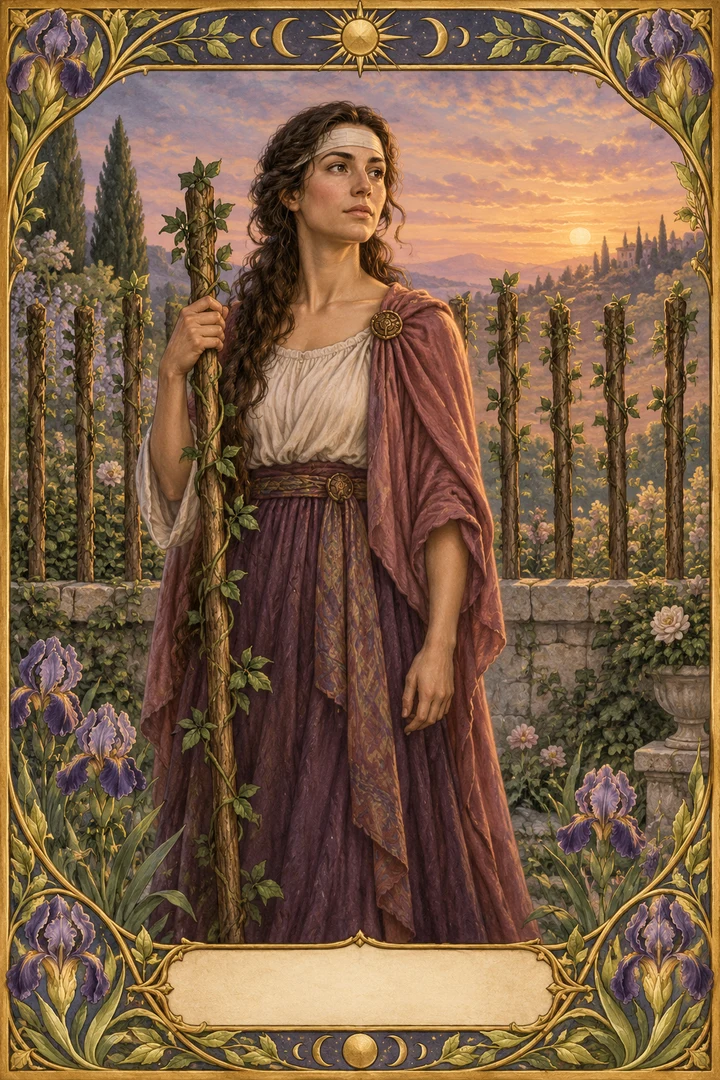
Experience can protect you; it can also leave you needing a place to rest.
Read the full guide ↗
Two of Wands
Choosing a horizon while keeping one foot in the life you have.
Read the full guide ↗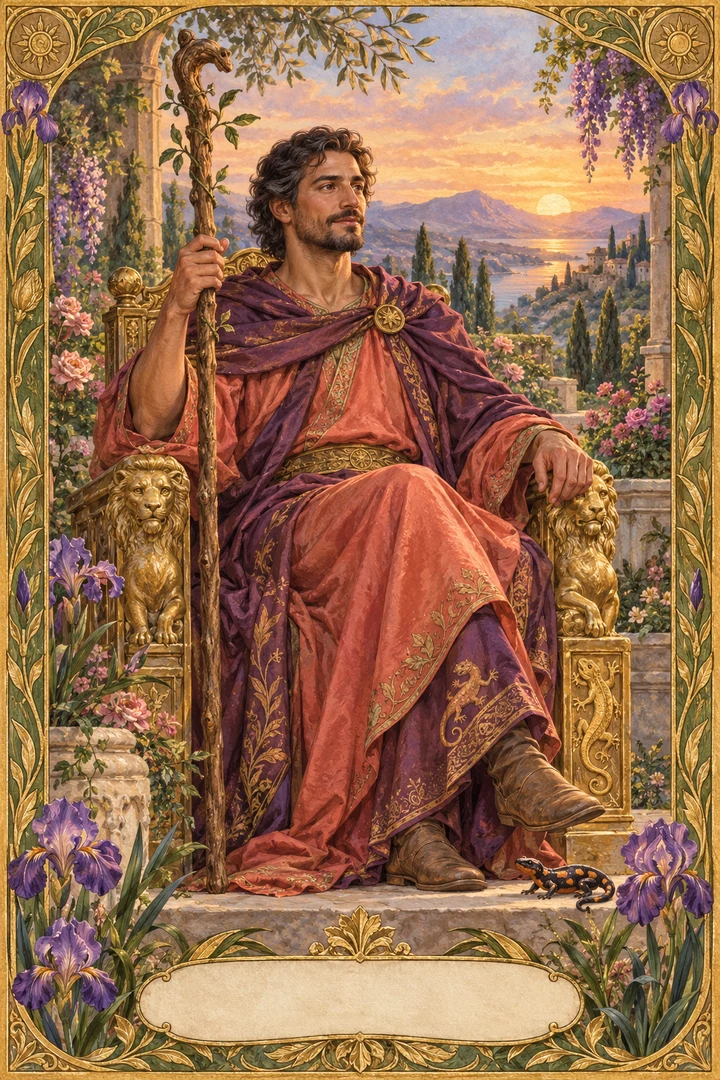
King of Wands
A direction becomes trustworthy when the person setting it also carries responsibility.
Read the full guide ↗