Three of Cups: upright, reversed, love & yes or no
A little shared delight: friendship, celebration and a place at the table without having to perform.
If this feels familiar
You may be the friend who remembers other people's small good news and makes sure it gets a response. Your own good moments deserve that attention too. You can tell somebody what you are pleased about without making it sound more impressive. There can be room for your quiet delight at the table.
A line to keep
My joy deserves a place at the table.
- Upright meaning
- Friendship · shared joy · celebration · community · recognition
- Three of Cups reversed
- Social exhaustion · exclusion · forced cheer · a gathering that does not fit
Upright meaning
Upright, the Three of Cups is commonly read through friendship, celebration and support within a group. The scale can be small: tea after a difficult week, people noticing a finished task or a familiar table where you can be quiet. Ask whether there is room for everybody to contribute and receive attention. Shared pleasure can be part of ordinary life without a major achievement to justify it.
You complete something that took effort and tell two friends. You might suggest a simple meal rather than immediately moving to the next task. The invitation lets your good news have witnesses without requiring an impressive celebration.
Three of Cups reversed
Reversed, examine the shape of your social life. A gathering may be tiring, a group may leave somebody out or you may keep agreeing to plans that do not fit your capacity. The issue could be timing, noise, conversation or an unspoken expectation to entertain. Name that detail before dismissing every relationship in the group. You can want company and need a different arrangement.
After a busy week, a loud evening feels like another task. Decline or suggest a shorter visit with one person. If you do attend, saying when you need to leave can make the limit easier to respect.
Three of Cups in love and relationships
In love, the Three can invite a wider view of affection: friendships, community and a shared world around a couple. Being single does not place you outside the theme. Reversed, check whether your social arrangements leave room for both people and for quieter forms of closeness.
If one partner enjoys group evenings and the other needs quiet time, discuss how often each arrangement feels welcome. Include time for friendships and time together, rather than asking one preference to prove how much either person cares.
Three of Cups: yes or no?
Upright often leans yes to a welcome gathering, asking for support or acknowledging good news. Keep your capacity among the conditions. Reversed, pause before joining an arrangement that has repeatedly left you depleted or excluded. You may choose a smaller form of connection instead; the reading cannot guarantee a group's response.
For ‘Should I join the celebration?’, an upright answer may fit a short visit you want to make. Reversed, ask whether you would be saying yes from interest or obligation. A warm message or another meeting can also express care.
A yes/no lean is a storytelling convention, not a probability or reliable prediction. Check real information before acting, especially about safety, money or another person's intentions.
Work, study and creative life
At work and in study, the Three offers an image for recognising shared effort. Give credit to the person who checked details, made a handover easier or helped somebody understand a task. Reversed, notice whether celebration has become compulsory sociability or whether the same few voices receive all the attention.
At a project review, name one specific contribution from each person rather than thanking ‘the team’ in the abstract. A brief acknowledgement during working hours can include people who cannot join an evening event.
How this card differs from nearby cards
The Two of Cups centres a one-to-one exchange. The Three widens the circle into a shared occasion. The Ten concerns ongoing belonging, while the Four asks about quietness and readiness to receive. These themes need not compete; a person can enjoy a gathering and need rest afterwards.
Common misreadings
Three figures do not prove a romantic third party. Celebration also does not require extroversion, alcohol or being entertaining. Read the quality of inclusion and the occasion you know rather than treating the scene as a literal forecast.
Reading lens, not a verdict
These readings use symbols to reflect on experiences you recognise. They cannot establish events or another person’s private feelings. Reversed meanings explore different ways a theme may be held, blocked or overused; they need not be a simple opposite. Yes/no readings are conditional conventions rather than guarantees.
Traditional symbolism
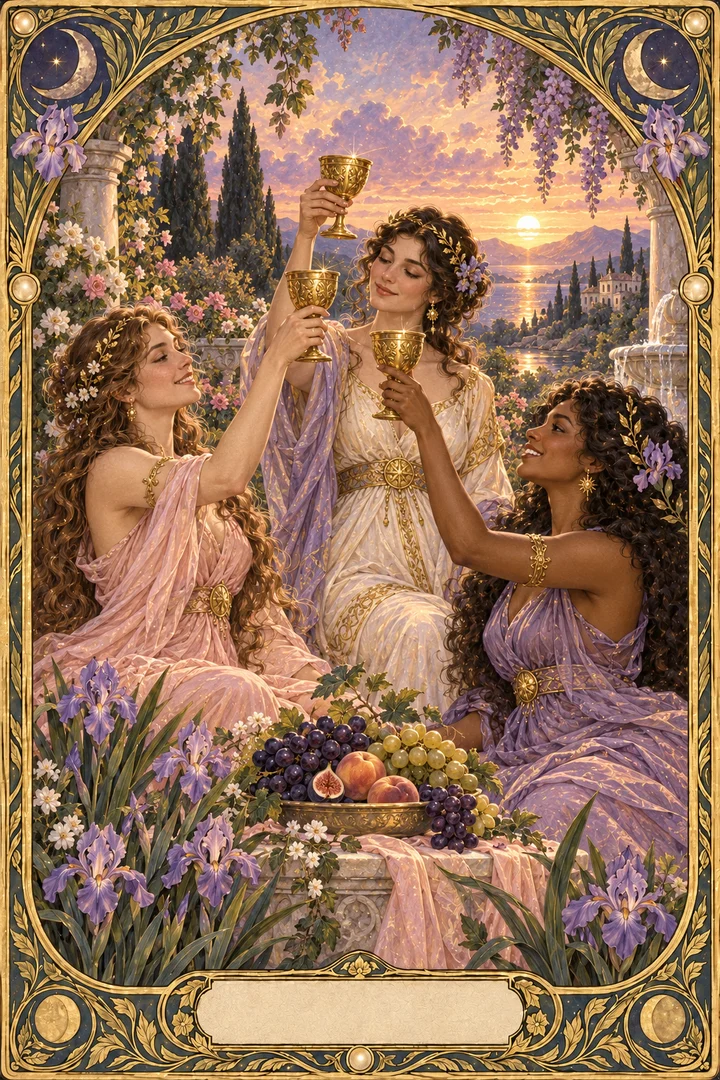
The traditional Three of Cups places three celebrating figures among harvest produce. Selfetti keeps three raised cups and a circle of adults in a flowering garden. The cups meet at a similar height, suggesting a shared moment rather than a single star of the scene. Our flowers and celestial setting are original additions to this familiar celebration.
A question to keep
With whom could I share a small piece of good news?
One small experiment
Tell one person something you are pleased about. Let the sentence stand without immediately minimising it.
Questions worth asking
Does the Three of Cups mean a party?
A party is one possible setting. A quiet meal, shared break or acknowledgement of progress can fit too. The useful question is whether pleasure and attention are shared.
Does the Three of Cups mean a third person in love?
The picture cannot establish a third party or infidelity. It offers themes of a wider social circle and shared affection. Use actual relationship information for questions about trust.
What does the reversed Three of Cups mean?
Here it can fit social exhaustion, exclusion or a gathering that leaves little room for your needs. Identify the detail that feels difficult, then consider changing the arrangement.
How is it different from the Ten of Cups?
The Three highlights an occasion of shared joy. The Ten highlights sustained belonging in a household or chosen family. A good celebration can contribute to belonging without proving that every need is met.
How to use this interpretation
These are symbolic prompts, not measured personality traits or predictions. Keep a real example beside any interpretation; you can disagree. Do not infer another person's feelings, health or financial outcomes from a card or sign.
Sources and method
V&A · Tarot · Selfetti · A. E. Waite · 1910
Historical image reference: A. E. Waite, The Pictorial Key to the Tarot (1910), illustrated by Pamela Colman Smith. Selfetti uses the traditional image as a starting point. The contemporary interpretations, including reversed and conditional yes/no readings, life examples, recognition passage and keepsake line are our own editorial treatment. Our original illustrations adapt the scenes with a celestial garden setting and inclusive adult figures.
Selfetti ·
Keep exploring

Two of Cups
Meeting at the same height: mutual attention, affection and enough room for two different people.
Read the full guide ↗
Ten of Cups
A place to belong as a whole person, with differences and difficult days allowed inside.
Read the full guide ↗
Four of Cups
When offers are present but desire is quiet: a pause to notice what you are ready to receive.
Read the full guide ↗