Two of Cups: upright, reversed, love & yes or no
Meeting at the same height: mutual attention, affection and enough room for two different people.

If this feels familiar
You may recognise the effort of wanting to meet somebody halfway while keeping your own shape. Perhaps it feels easier to accommodate a preference than to say yours aloud. Your willingness to consider another person can sit beside an honest request. You deserve to be present in the relationship you are helping to make.
A line to keep
I can meet you without leaving myself behind.
- Upright meaning
- Reciprocity · mutual attention · partnership · agreement · respect
- Two of Cups reversed
- Unequal effort · missed communication · unspoken needs · a rhythm to revisit
Upright meaning
Upright, the Two of Cups is often associated with mutual attention and partnership. Look for ordinary signs of an exchange: an invitation receives an answer, both people can suggest an arrangement and differences can be spoken. Reciprocity need not mean identical gestures or exactly equal message counts. It means neither person's needs disappear from the arrangement. A welcome meeting can be meaningful while leaving its future open.
You prefer a quiet dinner; a friend prefers a walk. Discuss the time, place and energy each of you has rather than treating one preference as the default. A shared plan can include both a short walk and somewhere to sit.
Two of Cups reversed
Reversed, the theme may fit uneven effort, missed communication or a rhythm that no longer feels comfortable. Name something observable before explaining why it happened. Who initiates? Are plans kept? Can you ask for a change? A conversation may reveal a manageable difference, or it may show that the other person is unwilling to meet the need. Give their actual response weight.
If you have arranged every meeting lately, try, ‘I would like to see you again. Would you choose a day this time?’ This makes the request clear and gives you something concrete to notice, without assuming what the earlier imbalance meant.
Two of Cups in love and relationships
In love, the Two can frame a wish to be met rather than simply admired. Ask whether both people can express intentions, choose a pace and say no without losing respect. Reversed, discuss the particular mismatch instead of asking a card to reveal a hidden explanation. Warmth and willingness need to appear in the real exchange.
One person likes frequent messages; the other wants fewer interruptions. Ask what kind of contact feels reassuring and realistic for each. An agreement you can both keep is more useful than a rule copied from another couple.
Two of Cups: yes or no?
Upright often leans toward a conditional yes to an invitation or partnership when mutual willingness is visible. Reversed leans toward clarifying the agreement before proceeding. The condition is an exchange you can actually observe, rather than hoping that your effort will create the other person's commitment.
For ‘Should I suggest another meeting?’, an upright reading may support one clear invitation. If earlier plans repeatedly went unanswered, the reversed theme invites checking whether you want to continue carrying the invitation alone. The card cannot supply the recipient's answer.
A yes/no lean is a storytelling convention, not a probability or reliable prediction. Check real information before acting, especially about safety, money or another person's intentions.
Work, study and creative life
For work and study, the Two can stand for a collaboration with clear exchange and mutual regard. Different skills can complement each other when responsibilities and feedback are discussed. Reversed, check whether one person has become responsible for all the invisible coordination as well as their own tasks.
Before a shared assignment, agree who handles research, writing and arranging the final review. Put the coordination on the list too. Both partners should be able to ask for a change if the work grows.
How this card differs from nearby cards
The Ace of Cups opens feeling; the Two adds response from another person. The Six brings familiar care and memory. The Ten widens the image into shared belonging. The Two is especially useful when your question concerns the exchange happening now.
Common misreadings
Two cups do not prove a soulmate, perfect compatibility or lifelong agreement. The card can describe friendship, collaboration and romance. Its number also cannot establish how many people are involved in a private relationship.
Reading lens, not a verdict
These readings use symbols to reflect on experiences you recognise. They cannot establish events or another person’s private feelings. Reversed meanings explore different ways a theme may be held, blocked or overused; they need not be a simple opposite. Yes/no readings are conditional conventions rather than guarantees.
Traditional symbolism
The traditional Two of Cups shows two people exchanging cups beneath a winged lion and paired serpents. Selfetti depicts two adult women, one with warm brown skin and one East Asian, offering their cups at equal height. This is our original inclusive adaptation of the exchange. Their equal positions invite a question about how both people can affect the relationship.
A question to keep
Where could the exchange make more room for both of us?
One small experiment
Choose one relationship and one specific request. Say what would help, then notice the answer rather than guessing it.
Questions worth asking
Does the Two of Cups mean mutual love?
Mutual attention is a common theme. To know whether love is shared, look at the other person's words and behaviour. A card offers a question about reciprocity; it cannot establish their feelings.
Can the Two of Cups represent friendship?
Yes. A friendship, partnership or collaboration can all involve two people responding to each other. The quality of the exchange matters more than the relationship label.
Does the reversed Two of Cups mean a breakup?
It can fit uneven effort or a missed connection, but it does not establish a breakup. Name the mismatch and see whether both people are willing to examine it.
How is the Two different from the Ten of Cups?
The Two focuses on a mutual exchange. The Ten concerns a broader sense of shared belonging, often across a household or chosen family. A pleasant meeting and an enduring home are different scales of experience.
How to use this interpretation
These are symbolic prompts, not measured personality traits or predictions. Keep a real example beside any interpretation; you can disagree. Do not infer another person's feelings, health or financial outcomes from a card or sign.
Sources and method
V&A · Tarot · Selfetti · A. E. Waite · 1910
Historical image reference: A. E. Waite, The Pictorial Key to the Tarot (1910), illustrated by Pamela Colman Smith. Selfetti uses the traditional image as a starting point. The contemporary interpretations, including reversed and conditional yes/no readings, life examples, recognition passage and keepsake line are our own editorial treatment. Our original illustrations adapt the scenes with a celestial garden setting and inclusive adult figures.
Selfetti ·
Keep exploring

Ace of Cups
A tender beginning: noticing a feeling, offering it a few words and making room to receive care.
Read the full guide ↗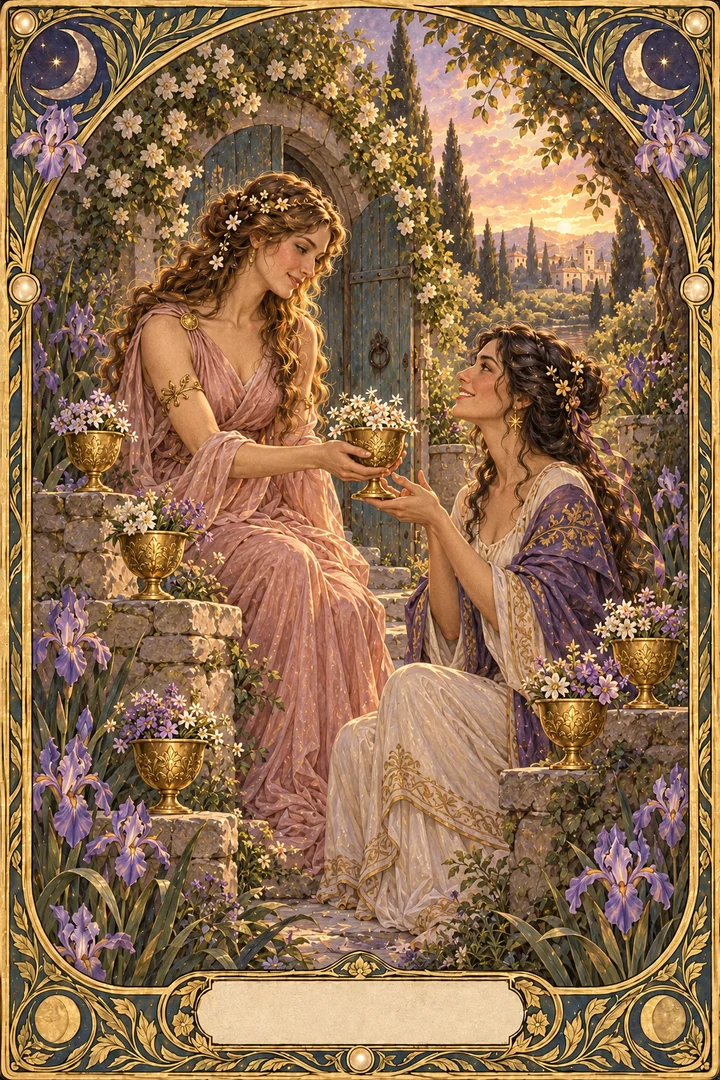
Six of Cups
Familiar kindness and small memories, with room for the person you have become.
Read the full guide ↗
Ten of Cups
A place to belong as a whole person, with differences and difficult days allowed inside.
Read the full guide ↗