Six of Cups: upright, reversed, love & yes or no
Familiar kindness and small memories, with room for the person you have become.
If this feels familiar
You may keep the small memories that give a friendship its texture: a shared joke, a familiar route, a cup made the way somebody likes it. That care can travel with you as you grow. You are allowed to have new needs and preferences even when others remember an older version of you fondly.
A line to keep
I can cherish the past and meet myself today.
- Upright meaning
- Memory · familiar kindness · simple care · reunion · an old pleasure
- Six of Cups reversed
- An old role outgrown · nostalgia crowding the present · renewed perspective · growing
Upright meaning
Upright, the Six of Cups is often read through memory, kindness and the comfort of something familiar. A person may remember how you take your tea, or an old activity may still offer pleasure. Let the memory be specific instead of declaring the whole past better. Familiarity can support a present exchange when both people have room to change. You can enjoy a remembered kindness and still notice what is different today.
An old friend remembers a place you both liked. Suggest revisiting it, then ask what they enjoy now. The meeting can hold a shared memory without requiring either of you to remain the person you were years ago.
Six of Cups reversed
Reversed, examine whether an old role or idealised memory is taking too much space. People may still expect the easygoing child, the organiser or the person who never needed help. You may also be finding a new relationship with the past: keeping what you value and recognising what you have outgrown. Ask which remembered detail is useful in the present, and which expectation needs updating.
At a reunion, somebody assumes you will make all the arrangements as you used to. You can say, ‘I would like to join, but I cannot organise this time.’ A familiar relationship can be given a current boundary.
Six of Cups in love and relationships
In love, the Six can frame familiar affection, shared history or nostalgia about a past connection. A memory is an experience you carry; it does not establish what the other person wants now. Reversed, notice whether you are comparing a present relationship with an edited version of the past or asking somebody to stay in an old role.
A familiar song reminds you of an earlier relationship. You can enjoy or grieve the memory without making contact automatically. If you do consider reaching out, account for the present circumstances and any stated boundaries.
Six of Cups: yes or no?
Upright may lean yes to a welcome reconnection or revisiting a simple pleasure, if present circumstances support it. Reversed invites checking whether you want the actual experience or its remembered version. Neither orientation supplies permission to cross somebody's boundary or guarantees that the past can be restored.
For ‘Should I suggest seeing an old friend?’, one respectful invitation may fit when contact is welcome. For ‘Will it be exactly as before?’, the card cannot promise that. Leave room for the current versions of both people.
A yes/no lean is a storytelling convention, not a probability or reliable prediction. Check real information before acting, especially about safety, money or another person's intentions.
Work, study and creative life
For work and study, the Six can highlight a useful skill, old interest or a supportive practice worth revisiting. Check what still fits instead of repeating a method because it once worked. Reversed, the question may concern outgrowing a role or updating an assumption about what you can do.
You enjoyed drawing before it became a graded task. Try a small private sketch without using it to prove your ability. The old interest can meet your current life in a lighter form.
How this card differs from nearby cards
The Two of Cups centres reciprocity now. The Six brings memory and familiar care into that exchange. The Five concerns a loss or unmet hope; the Ten concerns belonging built and maintained in the present. A cherished memory and a workable current relationship are different things to examine.
Common misreadings
The Six is sometimes treated as certain evidence that an ex will return. Nostalgia does not establish anybody's intention. Its traditional children also do not make this a prediction about pregnancy or a fixed instruction to behave as you did in childhood.
Reading lens, not a verdict
These readings use symbols to reflect on experiences you recognise. They cannot establish events or another person’s private feelings. Reversed meanings explore different ways a theme may be held, blocked or overused; they need not be a simple opposite. Yes/no readings are conditional conventions rather than guarantees.
Traditional symbolism
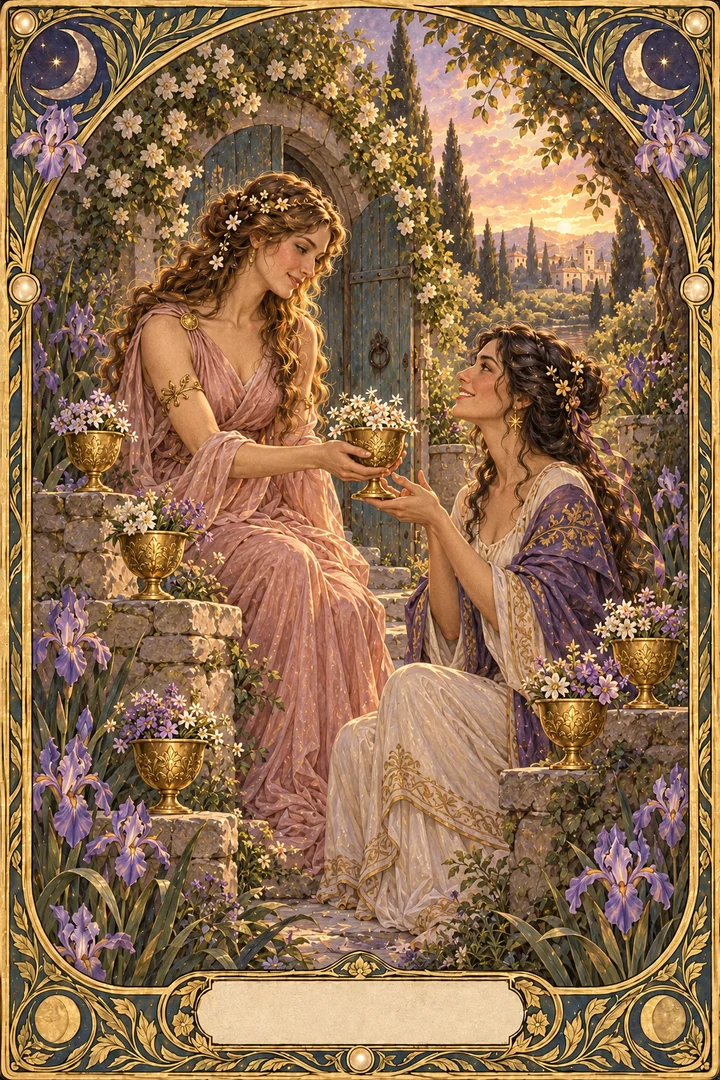
The traditional Six of Cups shows children in a sheltered garden with flower-filled cups. Selfetti adapts this into two adult childhood friends meeting again. One offers a flower cup and five others stand around the garden, making six. The adult reunion is our illustration's story; the floral cups and sheltered setting retain the historical image's familiar details.
A question to keep
What would I like to keep, and what needs room to change?
One small experiment
Choose one remembered kindness or activity. Adapt it to a small present-day gesture, with respect for everybody's current needs.
Questions worth asking
Does the Six of Cups mean an ex is coming back?
It can accompany reflection on the past, but it cannot establish a return or current feelings. Use present words, behaviour and boundaries when deciding whether contact is appropriate.
What does the reversed Six of Cups mean?
Here it can fit an old role outgrown, nostalgia dominating the present or a new perspective on memory. Ask what still supports you and what expectation needs updating.
Can the Six of Cups represent friendship?
Yes. Familiar kindness, shared history and simple care fit friendship well. The meaning need not be romantic or involve a literal childhood reunion.
Why are Selfetti's figures adults?
Our illustration adapts the traditional children's garden into a reunion of adult childhood friends. The six flower-filled cups remain. We describe this original adaptation separately from the historical image.
How to use this interpretation
These are symbolic prompts, not measured personality traits or predictions. Keep a real example beside any interpretation; you can disagree. Do not infer another person's feelings, health or financial outcomes from a card or sign.
Sources and method
V&A · Tarot · Selfetti · A. E. Waite · 1910
Historical image reference: A. E. Waite, The Pictorial Key to the Tarot (1910), illustrated by Pamela Colman Smith. Selfetti uses the traditional image as a starting point. The contemporary interpretations, including reversed and conditional yes/no readings, life examples, recognition passage and keepsake line are our own editorial treatment. Our original illustrations adapt the scenes with a celestial garden setting and inclusive adult figures.
Selfetti ·
Keep exploring
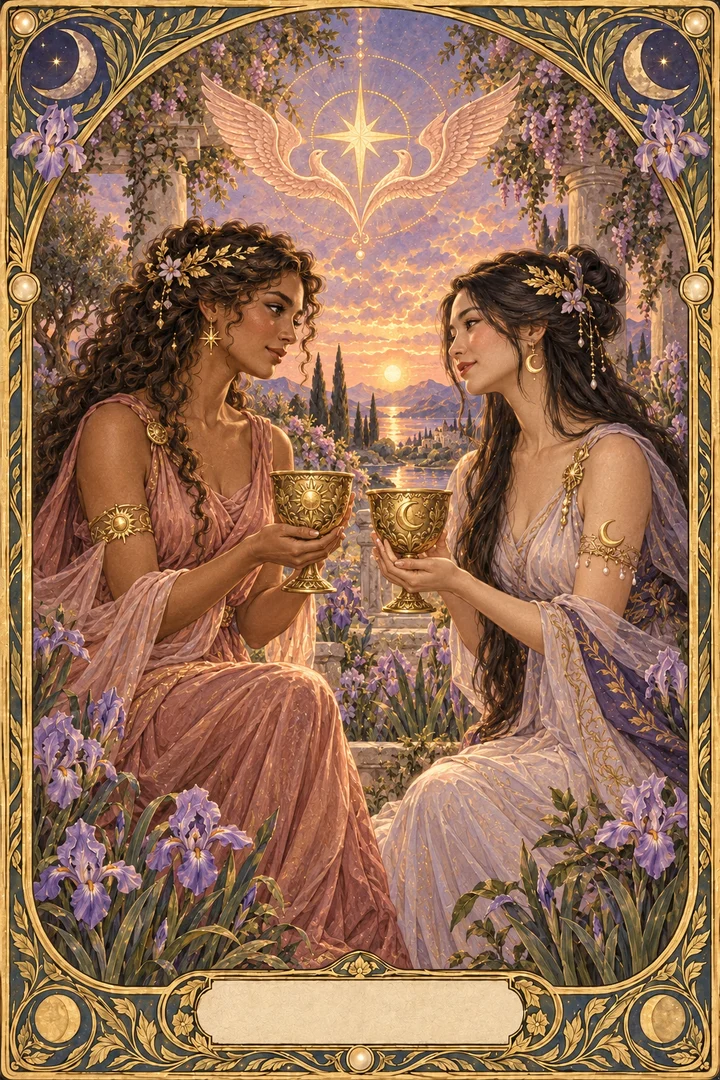
Two of Cups
Meeting at the same height: mutual attention, affection and enough room for two different people.
Read the full guide ↗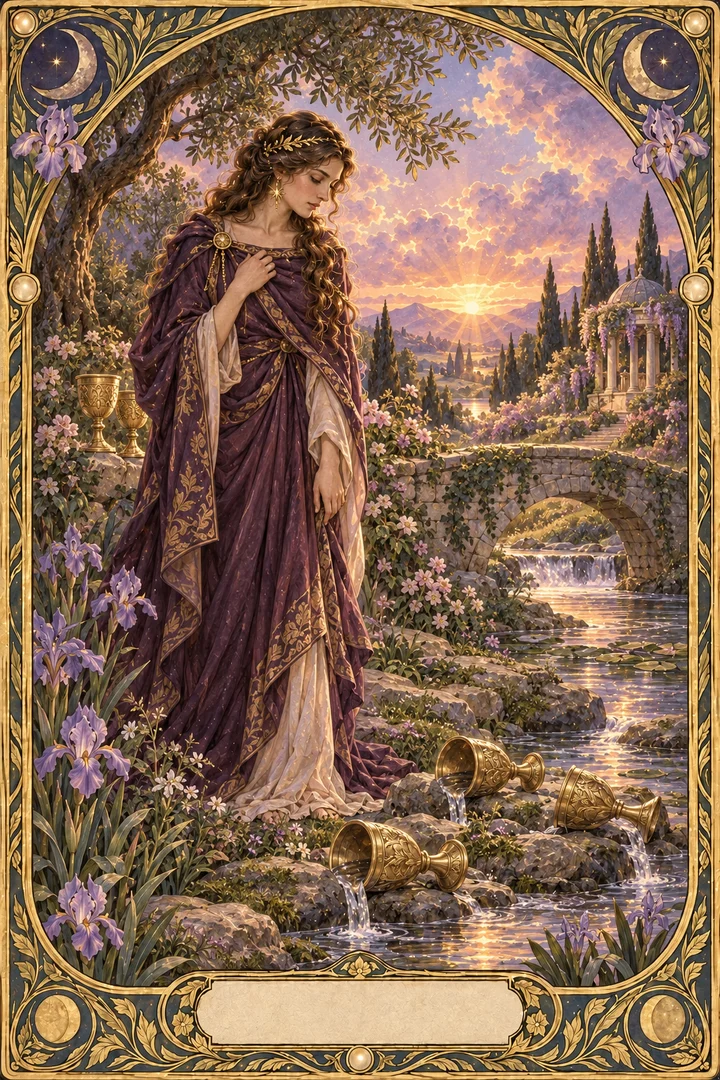
Five of Cups
What you hoped for can matter, even when the loss looks small to somebody else.
Read the full guide ↗
Ten of Cups
A place to belong as a whole person, with differences and difficult days allowed inside.
Read the full guide ↗