Three of Pentacles: upright, reversed, love & yes or no
Good work grows when different skills can speak to one another.
If this feels familiar
You can have something useful to offer and still need another person's perspective. Asking for feedback does not make your contribution smaller. Work can feel better when it is seen before it is perfect, and when the person reviewing it respects the craft already present. You do not have to carry the whole arch alone.
A line to keep
My contribution can grow through a real exchange.
- Upright meaning
- Collaboration · craft · feedback · clear roles · mutual respect
- Three of Pentacles reversed
- Unclear roles · unheard expertise · disconnected work · feedback without respect
Upright meaning
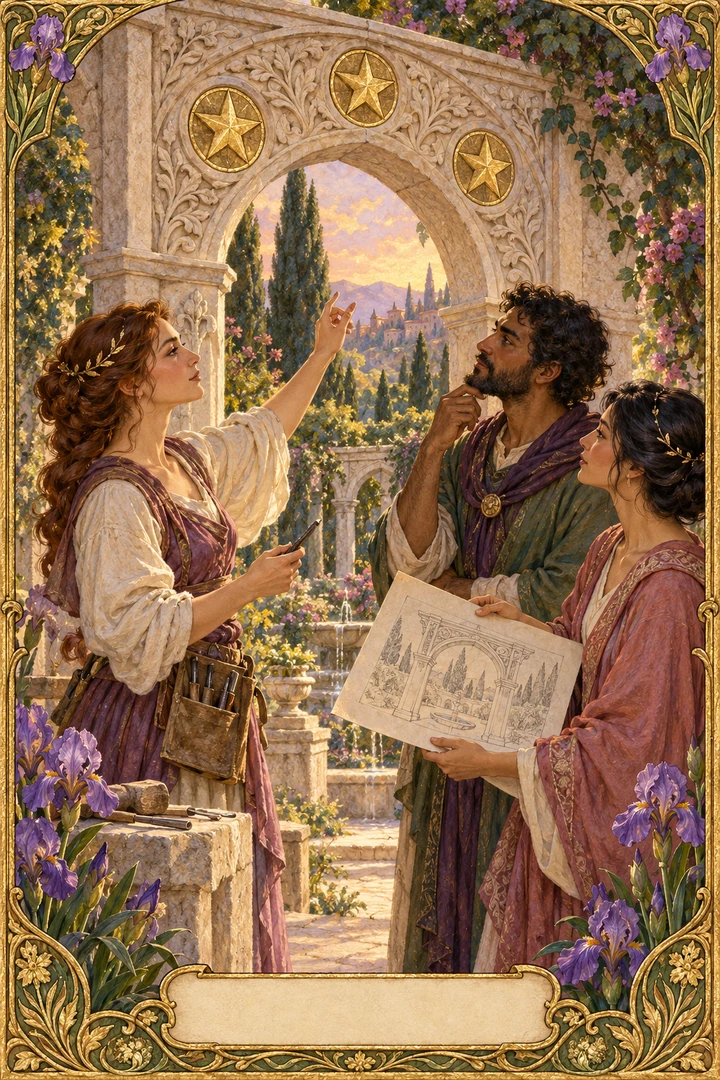
The Three of Pentacles is often read as a working collaboration: different skills meeting around a shared task, with room for questions and review. A craftsperson and two companions discuss an unfinished arch, and each brings something the others do not. The card does not promise that teamwork will be smooth. It asks whether roles, standards and credit are clear enough for expertise to be heard. Include planning and feedback in the agreement, not only at the end.
On a shared assignment, one person researches, one drafts and one checks the structure. You agree how feedback will be given and who coordinates the final version. A short check-in halfway through prevents one person from silently doing all the joining-up work.
Three of Pentacles reversed
Reversed, the Three can fit unclear roles, expertise that goes unheard or work that feels disconnected from the people doing it. Feedback may arrive without respect, or a decision may be made away from the unfinished work. Bring the actual draft and the decision into the same conversation. Asking for clarity is not an admission of incompetence, and naming a gap is part of the craft.
You have been revising a document alone while two colleagues give conflicting notes. Instead of guessing, you ask for one meeting with the draft on the table. You say what you need decided and who will own the next version.
Three of Pentacles in love and relationships
In love, the Three asks about practical cooperation. Shared life includes concrete tasks, and affection does not automatically make coordination easy. Discuss one real responsibility and what each person will own, rather than assuming the other will notice what needs doing. Reversed, check whether one person's effort or knowledge is being overlooked. A fair arrangement can be talked about without turning it into a scoreboard.
You and your partner keep disagreeing about household admin. You sit down with the actual list, divide it by preference and time, and agree to review it in a month. The conversation is about the task, not about who cares more.
Three of Pentacles: yes or no?
In a yes/no convention, upright leans toward a conditional yes to collaborating when roles, standards and feedback are agreed. The condition is that the arrangement is clear enough to work. Reversed, pause and clarify where effort or credit is unequal. Neither orientation guarantees promotion, talent or automatic team harmony; tarot readers do not share one universal yes/no rule.
For ‘Should I join this project?’, an upright yes can support saying yes once you know your role and how decisions will be made. For ‘Will the team appreciate my work?’, the answer depends on the actual exchange, not on the card alone.
A yes/no lean is a storytelling convention, not a probability or reliable prediction. Check real information before acting, especially about safety, money or another person's intentions.
Work, study and creative life
At work and in study, the Three supports asking for specific feedback on a draft and making responsibilities visible. A good team does not depend on one person silently doing all the joining-up work. Name what you are contributing and what you need from others. Reversed, notice whether your expertise is being ignored or whether you are withholding it. A clear request can reopen a stalled exchange.
Before a deadline, you send a draft to a colleague and ask one focused question about structure. You also state which parts you will revise yourself. The exchange stays useful because the request is specific and the ownership is clear.
How this card differs from nearby cards
The Three combines different skills around a shared task. The Eight of Pentacles practises a skill through repetition and focus. The Six of Pentacles explores how resources are given and received. The Three of Cups celebrates companionship rather than a working agreement. These are different questions, not guaranteed stages of a project or a relationship.
Common misreadings
Three figures do not prove a third party in a relationship. The image is not a promise of promotion, talent or automatic team harmony. It also does not mean that collaboration is always the right answer; some work is done alone. Keep the interpretation near the actual task and the people involved.
Reading lens, not a verdict
These readings use symbols to reflect on experiences you recognise. They cannot establish events, financial outcomes or another person's private feelings. Reversed meanings explore how a theme may be internal, blocked or overused; they are a separate reference, since the one-card draw uses upright cards. Yes/no interpretations are conditional editorial conventions, not guarantees or a universal rule.
Traditional symbolism
The traditional Three of Pentacles shows a craftsperson at work in a stone arch, with two figures holding plans and three pentacles set into the stone. Selfetti keeps the arch, the tool and the unlettered drawing, and sets the scene in a garden with three adult collaborators. We read the three coins as separate contributions that are countable and visible. The garden and the diverse figures belong to our adaptation; they do not add a hidden symbol or a separate prediction.
A question to keep
What part of this work needs another person's perspective?
One small experiment
Show one unfinished piece to an appropriate collaborator. Ask one specific question, and agree who owns the next revision.
Questions worth asking
Does Three mean a third party?
No. The three figures represent different skills meeting around a shared task. The card does not indicate a third person in a relationship. Read it as a question about collaboration, roles and feedback in the work itself.
How is it different from Eight?
The Three is about combining different skills with others. The Eight is about practising one skill through repetition and focus. One asks how contributions meet; the other asks how a craft is developed alone.
What if one person's expertise is ignored?
That fits the reversed reading. Bring the unfinished work and the decision into the same conversation. Ask for specific feedback and clarify who owns the next revision. A request for clarity is not an admission of incompetence.
Can collaboration include asking for help?
Yes. Asking for help is part of a working exchange, not a failure of skill. Name what you need and leave room for the other person's answer. Clear roles make it easier for expertise to be heard.
How to use this interpretation
These are symbolic prompts, not measured personality traits or predictions. Keep a real example beside any interpretation; you can disagree. Do not infer another person's feelings, health or financial outcomes from a card or sign.
Sources and method
V&A · Tarot · Selfetti · A. E. Waite · 1910
Historical image reference: A. E. Waite, The Pictorial Key to the Tarot (1910), illustrated by Pamela Colman Smith. The contemporary readings, life examples, recognition passages and keepsake lines are Selfetti's own editorial interpretation, including the conditional yes/no and reversed themes. Our original celestial garden illustrations adapt the traditional scenes with inclusive figures; ornamental flowers and frames do not add predictions. The one-card draw uses upright cards; reversed meanings are a separate reference.
Selfetti ·
Keep exploring
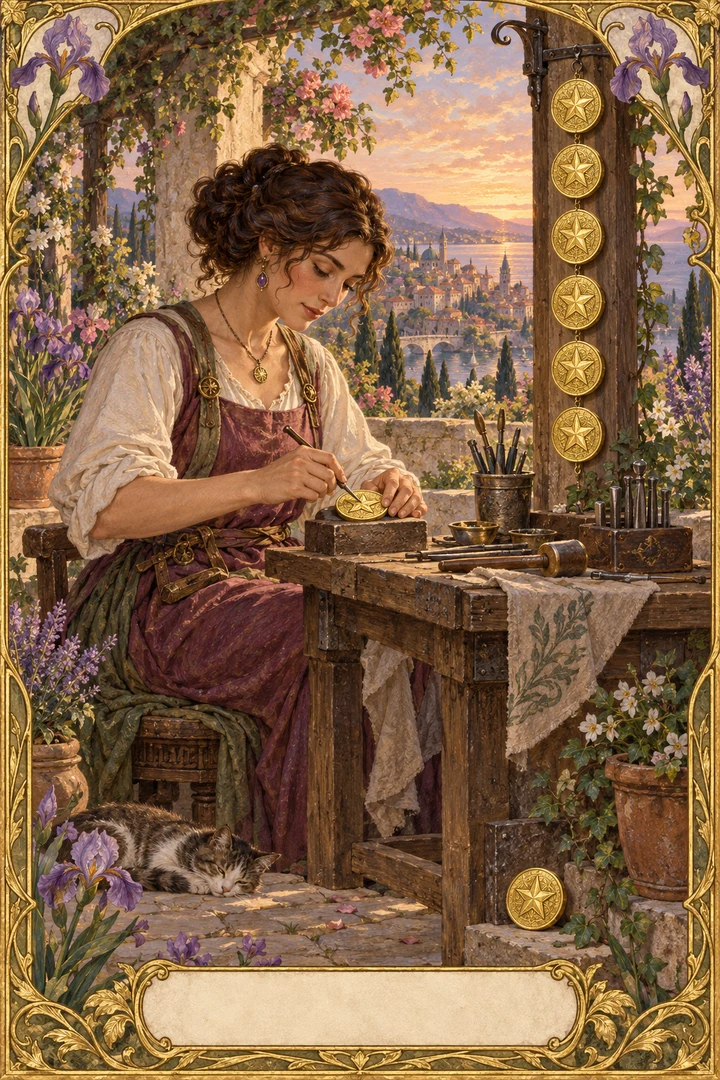
Eight of Pentacles
A skill becomes yours through attentive practice, with room for an imperfect version.
Read the full guide ↗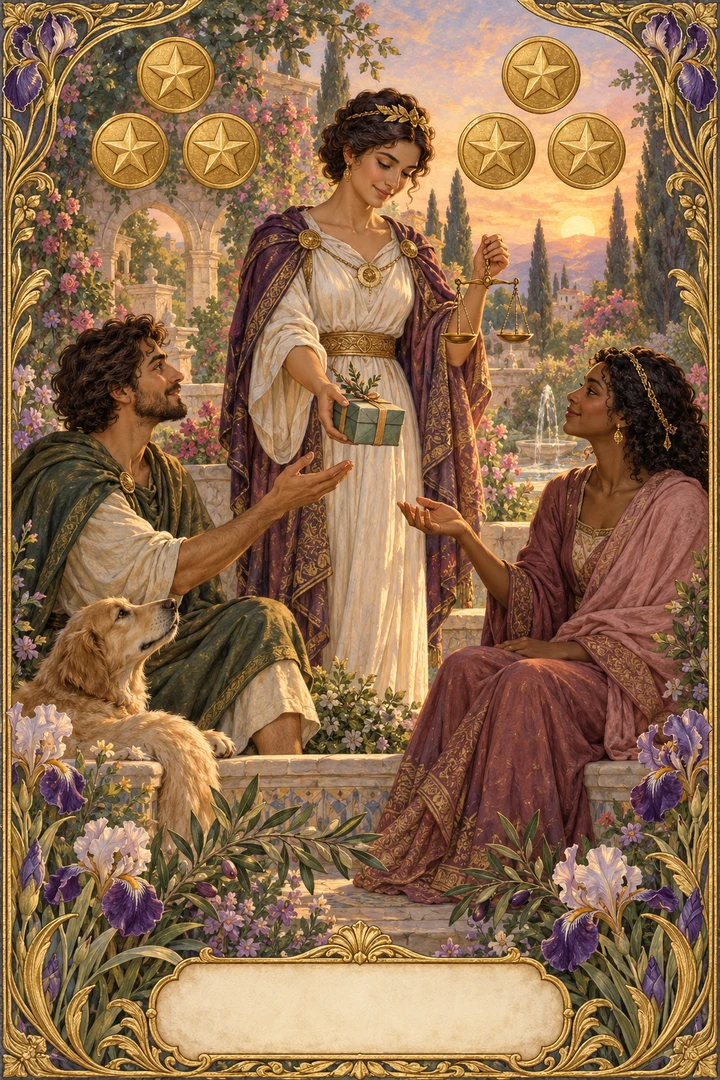
Six of Pentacles
Care becomes fairer when giving and receiving both leave room for choice.
Read the full guide ↗
Page of Pentacles
A useful skill can begin with a learner's attention and a small piece of ground.
Read the full guide ↗