Five of Pentacles: upright, reversed, love & yes or no
Difficulty deserves practical support, rather than a verdict on your worth.

If this feels familiar
You may have become used to making a hard week sound manageable. You do not have to disguise a need to deserve respect. One honest request can let someone stand beside you without explaining your whole life. Perhaps you have been carrying a practical worry alone, or you have been the one everyone leans on. The Five of Pentacles invites you to let a small, specific need be visible. You are not asking for rescue, only for company or a concrete step.
A line to keep
My need deserves care, not shame.
- Upright meaning
- Hardship · feeling outside · unmet practical needs · companionship · accessible help
- Five of Pentacles reversed
- Support becoming reachable · difficulty asking · a gradual repair · needs to name
Upright meaning
The Five of Pentacles often speaks to a period when something essential is missing: money, warmth, health, belonging or a sense of being seen. The traditional image of two figures in snow outside a lit window can frame that experience without turning it into a forecast. The card does not say your difficulty is permanent or deserved. It asks you to identify the immediate need and look for what assistance is genuinely available. Companionship matters here: you do not have to carry the whole weight alone, and help may come from a person, a service or a small practical step.
An unexpected household repair leaves you short and isolated. You ask a trusted neighbour for a specific favour, such as a lift to the shop or an hour of company while you sort out the next step. The action is naming one concrete need and letting someone respond.
Five of Pentacles reversed
Reversed, the Five of Pentacles can suggest that support is becoming reachable, or that asking still feels hard. You may be checking the terms of available help and whether you can actually access it. Improvement can be gradual and does not mean the difficulty was imaginary. This orientation may also point to an internal sense of exclusion that persists even when practical circumstances shift. Name what you need, and notice whether the route to help is open, blocked or simply unfamiliar.
You have been managing a health issue alone, telling yourself it is not serious enough to mention. A friend offers to go with you to an appointment. You say yes, and together you look up the practical details. The step is small, but the isolation begins to loosen.
Five of Pentacles in love and relationships
Loneliness can occur inside or outside a relationship. The Five of Pentacles asks you to name a concrete form of support and notice the reply. It cannot establish abandonment or reveal another person's feelings. If you are partnered, you might say, ‘I have been feeling far away from you lately. Could we spend an hour together without distractions?’ If you are single, the card can point to the need for companionship rather than a verdict on your desirability. The focus stays on what you can ask for and what is actually offered.
After a difficult week, you tell your partner, ‘I need a quiet evening with you, not to solve anything, just to be together.’ The request is specific and leaves room for their answer. You are not demanding a feeling, only naming a need.
Five of Pentacles: yes or no?
In a yes/no convention, the Five of Pentacles leans toward a conditional yes to seeking accessible support, and a pause on any new commitment that would deepen an unmet need. The card cannot determine financial or medical outcomes. If you are asking whether to ask for help, the answer may be yes, provided you can identify a real route. If you are asking whether to take on more, the card suggests checking your capacity first. No universal rule governs yes/no readings.
For ‘Should I apply for the benefit I might qualify for?’, a conditional yes: gather current information and make the call. For ‘Should I lend money I cannot spare?’, the card suggests pausing. The outcome depends on real-world factors, not the draw alone.
A yes/no lean is a storytelling convention, not a probability or reliable prediction. Check real information before acting, especially about safety, money or another person's intentions.
Work, study and creative life
At work or in study, the Five of Pentacles can highlight an unmet practical need: fair pay, reasonable hours, training, childcare or a supportive colleague. Name the need and look for a real support route. For debt, benefits, health or employment rights, use appropriate services and current information rather than drawing a conclusion from the image. The card does not predict job loss or financial ruin. It asks what would make the next week more manageable and who or what could realistically help.
You are struggling to meet a deadline because of caregiving responsibilities. You ask your manager about flexible hours or a temporary adjustment. The conversation is about a practical solution, not a confession of failure.
How this card differs from nearby cards
The Five of Pentacles names hardship and exclusion. The Six of Pentacles explores support with dignity and the balance of giving and receiving. The Four of Pentacles concerns protecting resources and holding on. The Five of Cups centres emotional loss rather than practical need. These are different questions, not a sequence of guaranteed stages. The Five of Pentacles asks what is missing right now and what help is genuinely within reach.
Common misreadings
Snow and crutches do not predict poverty, illness, injury or abandonment. The card is not a verdict on your worth or a sign that you deserve to struggle. Assistance is not always nearby or easy to obtain; difficulty accessing it is not a personal failure. The lit window may represent help that exists but feels out of reach, or a warmth you have not yet noticed. Keep the interpretation close to what you actually recognise in your life.
Reading lens, not a verdict
These readings use symbols to reflect on experiences you recognise. They cannot establish events, financial outcomes or another person's private feelings. Reversed meanings explore how a theme may be internal, blocked or overused; they are a separate reference, since the one-card draw uses upright cards. Yes/no interpretations are conditional editorial conventions, not guarantees or a universal rule.
Traditional symbolism
The traditional Five of Pentacles shows two figures walking through snow past a lit stained-glass window, one on crutches, both seemingly unnoticed. Selfetti keeps the cold evening, the glowing building and the five golden star-coins, but places the pair in a garden setting. Our adaptation gives them dignity and companionship: they walk together, one with simple wooden crutches, the other in a warm plum cloak. A visible nearby doorway suggests that support may be closer than it appears. The five star-coins are clearly separated and countable in the arched window. We read the scene as a moment of practical need and exclusion, not a prediction of poverty or illness.
A question to keep
What immediate need could I name plainly, and who could realistically help?
One small experiment
Name one practical need and one accessible support route. Check what it offers and make a specific request if it fits.
Questions worth asking
Does Five predict poverty or illness?
No. The card is a symbolic image of hardship and exclusion, not a forecast of poverty or illness. It can point to a difficult period, but it does not determine your health, finances or future. Use real-world information and appropriate support for those concerns.
Does reversed Five guarantee recovery?
No. Reversed can suggest that support is becoming reachable or that asking still feels hard. Improvement may be gradual and does not mean the difficulty was imaginary. It is not a guarantee of recovery, only an invitation to check what help is actually available.
What if support is inaccessible?
Difficulty accessing help is not a personal failure. The card acknowledges that assistance may be nearby but out of reach. Name the barrier plainly, look for alternative routes, and consider advocacy services or community resources. You are not required to solve everything alone.
How is it different from Five of Cups?
Five of Pentacles centres practical need, exclusion and material hardship. Five of Cups centres emotional loss, regret and what has spilled. One asks what you need to survive and who can help; the other asks how you grieve and what you can still turn toward.
How to use this interpretation
These are symbolic prompts, not measured personality traits or predictions. Keep a real example beside any interpretation; you can disagree. Do not infer another person's feelings, health or financial outcomes from a card or sign.
Sources and method
V&A · Tarot · Selfetti · A. E. Waite · 1910
Historical image reference: A. E. Waite, The Pictorial Key to the Tarot (1910), illustrated by Pamela Colman Smith. The contemporary readings, life examples, recognition passages and keepsake lines are Selfetti's own editorial interpretation, including the conditional yes/no and reversed themes. Our original celestial garden illustrations adapt the traditional scenes with inclusive figures; ornamental flowers and frames do not add predictions. The one-card draw uses upright cards; reversed meanings are a separate reference.
Selfetti ·
Keep exploring
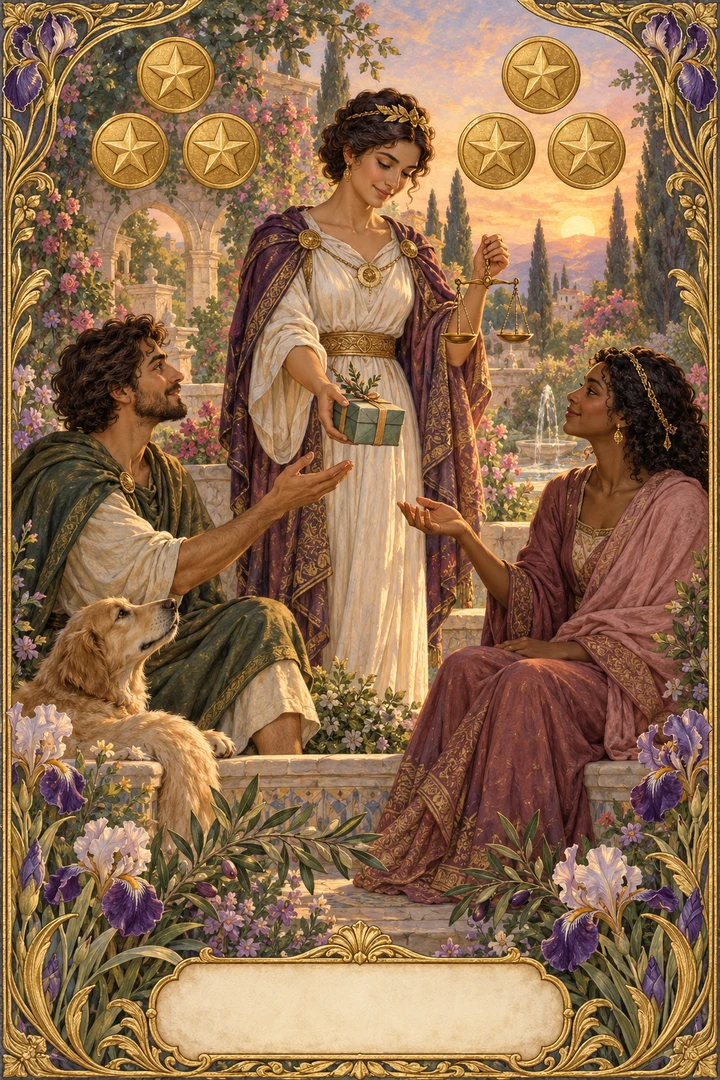
Six of Pentacles
Care becomes fairer when giving and receiving both leave room for choice.
Read the full guide ↗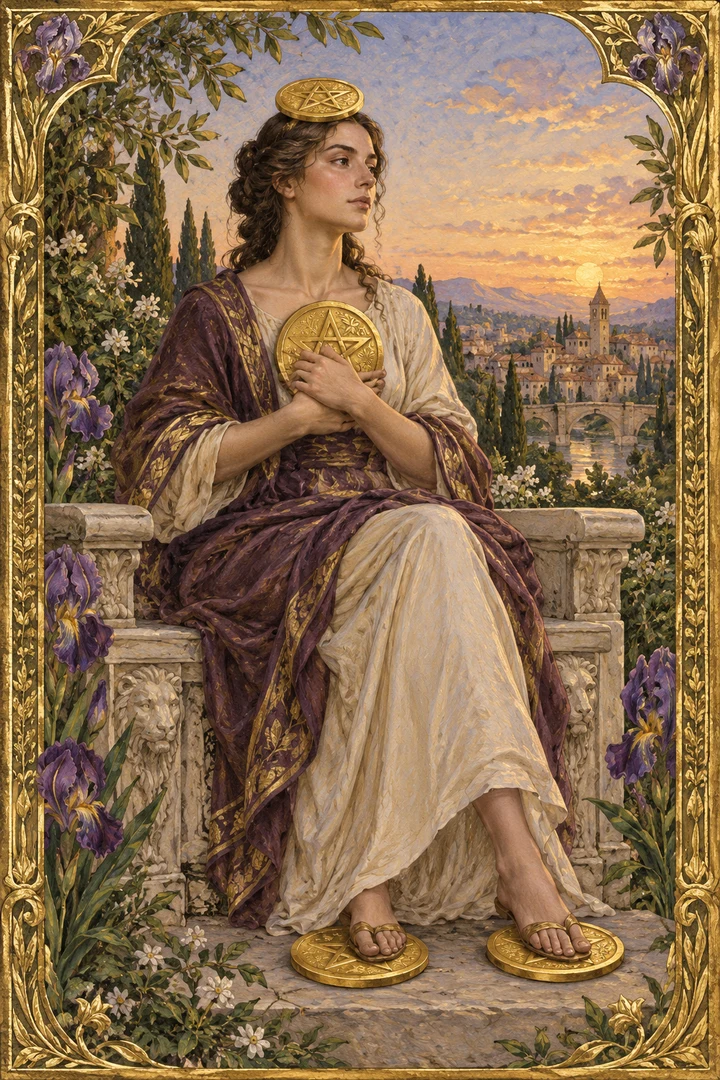
Four of Pentacles
Protecting what supports you, while noticing when protection leaves too little room to live.
Read the full guide ↗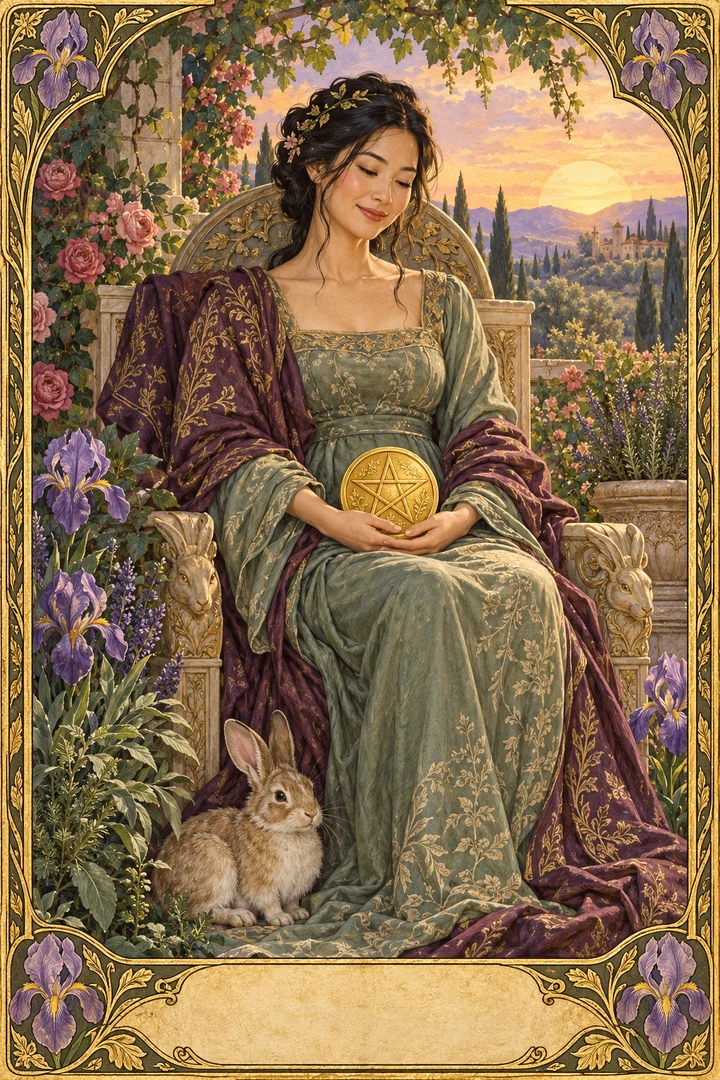
Queen of Pentacles
Practical warmth can include the person doing the caring.
Read the full guide ↗