 00 / SELFETTI
The Fool
What could you try before you feel completely ready?
Explore this card
Selfetti shows an adult traveller in a flowing pale dress near a rocky ledge, accompanied by a small white dog. A bright sun, flowering garden and distant mountains frame the open space. The ledge can suggest a beginning that needs attention to footing; the companion suggests support. This is our original garden adaptation, not a literal reproduction of every historical detail.
- Suppose you keep talking about learning to paint but never book anything. A Fool-shaped step is one evening class, borrowed brushes and no announcement that you are becoming an artist. You find out whether you enjoy the hour. If you do, you decide about the next hour. The beginning stays small enough to survive being wrong about it.
- If you have been circling a conversation, a Fool-shaped opening might be, 'I like this and I do not know yet what I want it to become. Can we talk about that?' It admits the uncertainty instead of performing confidence. Compare that with declaring a future on the second date, or with saying nothing for months to avoid looking eager. The card asks about the honesty of the beginning, not the outcome.
- If you want to move into a new field, a Fool-shaped move is one short course or one conversation with someone doing the work, not a resignation letter. If a project feels stale, try the smallest experiment you can explain to a colleague in a sentence. These are examples of applying the beginning theme; the card does not establish that a job, exam or application will succeed.
Choose a small, reversible first step.
Read the full guide ↗ · One card. A little room for yourself. ↗ 01 / SELFETTI
The Magician
Which tool or skill are you overlooking?
Explore this card
Selfetti shows an adult figure holding a wand upward, with the other hand directed toward a table bearing a cup, sword, coin and wooden staff. An infinity motif floats above, with flowers around the table. The upward gesture and tools at hand frame the tension between an idea and its practical expression. Garden ornament belongs to this original illustration.
- Suppose you keep saying you will start a portfolio once you buy better software. The Magician approach is to make one page with the tools you already own. In a personal situation, the same pattern might be telling a friend, 'I keep talking about this idea; I am going to try one small version this week.' The shift is from describing the plan to producing a first piece of evidence.
- If you keep saying you will make more time, a useful sentence is, 'I want to see you properly, not just text. Are you free Thursday, or should we pick a day that works?' It offers something concrete and leaves room for an answer. Compare that with 'I will make it up to you soon,' which sounds warm but commits to nothing. When reading the card as feelings, treat its theme as a prompt about effort and follow-through; the other person's actual feelings still need their own words and behavior.
- If a job search feels stuck, rewrite one project as a short case study with the problem, your action and the result. If you cannot do that yet, one more course may not solve the problem. In a team, replace 'We should improve our process' with one concrete artifact, such as a shared checklist. These are examples of applying the resourcefulness theme; the card does not establish that an application, exam or pitch will succeed.
Make something small with what you already have.
Read the full guide ↗ · One card. A little room for yourself. ↗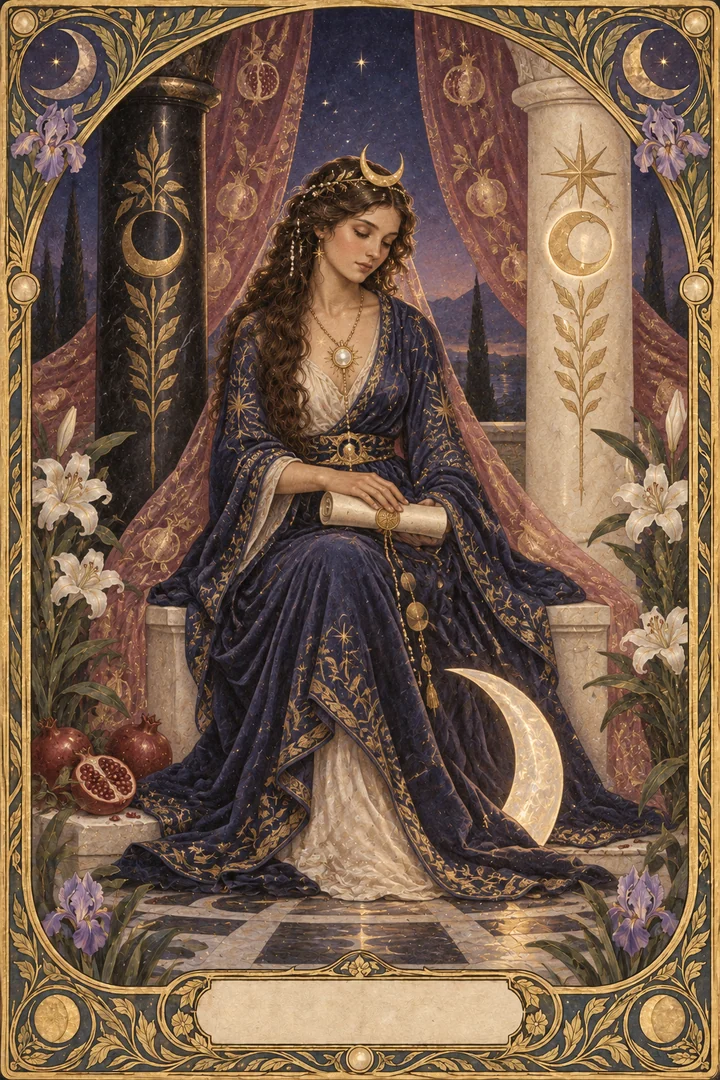 02 / SELFETTI
The High Priestess
What needs quiet attention before an answer?
Explore this card
Selfetti shows a seated adult figure in a dark flowing gown between contrasting pillars, with a pale veil behind and a crescent near the feet. The held text and enclosed space can frame an inward question beside information not yet spoken. The garden and golden frame are our illustration's decoration, without added predictive meaning.
- Suppose you keep agreeing to a weekly commitment and feel heavier each time it appears. The High Priestess approach is to sit with that heaviness before explaining it away: 'I notice I dread this, and I do not yet know what that means.' You might then check one fact, such as how often you actually enjoy it. In a personal situation, the same pattern might be admitting, 'I have not said what I want because I am afraid of the answer.' The quiet knowing comes first; the words can follow.
- If you keep feeling uneasy after time together, a useful sentence is, 'I have been sitting with something and I want to understand it before I bring it to you.' It honors your inner signal without turning it into an accusation. Compare that with 'I know something is wrong with us,' which treats a feeling as a verdict. When reading the card as feelings, treat its theme as a prompt about inner attention; the other person's actual feelings still need their own words and behavior.
- If a role sounds good on paper but your stomach tightens each time you imagine it, write down what you noticed before deciding. You might find that the schedule, not the work, is the problem. In a team, replace 'I have a bad feeling about this plan' with one concrete question, such as who will own the handover. These are examples of applying the quiet-attention theme; the card does not establish that an offer, exam or proposal will succeed.
Write down an observation without explaining it away.
Read the full guide ↗ · One card. A little room for yourself. ↗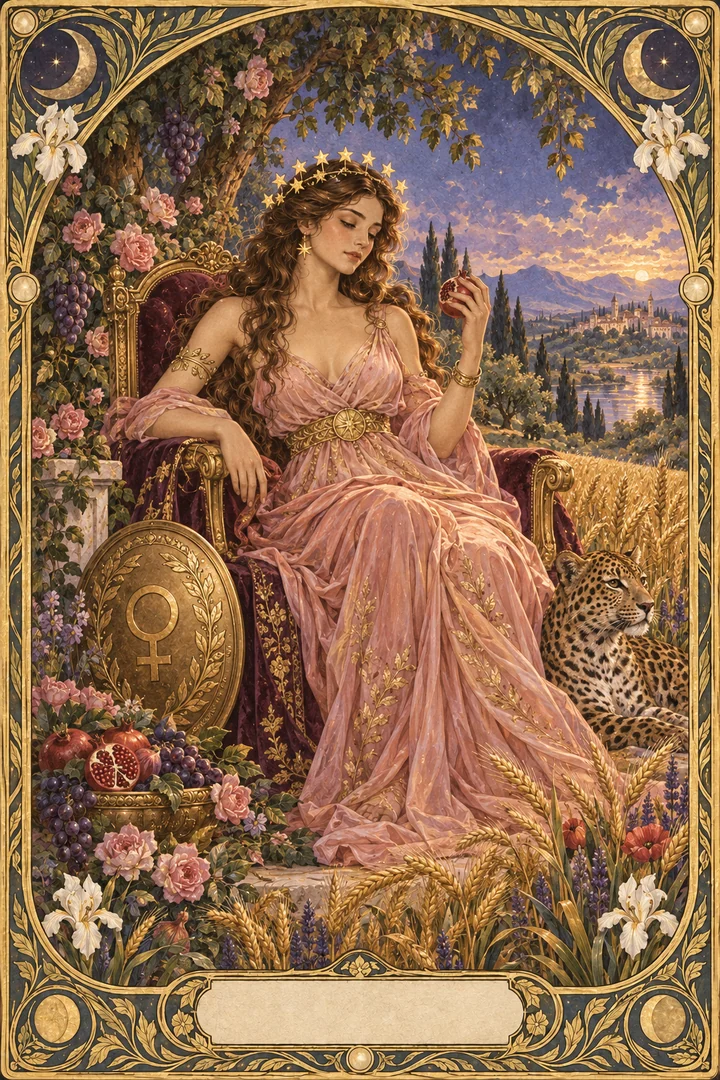 03 / SELFETTI
The Empress
What grows when you give it regular care?
Explore this card
Selfetti shows an adult figure seated on a cushioned throne amid flowers and growing plants, with a flowing pink gown and an ornamental shield nearby. The settled seat and abundant garden offer an image of receiving care as well as sustaining growth. The original artwork adapts traditional abundance without making fertility or pregnancy claims.
- Suppose you keep saying you will rest once the busy season ends, and the busy season keeps renewing itself. The Empress approach is smaller and more regular: one unhurried meal, one evening without obligations, one walk that is not also errands. In a friendship, it might be a standing check-in rather than a grand gesture. The growth comes from repetition, not intensity.
- If you notice you are always the one arranging, remembering and smoothing things over, a useful sentence is, 'I love doing things for us, and I would like it to be more shared. Could you take over the planning next time?' It names what you give and asks for something concrete. Compare that with quietly keeping score and then feeling resentful. When reading the card as feelings, treat its theme as a prompt about care and receiving; the other person's actual feelings still need their own words and behavior.
- If a long project keeps stalling, the Empress approach might be a small weekly block of focused work rather than one exhausting weekend. If you are the person everyone brings problems to, it might be protecting one meeting-free morning. These are examples of applying the nourishment theme; the card does not establish that a promotion, exam or proposal will succeed.
Make time for one nourishing routine.
Read the full guide ↗ · One card. A little room for yourself. ↗ 04 / SELFETTI
The Emperor
Where would a clear boundary help?
Explore this card
Selfetti shows an adult ruler seated on a substantial stone throne, wearing red and gold and holding a sceptre. Mountains rise behind the garden. The seat and held emblem can frame responsibility alongside the risk of becoming immovable. The pictured role is a symbolic approach, not a claim about the reader's gender or authority.
- Suppose a shared project keeps stalling because nobody knows who decides what. The Emperor approach is to agree, in one sentence, who owns the final call and by when. That single agreement can do more than another round of discussion. In a personal situation, the same pattern might be saying, 'I can help on Saturday mornings, but not on weeknights.' The boundary is not a rejection; it is what makes the help sustainable.
- If you keep feeling stretched by last-minute requests, a useful sentence is, 'I want to see you, and I need a day's notice to make it work.' It states the boundary and leaves room for the other person to respond. Compare that with 'You never respect my time,' which has already decided what the pattern means. When reading the card as feelings, treat its theme as a prompt about agreements and roles; the other person's actual feelings still need their own words and behavior.
- If a group assignment keeps drifting, write one sentence naming who owns the final version and when it is due. If you cannot do that yet, another meeting may not solve the problem. In a solo project, replace 'I need to work harder' with one concrete block of time and one deliverable. These are examples of applying the structure theme; the card does not establish that a promotion, exam or proposal will succeed.
Choose one responsibility and define where it ends.
Read the full guide ↗ · One card. A little room for yourself. ↗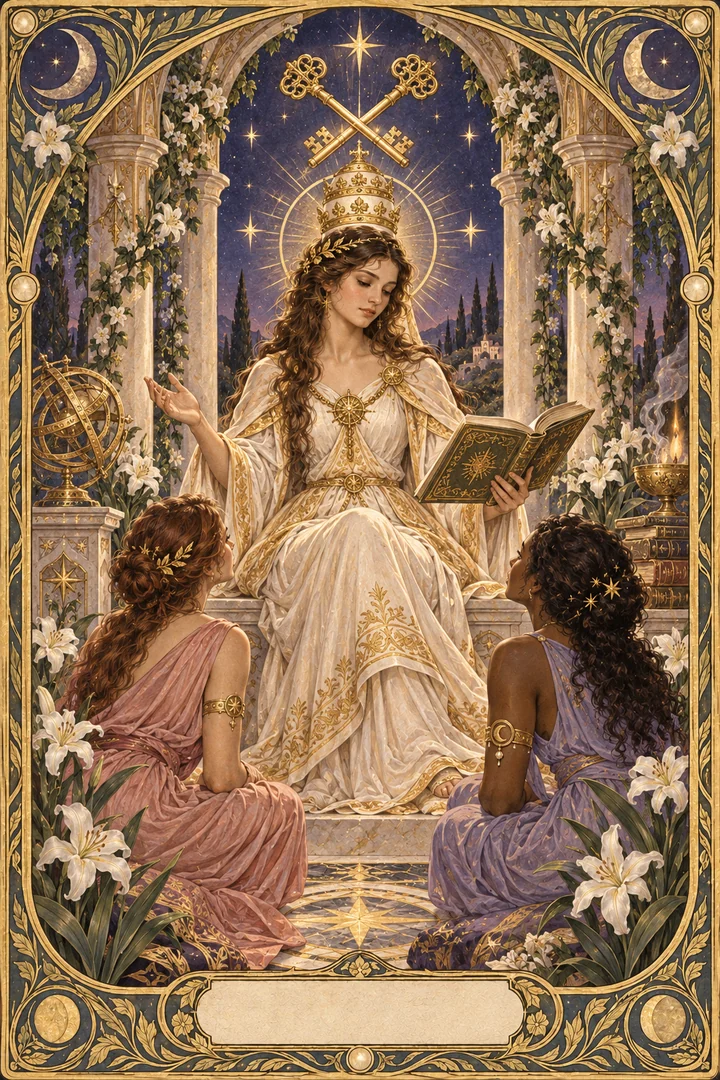 05 / SELFETTI
The Hierophant
Which inherited rule still serves you?
Explore this card
Selfetti shows a seated adult spiritual figure between pillars, one hand raised, with two adult attendants facing the seat. Flowers soften the formal setting. The shared gesture and arrangement offer an image of learning within a tradition while leaving room to examine its rules. Our figures adapt the historical composition.
- Suppose you are considering a meditation practice your family has kept for generations. The Hierophant approach is to try it with curiosity, noticing whether it brings you peace or simply feels obligatory. In a work setting, the same pattern might be learning from a mentor whose methods are old but effective. The card asks you to honour the source while checking whether the practice still fits who you are becoming.
- If your families expect a certain kind of wedding, a useful sentence is, 'I want to honour our families, and I also want us to choose what feels true for us. Can we talk about which traditions matter most?' It names the tension without turning it into a battle. Compare that with silently going along and feeling resentful later. The card supports honest negotiation, not a verdict on the relationship.
- If your team keeps using a reporting format that no one reads, the reversed Hierophant invites you to ask, 'What decision is this meant to support?' You might propose a simpler version. In a study context, you might follow a proven revision method but adapt the schedule to your life. These are examples of applying the tradition-and-questioning theme; the card does not establish that a promotion or exam result will go a certain way.
Keep one useful tradition and question one assumption.
Read the full guide ↗ · One card. A little room for yourself. ↗ 06 / SELFETTI
The Lovers
What choice would reflect your values?
Explore this card
Selfetti shows two adult figures facing each other beneath a winged angel, with trees, flowers and mountains around them. Their exchanged gaze and the open space between them offer a way to think about mutual choice and values. The original artwork does not identify a partner or reveal anyone's feelings.
- Suppose a friend asks you to commit to a weekly plan you are not sure you can keep. The Lovers approach is to ask yourself which value matters here: reliability, honesty or closeness. You might say, 'I want to see you regularly, and I cannot promise every week. Can we try every other week and check in?' The choice expresses what you want to stand beside rather than what sounds agreeable in the moment.
- If you keep saying yes to plans you do not want, a useful sentence is, 'I like spending time with you, and I need more quiet evenings than we have been having. What would feel realistic for both of us?' It says what you experience and makes room for an answer. Compare that with staying silent and then feeling resentful, which has already decided what the other person should have guessed.
- If a project keeps pulling you toward work you do not value, write down the value at stake: learning, fairness, autonomy or stability. Then ask, 'Which part of this role expresses that value, and which part does not?' In a team, replace 'I am not comfortable' with one concrete preference, such as which decisions you want to be consulted on. These are examples of applying the values theme; the card does not establish that a job offer, exam or proposal will succeed.
Name the value behind an upcoming decision.
Read the full guide ↗ · One card. A little room for yourself. ↗ 07 / SELFETTI
The Chariot
What direction deserves your attention now?
Explore this card
Selfetti shows an adult driver beneath a starry canopy, with contrasting dark and pale sphinx-like animals in front and a city behind. The paired animals and held reins frame coordinating different impulses toward a direction. The flowers and celestial ornament belong to our original garden illustration.
- Suppose you are juggling a demanding project and a personal commitment. The Chariot approach is to decide which outcome matters most this week, then give it a protected block of time. The other commitment still gets attention, but it no longer sets the pace. In a personal situation, the same pattern might be admitting, 'I want to move forward, but I keep saying yes to things that pull me sideways.' The breakthrough is choosing one direction and letting the rest wait.
- If you and your partner keep disagreeing about plans, a useful sentence is, 'I want us to choose one direction for the next few months. What matters most to you?' It names your intention and makes room for their answer. Compare that with 'We are doing it my way because I know best,' which has already decided the outcome. When reading the card as feelings, treat its theme as a prompt about shared direction or effort; the other person's actual feelings still need their own words and behavior.
- If a project feels stuck, write the single result you want this week and the one action that moves you toward it. If you cannot do that yet, another meeting may not solve the problem. In a team, replace 'We need to work harder' with one concrete agreement, such as which task gets done first. These are examples of applying the direction theme; the card does not establish that a promotion, exam or proposal will succeed.
Pick one destination before adding more tasks.
Read the full guide ↗ · One card. A little room for yourself. ↗ 08 / SELFETTI
Strength
Where could patience be more useful than pressure?
Explore this card
Selfetti shows an adult figure gently touching a lion, with an infinity motif overhead and a flowering landscape around them. The lion's presence and the unforced touch frame courage that can be patient rather than harsh. The illustration offers a symbolic interaction, not a measure of the reader's strength.
- Suppose a recurring argument keeps escalating because both people are trying to win it. The Strength approach is to pause, then say, 'I want to solve this with you, and I need a minute first.' A calm boundary can do more than a louder point. In a personal situation, the same pattern might be responding to your own mistake with, 'That was hard, and I can try again tomorrow,' instead of replaying it all night.
- If a conversation keeps turning into a fight, a useful sentence is, 'I care about this, and I want to talk about it without either of us getting hurt. Can we slow down?' It says what you want and makes room for the other person. Compare that with 'You always do this,' which has already decided what the pattern means. When reading the card as feelings, treat its theme as a prompt about patience or self-respect; the other person's actual feelings still need their own words and behavior.
- If a project keeps stalling, pick one task you can finish this week and let the rest wait. If a colleague is difficult, decide in advance how you will respond calmly rather than rehearsing the argument. These are examples of applying the patience theme; the card does not establish that a promotion, exam or proposal will succeed.
Try a firm but kind response to one difficulty.
Read the full guide ↗ · One card. A little room for yourself. ↗ 09 / SELFETTI
The Hermit
What becomes clearer away from other opinions?
Explore this card
Selfetti shows an adult figure with long hair standing on a rocky height, holding a lantern and a staff under a starry sky. Unlike the elderly figure in the historical card, this is our adult garden character. The small light and large dark landscape offer an image of looking for one usable question rather than every answer.
- Suppose every conversation about a decision leaves you more confused than before. The Hermit approach is to take one evening without advice: write down what you already know, what you are afraid of, and what you would choose if no one were watching. In a personal situation, the same pattern might be noticing that you keep asking friends whether you should stay, when the real question is what you want. The quiet does not decide for you; it lets the actual question surface.
- If you keep feeling unsettled after time together, a useful sentence is, 'I need a quiet evening to think, and I want to talk about it tomorrow.' It names the space and promises the return. Compare that with going silent for days and hoping the other person understands. When reading the card as feelings, treat its theme as a prompt about reflection or distance; the other person's actual feelings still need their own words and behavior.
- If a project feels scattered, block one hour with no messages and write the single question you are trying to solve. If you cannot name it, more hours may not help. In a team, replace 'I will look into it' with a date and the one thing you will report back. These are examples of applying the reflection theme; the card does not establish that a job offer, exam or proposal will succeed.
Take ten quiet minutes before asking for more advice.
Read the full guide ↗ · One card. A little room for yourself. ↗ 10 / SELFETTI
Wheel of Fortune
What is changing, and what remains within your control?
Explore this card
Selfetti shows a large ornamented wheel suspended in a cloudy sky, surrounded by winged figures and animal motifs. Its circular structure beside changing clouds frames cycles and changing circumstances. Letters and decoration draw on historical tarot imagery; they do not calculate the reader's luck.
- Suppose a reorganisation changes your team without warning. You did not choose it, and you cannot reverse it. What you can influence is which projects you protect, who you ask for clarity and how you pace the next two weeks. In a personal situation, the same pattern might be a friendship that naturally drifts when schedules change. The turn is real; your next small choice is still yours.
- If a move or a new job changes how often you see each other, a useful sentence is, 'Our rhythm is changing, and I want to talk about what we can keep.' It names the turn without pretending to control it. Compare that with silently waiting to see whether the other person notices. When reading the card as feelings, treat its theme as a prompt about change and timing; the other person's actual feelings still need their own words and behavior.
- If a budget change removes a resource you relied on, list what is gone, what remains and one adjustment you can make this week. If the same deadline slips every quarter, the loop may be the real issue, not the latest excuse. These are examples of applying the cycle theme; the card does not establish that a promotion, exam or project will succeed.
Separate what you can influence from what you cannot.
Read the full guide ↗ · One card. A little room for yourself. ↗ 11 / SELFETTI
Justice
What would a fair account of this situation include?
Explore this card
Selfetti shows an adult figure seated between pillars, holding an upright sword and scales, with a curtain behind. The straight blade and balancing instrument frame clarity alongside proportion. The original flowers and ornament add atmosphere rather than a promise about a legal outcome.
- Suppose two people share a task and one keeps covering the other's missed deadlines. A Justice approach is to write down what each person actually agreed to do, then discuss the gap without turning it into a character verdict. In a personal situation, it might sound like, 'I said I would handle this and I did not. That is on me. Can we agree what happens next time?' The fairness is in the specifics, not in who feels more wronged.
- If one person always plans and the other always follows, a useful sentence is, 'I would like us to take turns deciding what we do. Does that work for you?' It names the pattern and invites a response. Compare that with 'You never make an effort,' which delivers a verdict and leaves nothing to answer. When reading the card as feelings, treat its theme as a prompt about fairness and honesty; the other person's actual feelings still need their own words and behavior.
- If a team keeps missing deadlines, write down what each role was expected to deliver and where the handoffs failed, rather than naming a culprit. If you are graded or reviewed, ask which criteria were used and how they were applied. These are examples of applying the fairness theme; the card does not establish that a promotion, grade or dispute will go your way.
Write the facts separately from your interpretation.
Read the full guide ↗ · One card. A little room for yourself. ↗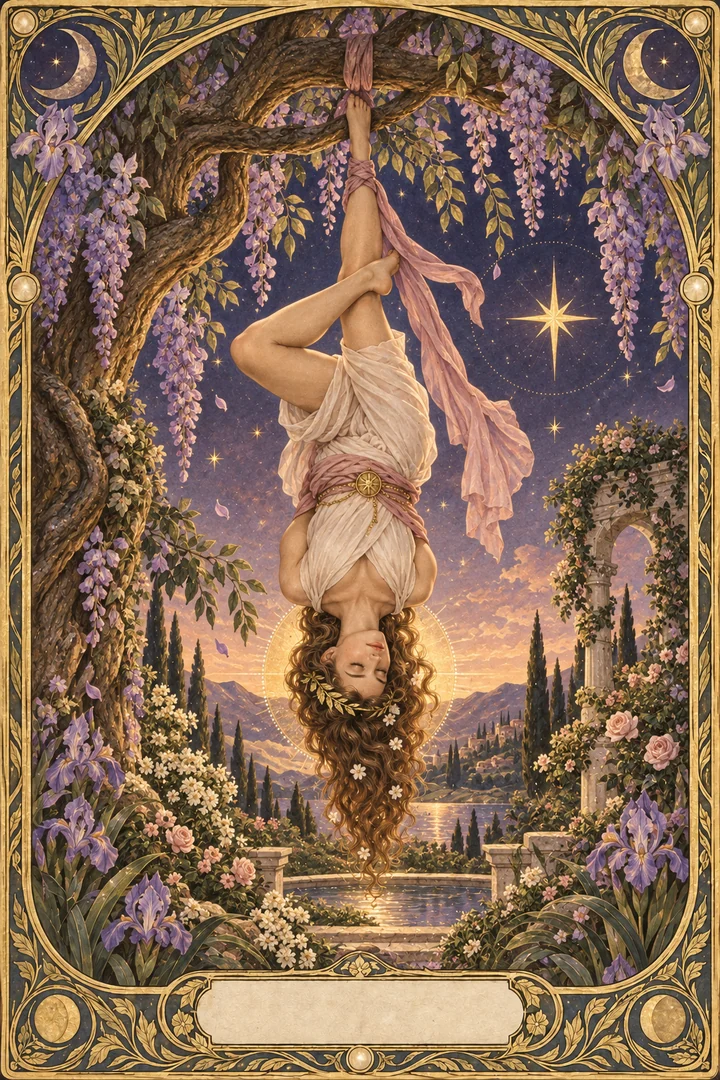 12 / SELFETTI
The Hanged Man
What might you notice from a different angle?
Explore this card
Selfetti shows an adult figure suspended upside down by one leg from a tree, with the other leg bent and flowing hair toward the garden below. The unusual orientation and composed pose can frame a pause that changes perspective. The hanging is symbolic; it does not describe harm to the reader.
- Suppose a project is stuck because everyone keeps repeating the same arguments. Instead of forcing a decision, you might ask, 'What would this look like from the customer's point of view?' That single question can reveal an assumption nobody noticed. In a personal situation, you might stop rehearsing your defence and simply listen to what the other person is actually saying. The pause itself becomes the action.
- If you are unsure where a relationship is going, a useful sentence is, 'I enjoy our time together, and I am not sure what we are building. Can we talk about what we each want?' It names your experience without demanding a verdict. Compare that with silently waiting for the other person to read your mind, or giving up your own plans in the hope they will notice. The card supports a pause that opens conversation, not one that replaces it.
- If an essay feels stuck, try writing the opposite argument for one paragraph. If a team meeting keeps going in circles, ask each person to describe the problem from the customer's point of view. These are examples of applying the perspective theme; the card does not establish that a job offer, exam or proposal will succeed. It simply invites you to pause and look again before pushing forward.
Describe the situation without using your usual explanation.
Read the full guide ↗ · One card. A little room for yourself. ↗ 13 / SELFETTI
Death
What ending could make room for something else?
Explore this card
Selfetti shows a skeletal rider on a white horse, carrying a dark banner with a pale flower, beside plants and a distant sunrise. The stark rider and returning light frame closure alongside transition. The historical title is a symbol for endings and change, never a forecast of death.
- Suppose you keep saying yes to a weekly commitment that drains you. The ending may be the commitment itself, or the identity of being the person who always shows up. A clear goodbye, even a small one, can return time and attention to something that actually fits your life now. The card asks what you are ready to retire.
- If you keep re-reading old messages and hoping a situation will return to how it was, that is a reversed Death pattern. A useful step might be to ask, 'What do I actually want now, separate from what we used to be?' The answer may be a clearer goodbye, a redefined friendship or a new agreement. The card does not tell you what the other person wants.
- If a project keeps stalling because everyone is protecting an old plan, the Death theme might be to retire that plan openly. A short statement like 'This approach has served us, and it is time to close it' can free the team to try something else. In study, it might mean dropping a subject that no longer fits your goals. These are examples of applying the transition theme, not forecasts.
Let go of one small commitment that no longer fits. This card does not predict a death.
Read the full guide ↗ · One card. A little room for yourself. ↗ 14 / SELFETTI
Temperance
Which two needs could coexist?
Explore this card
Selfetti shows a winged adult figure pouring between two cups, with one foot at the water and the other on land. A path and soft hills appear behind. The pouring and divided footing offer an image of adjusting a rhythm while keeping contact with daily life. The garden is our original adaptation.
- Suppose you want to see a friend more often, but your weeks are already full. The Temperance approach is not to promise every weekend or to give up entirely, but to try one standing slot a month and see how it feels. In a personal situation, the same pattern might be saying, 'I want to talk about this, and I need to do it when neither of us is exhausted.' The middle is designed, not discovered.
- If one of you wants more time together and the other needs more solitude, a useful sentence is, 'I want us to feel close, and I also need some evenings alone. What would a good week look like for you?' It names both needs and invites a shared design. Compare that with 'You never make time for me,' which has already decided what the other person's behavior means. When reading the card as feelings, treat its theme as a prompt about pacing or integration; the other person's actual feelings still need their own words and behavior.
- If a project keeps stalling, try one focused hour each morning instead of a heroic weekend. If two deadlines collide, name what will move rather than quietly absorbing both. In study, alternate a difficult subject with a lighter one rather than forcing one long block. These are examples of applying the Temperance theme; the card does not establish that a job offer, exam or proposal will succeed.
Design a smaller compromise you can actually sustain.
Read the full guide ↗ · One card. A little room for yourself. ↗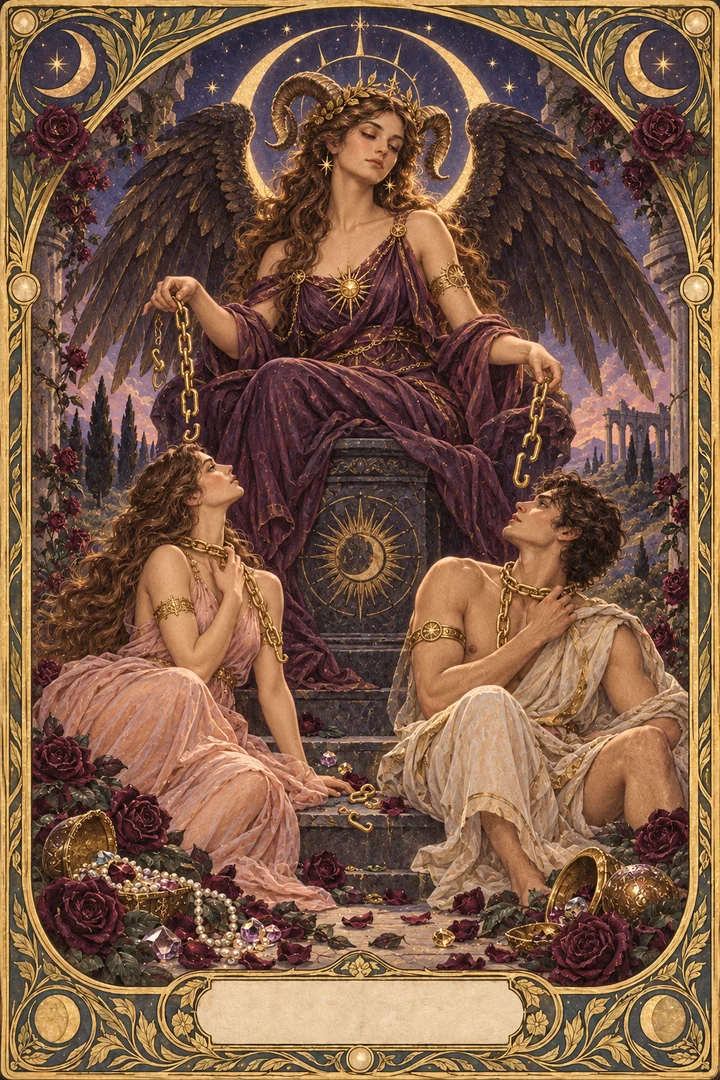 15 / SELFETTI
The Devil
What habit feels automatic rather than chosen?
Explore this card
Selfetti shows a horned seated figure above two adult figures, with chains and a central pedestal in the garden. The chain and the difference in height can frame a binding arrangement worth examining. The scene is symbolic, not proof of wrongdoing, addiction or another person's power over the reader.
- Suppose you keep saying yes to a weekly commitment that leaves you drained. The Devil approach is to notice the trigger: the message arrives, and you reply before you think. Instead of deciding to quit everything, try one smaller boundary, such as, 'I need to check my week and get back to you tomorrow.' The pattern becomes visible in the pause, not in a dramatic exit.
- If you keep agreeing to plans you do not want, a useful sentence is, 'I want to see you, and I need to say no to this one.' It names your experience without accusing the other person. Compare that with staying quiet and then feeling resentful. When reading the card as feelings, treat its theme as a prompt about your own patterns; the other person's actual feelings still need their own words and behavior.
- If you keep agreeing to extra tasks, write down what you would say if you decided today: 'I can take this on if we move the other deadline.' If you cannot say that yet, notice the moment the request arrives and give yourself an hour before replying. These are examples of applying the attachment theme; the card does not establish that a job offer, exam or proposal will succeed.
Notice one trigger and create a little space before responding.
Read the full guide ↗ · One card. A little room for yourself. ↗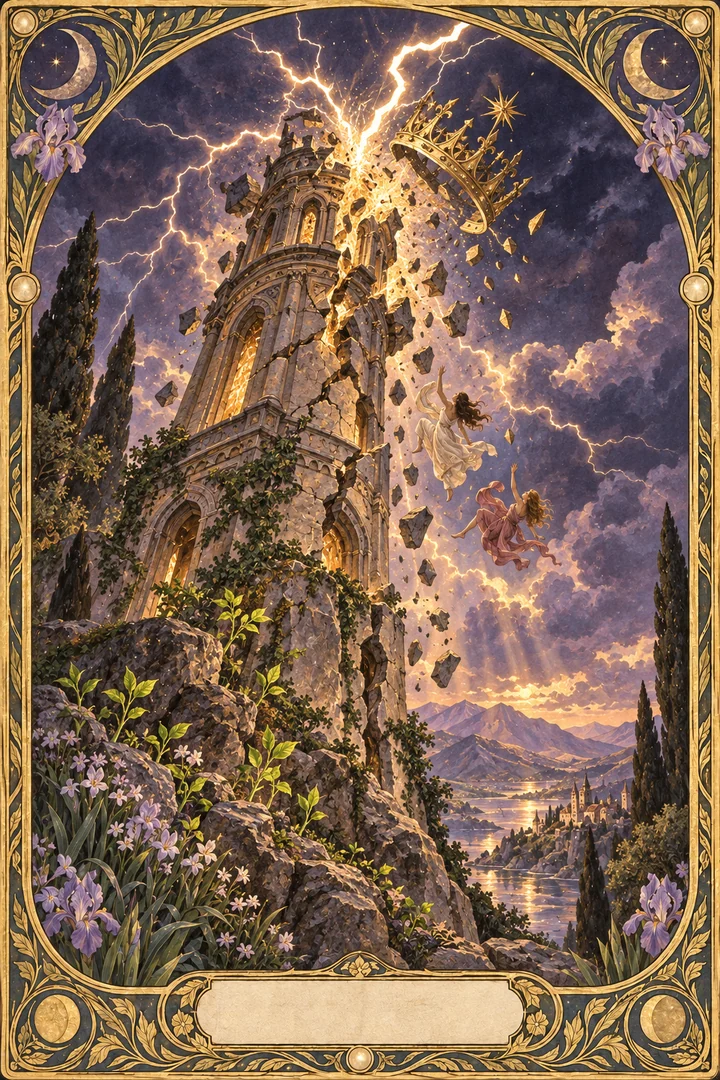 16 / SELFETTI
The Tower
Which assumption could use a reality check?
Explore this card
Selfetti shows lightning striking a stone tower amid a dark sky and flowering plants. Light enters the damaged structure while the surrounding landscape remains visible. The broken structure and continuing garden frame disruption alongside what can still be tended. The artwork does not predict a disaster.
- Suppose a shared plan changes overnight because a key person leaves. The Tower moment is the news itself; the useful next step is smaller. Ask which part of the plan still stands, which assumption just failed and what one safe piece can be rebuilt this week. In a personal situation, the same pattern might be discovering that a belief you organised your time around no longer fits. The disruption is real, and the first repair can still be modest.
- If a recurring argument keeps returning, a useful sentence is, 'I notice we keep circling this, and I would rather understand it than win it. Can we talk about what each of us expects?' It names the pattern and leaves room for an answer. Compare that with 'You always ruin this,' which has already decided the meaning. When reading the card as feelings, treat its theme as a prompt about honesty and change; the other person's actual feelings still need their own words and behaviour.
- If a project keeps stalling, list the assumptions it rests on and mark which one has already changed. If you cannot name it yet, another status meeting may not help. In a team, replace 'we need to start over' with one agreement, such as which decision must be remade first. These are examples of applying the disruption theme; the card does not establish that a job, exam or proposal will fail.
Check one assumption with evidence. This card does not forecast a disaster.
Read the full guide ↗ · One card. A little room for yourself. ↗ 17 / SELFETTI
The Star
What would gentle hope look like in practice?
Explore this card
Selfetti shows an adult figure beside water beneath a large star and smaller stars, with pouring vessels and a flowing pale pink dress in the garden. The water and steady light offer an image of quiet replenishment. Our clothed adult figure adapts the historical scene; the star does not guarantee a future event.
- Suppose you have been recovering from burnout and someone asks about your five-year plan. The Star approach is to say, 'I am not there yet, but I can walk for twenty minutes today.' That small action supports a future you care about without pretending you are ready for everything. In a personal situation, it might be writing one honest sentence in a journal instead of solving your whole life at once.
- If contact has become inconsistent, a useful sentence is, 'I like hearing from you, and I am unsure what rhythm works for us. What would feel realistic?' It says what you experience and makes room for an answer. Compare that with 'If you cared, you would reply faster,' which has already decided what the delay means. When reading the card as feelings, treat its theme as a prompt about hope or communication; the other person's actual feelings still need their own words and behavior.
- If a project feels overwhelming, write down the single next task and give it twenty focused minutes. If you cannot do that yet, another planning session may not solve the problem. In a team, replace 'We need to work harder' with one concrete agreement, such as a realistic deadline. These are examples of applying the hope theme; the card does not establish that a job offer, exam or proposal will succeed.
Do one small thing that supports a future you care about.
Read the full guide ↗ · One card. A little room for yourself. ↗ 18 / SELFETTI
The Moon
What do you know, and what are you filling in?
Explore this card
Selfetti shows a dog and a wolf facing a large moon between two towers, with a small water creature emerging from a pool and a path into the distance. The familiar and wild animals beside dim light frame uncertainty and imagination. The original garden does not supply facts about what is hidden.
- Suppose a friend seems distant and you start imagining reasons. You notice the distance but do not know its cause. Instead of deciding they are upset with you, you could say, 'I have noticed you seem quieter lately. Is everything okay?' This keeps the observation separate from the story. In a work situation, if a project feels off but no one has said anything, you might ask, 'Can we check in on how this is landing for everyone?' The Moon supports questions that make room for answers.
- If you are unsure where a relationship stands, a useful sentence is, 'I enjoy our time together, and I am not sure what we are building. Can we talk about what we each want?' This states your experience and opens a conversation. Compare that with silently interpreting every delayed reply as rejection. When reading The Moon as feelings, treat its theme as a prompt about uncertainty and communication; the other person's actual feelings still need their own words and behavior.
- If a team project feels stuck, you might write down what you believe the goal is and ask, 'Is this what we are aiming for?' If you are studying a difficult topic, try explaining it to someone else and notice where you stumble. Those stumbles show what is still unclear. These are examples of applying the Moon's theme; the card does not establish that a job offer, exam or proposal will succeed.
Ask a clarifying question instead of treating uncertainty as proof.
Read the full guide ↗ · One card. A little room for yourself. ↗ 19 / SELFETTI
The Sun
What deserves to be enjoyed without improvement?
Explore this card
Selfetti shows an adult figure in a pale dress on a white horse beneath a bright sun, with a red banner and sunflowers. The historical card often depicts a child; our illustration deliberately uses an adult. The open light and flowers frame enjoyment and clarity without promising constant happiness.
- Suppose a project finally ships and you immediately open the next document. The Sun approach is to pause, tell one person it went well, and let the satisfaction land before moving on. In a personal situation, the same pattern might be noticing that a walk, a meal or a conversation felt genuinely good, without asking what it means or how to improve it. The warmth is in the noticing.
- If you have been saying 'I'm fine' while feeling distant, a useful sentence is, 'I love our time together, and I have been carrying something I have not said. Can I tell you about it?' It keeps the warmth and makes room for the real. Compare that with 'Everything is perfect,' which can leave the other person guessing. When reading the card as feelings, treat its theme as a prompt about openness or shared pleasure; the other person's actual feelings still need their own words and behavior.
- If a presentation lands well, write down one sentence about what worked before you open the next task. If a team result is strong, say so out loud and name who helped. If you are exhausted but keep saying everything is fine, tell one trusted colleague what is actually hard. These are examples of applying the warmth theme; the card does not establish that a promotion, grade or project will succeed.
Share or savor one ordinary thing that went well.
Read the full guide ↗ · One card. A little room for yourself. ↗ 20 / SELFETTI
Judgement
What have you learned that changes your next choice?
Explore this card
Selfetti shows a winged angel sounding a trumpet above adult figures reaching upward from an earthly garden scene. The call and lifted hands can frame a moment of review or response. The image does not judge the reader's worth or establish a spiritual verdict.
- Suppose you keep replaying a conversation where you stayed silent when you wanted to speak. The Judgement approach is to ask, 'What did I need in that moment, and what would I say if something similar happened this week?' A short honest answer can do more than another year of self-criticism. In a personal situation, the same pattern might be admitting, 'I ended that friendship badly, and I am ready to apologise without demanding forgiveness.' The review becomes useful when it changes your next step.
- If an old disagreement keeps returning, a useful sentence is, 'I keep reacting as if this is the same fight as before. What would help us respond differently this time?' It names your part and makes room for an answer. Compare that with 'I always ruin things,' which has already decided the verdict. When reading the card as feelings, treat its theme as a prompt about review or accountability; the other person's actual feelings still need their own words and behaviour.
- If a project did not go as planned, write three lines: what you observed, what you would do differently, and what you will ask for next time. If you cannot name a change, another post-mortem may not help. In a team, replace 'We failed' with one agreement, such as who will flag risks earlier. These are examples of applying the review theme; the card does not establish that a job offer, exam or proposal will succeed.
Review a past choice with curiosity rather than punishment.
Read the full guide ↗ · One card. A little room for yourself. ↗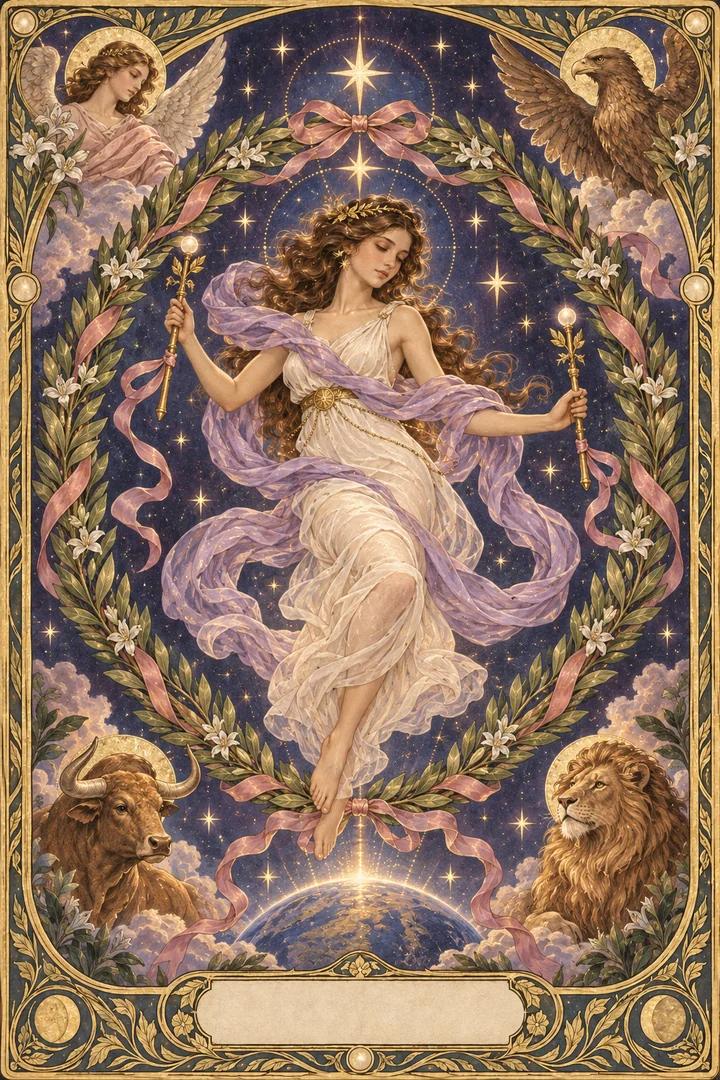 21 / SELFETTI
The World
What would help you recognise a chapter is complete?
Explore this card
Selfetti shows an adult figure within a leafy oval wreath, surrounded by four corner figures and a starry landscape. The containing wreath and surrounding figures frame integration and acknowledgement of a whole cycle. Our flowing gown and garden ornament adapt the historical scene without predicting completion.
- Suppose you finish a course you started two years ago. The certificate arrives, and you immediately open the next application. The World approach is to spend ten minutes writing what changed in you, not just what you passed. In a personal situation, the same pattern might be realising a friendship has run its course and saying so kindly, rather than letting it fade without a word. The completion is the naming.
- If a long relationship is ending, a useful sentence is, 'I want to say what this time gave me before we close it.' It honours the whole without pretending the ending is easy. Compare that with leaving silently and telling yourself it does not matter. When reading the card as feelings, treat its theme as a prompt about closure or integration; the other person's actual feelings still need their own words and behaviour.
- If a team project ends, write a short handover of what was built, what was learned and what remains open. If you cannot name what remains, the project may not be as closed as it looks. In study, replace 'I am done with this subject' with one sentence about what you can now do. These are examples of applying the completion theme; the card does not establish that a promotion, grade or contract will follow.
Mark a small completion before rushing to the next task.
Read the full guide ↗ · One card. A little room for yourself. ↗ 22 / SELFETTI
Ace of Swords
What fact would make this decision clearer?
Explore this card
In the Rider–Waite–Smith image, a hand emerges from a cloud holding a sword beneath a crown. The sword cuts a distinct line through the sky: we use it here as an image of separating one thought from the noise around it. The crown suggests the force of a clear idea, while the hand reminds us that somebody must decide how to use that force. Selfetti's illustration keeps the raised sword, crown and clouds, adding golden leaves and an open landscape. Its decorative flowers and moons belong to our artwork, not a separate set of traditional card meanings.
- Upright, the Ace of Swords is commonly read as a mental breakthrough: naming a truth, understanding a problem or beginning a conversation that has been avoided. As an Ace, it describes a beginning rather than a finished result. The useful distinction is between having an insight and acting on it well. You may finally know what you want to say, but still need evidence, timing and a way for the other person to respond. Read it as an invitation to make the question clearer and the next step more precise.
- In love, the upright Ace of Swords emphasizes honest conversation, clearer expectations and recognizing what a relationship actually needs. It can fit a new connection in which you want to discuss intentions, or an established relationship in which an unspoken issue needs words. Reversed, the focus shifts to mixed messages, assumptions or an argument in which the wording obscures the feeling. Clarity works best with warmth: being direct does not require making the other person feel cross-examined.
Write a one-sentence question, then identify one person or source that can answer it directly.
Read the full guide ↗ · One card. A little room for yourself. ↗ 23 / SELFETTI
Two of Swords
What is the smallest piece of information that would make this choice clearer?
Explore this card
The traditional image shows a seated, blindfolded figure holding two crossed swords before water. The still posture and held blades suggest a balance that takes effort to maintain. Selfetti's painting gives this pause a spacious sky and delicate flowers. The blindfold can invite a question about what you are not looking at; it is not proof that you are foolish or incapable.
- The Two of Swords often describes a choice held still. Two reasonable needs may be pulling in different directions: closeness and space, security and freedom, speaking and keeping the peace. Pausing can protect you from a rushed answer. It becomes less useful when the pause has no question, deadline or next step. Read this card by naming the two positions as fairly as possible. What information is missing? What value would matter even if both options remained imperfect? The task is to give the decision a shape you can actually hold.
- In love, the Two of Swords can point to an unspoken difference or an uncertain next step. One person may want a definition while the other needs time. Begin with the actual question: contact, exclusivity, plans, or how to repair a disagreement. A pause is more respectful when both people know what it means and when you will revisit it. The image does not reveal a secret third person or prove that affection is absent.
Write one sentence for each side of the choice. Add the need you want to protect, then choose one question to ask or one small comparison to make.
Read the full guide ↗ · One card. A little room for yourself. ↗ 24 / SELFETTI
Three of Swords
What part of this hurt needs to be named, and what would care look like today?
Explore this card
The traditional heart pierced by three swords places sorrow in the centre of the picture, with rain around it. Selfetti's floral frame holds the image with care rather than making pain a spectacle. The heart remains visible: a hurt experience can occupy your attention without becoming the whole story of who you are.
- The Three of Swords is often read through heartbreak, disappointment and words that land painfully. Something matters enough to hurt. Begin with what happened, rather than making the card explain the cause. A conversation, a separation or an unmet hope may have brought a difficult truth into view. Giving that truth a clear sentence can make it less shapeless. You do not have to rush into gratitude for a painful experience. First, acknowledge the loss and what you need around it.
- In a relationship reading, the Three of Swords can frame disappointment, distance or a painful conversation. It does not by itself identify infidelity or announce a breakup. Ask what is known, what was promised and what response is possible now. For a single reader, an old disappointment may influence how safe a new connection feels. Your caution can be understandable while still allowing you to learn about this person at their own pace.
Write what happened and how it felt as two separate sentences. Choose one kind response you can offer yourself before deciding what to say to anyone else.
Read the full guide ↗ · One card. A little room for yourself. ↗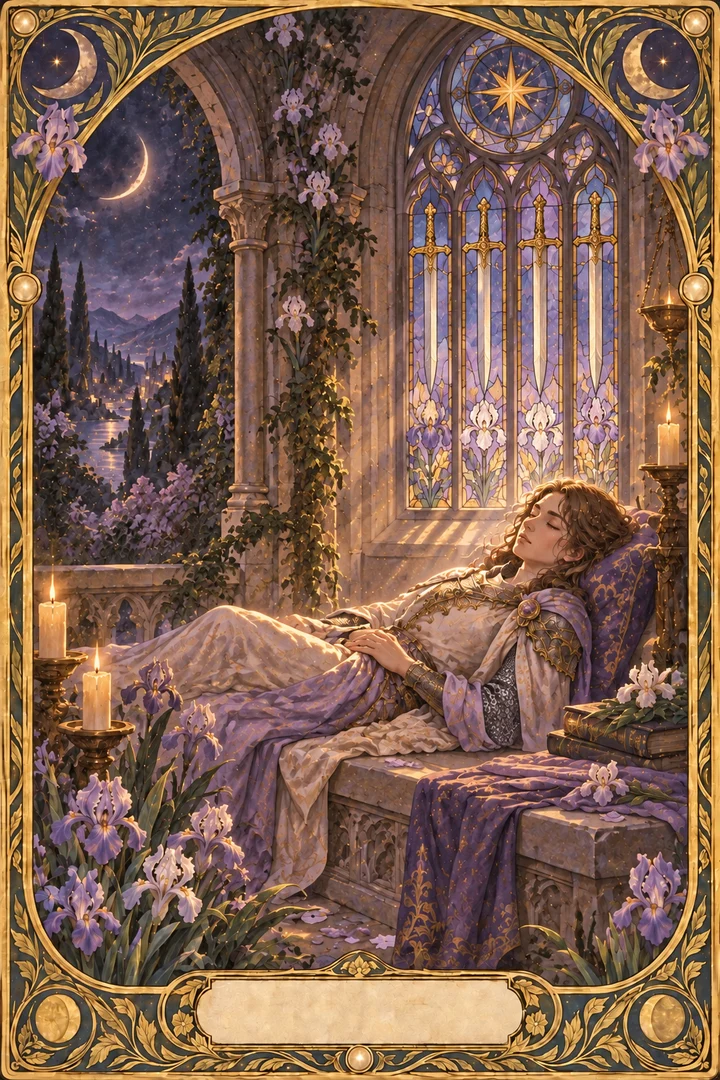 25 / SELFETTI
Four of Swords
What would make a small pause feel protected rather than unfinished?
Explore this card
The traditional reclining figure and four swords form a scene of stillness, with one blade placed apart from three above. It resembles a place set aside from ordinary activity. Selfetti's gentle light and garden details make that separation feel sheltered. The figure's stillness is a symbol to consider, not a forecast of physical illness or death.
- The Four of Swords describes a period of stillness after strain. Attention has limits, and continuing to respond can leave little room to understand what you feel. A deliberate pause can let a difficult conversation, a busy week or an unfinished decision settle. Give it a shape: what are you stepping back from, what will support the pause, and when will you check in again? Rest does not need to become another performance you must do perfectly.
- In love, the Four of Swords can invite breathing room after tension. A useful pause is explained and has a way back into conversation. It should not require one person to guess whether the relationship still exists. For a single reader, a season of quiet can be a valid preference; it does not mean you have lost the ability to connect.
Set aside one realistic interval. Name what can wait and, if needed, tell someone when you will return. Let the interval be quiet without measuring how well you rested.
Read the full guide ↗ · One card. A little room for yourself. ↗ 26 / SELFETTI
Five of Swords
What do I want this conversation to leave behind?
Explore this card
The traditional image shows one figure holding swords while two figures withdraw. The arrangement makes the aftermath visible: possession of the weapons does not look like shared peace. Selfetti's garden setting gives the scene a quieter frame. Look at where your attention goes: the person who remains, those leaving, or the space between them.
- The Five of Swords asks you to look beyond who had the best argument. A reply can be technically accurate and still make it harder to speak honestly afterward. Competition, pride or the need to defend yourself may have taken over the original issue. Consider what the exchange achieved and what it damaged. Sometimes the useful next step is to return to the subject in a different tone. Sometimes it is to leave a conversation that has become a contest. The card does not require you to give up a necessary boundary.
- In love, the Five of Swords can highlight a pattern of keeping score, defensive replies or using a vulnerable detail to win an argument. The question is how disagreement feels between you. Can each person remain a person worth hearing when you disagree? For a single reader, the card may bring attention to the urge to make someone regret rejecting you. You can protect your dignity without turning the connection into an audience for revenge.
Before replying, finish two sentences: “The issue I need to address is…” and “The connection or boundary I want to preserve is…”. Remove one line that serves only to score a point.
Read the full guide ↗ · One card. A little room for yourself. ↗ 27 / SELFETTI
Six of Swords
What support would make the next part of this transition more manageable?
Explore this card
The traditional picture shows a boat carrying passengers and six swords toward another shore. A person helps guide the passage. Selfetti's water and soft light invite attention to the movement between places rather than a dramatic escape. The presence of a boat is a symbol; it does not require a literal trip by water.
- The Six of Swords is often read as movement away from a difficult period toward a more workable situation. The passage can be modest: a different routine, a calmer way to communicate or a practical change in surroundings. The swords travel with the passengers, so the image need not mean forgetting everything that happened. You can carry knowledge from an experience while giving it less control over your daily life. Look for the route, the support and the next manageable step.
- For relationships, the Six of Swords can reflect a calmer phase after conflict, a change in how you relate, or a departure handled with care. It cannot decide which of those applies. Notice what both people have agreed to and whether the new pattern is real. For a single reader, you may be making room for connection while still carrying a memory of what was difficult before.
Name one thing to take forward and one arrangement to leave behind. Identify the person, resource or small routine that can support your next step.
Read the full guide ↗ · One card. A little room for yourself. ↗ 28 / SELFETTI
Seven of Swords
What am I protecting, and who needs accurate information to make their own choice?
Explore this card
In the traditional scene, a figure carries five swords away while two remain behind, looking back toward a camp. The uneven division invites attention to what has been taken and what has been left unresolved. Selfetti gives the scene a gentle landscape and floral frame; the beauty of the picture does not erase the question of responsibility.
- The Seven of Swords can invite reflection on strategy, private plans and information that is being handled selectively. Those situations are not all the same. Keeping a draft private while you develop it can be reasonable; hiding a detail that another person needs for an informed choice has a different effect. Ask what is being protected, who is affected and what agreement applies. This card is most useful when you examine the particular arrangement rather than immediately declaring that someone is dishonest.
- In love, this card can prompt a conversation about privacy, trust and what needs to be shared. Each person can have private thoughts and friendships. Agreements about exclusivity, money or shared plans still need enough clarity for both people to choose freely. The image alone cannot establish cheating, a secret relationship or malicious intentions.
Separate the private part of the situation from the shared commitment. Write one clear update for anyone whose plans depend on yours.
Read the full guide ↗ · One card. A little room for yourself. ↗ 29 / SELFETTI
Eight of Swords
Which limit is confirmed, and which assumption could I check with one question?
Explore this card
The traditional figure is blindfolded and bound among eight upright swords, with a distant building behind. The picture invites attention to how a limited view changes the experience of a situation. Selfetti's open landscape and flowers keep a sense of space around the figure. Any opening you see is a question to explore, not proof that real-world constraints are easy to escape.
- The Eight of Swords often frames a situation in which every option seems closed. Some limits may be real: time, responsibilities, money or another person's decision. Others may be assumptions that have not been checked. The useful task is to distinguish them. Avoid turning the card into an accusation that you created all your difficulties. Look for one specific constraint, then ask what information, support or smaller arrangement might change your room to move.
- In love, this card can invite a look at the roles or expectations that make you feel unable to speak. What do you believe would happen if you stated a preference? What has actually happened before? Consider the distinction with care. The image does not make a relationship safe or unsafe by itself, and it cannot choose your next step for you.
Make two short lists: confirmed constraints and untested assumptions. Choose one assumption to check or one person who could help with a real constraint.
Read the full guide ↗ · One card. A little room for yourself. ↗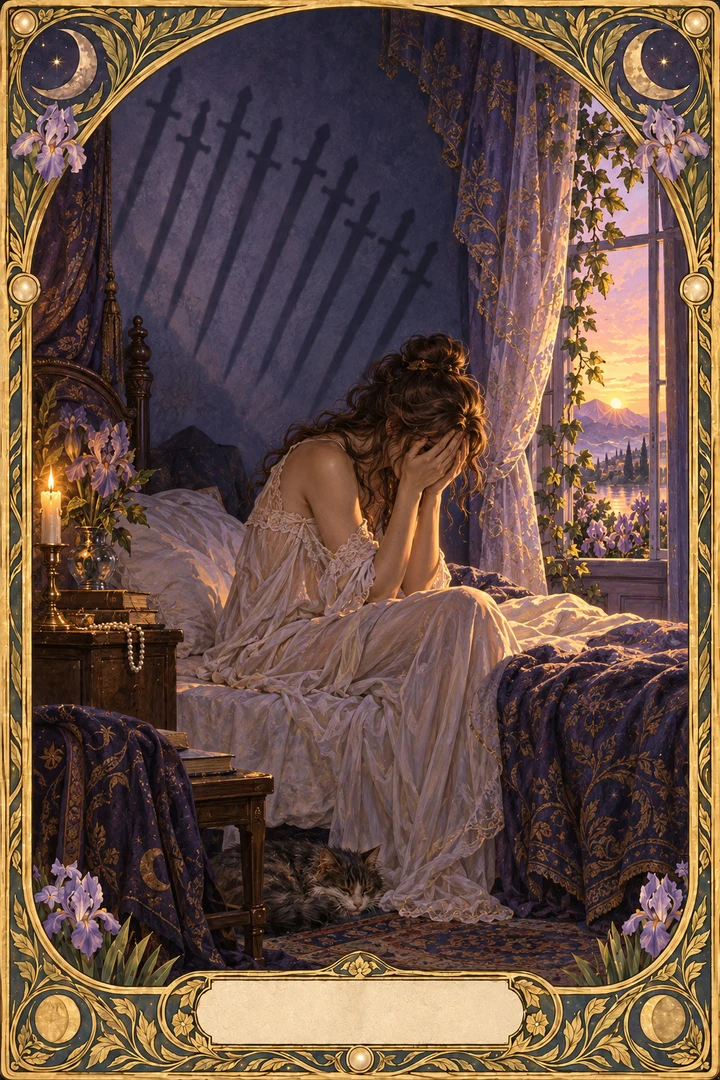 30 / SELFETTI
Nine of Swords
What do I know happened, and what am I afraid it means?
Explore this card
The traditional figure sits up in bed with hands over the face while nine swords hang across the dark background. The thought seems to fill the room. Selfetti's flowers and soft horizon light leave a gentler space around this scene. Darkness in an illustration expresses a mood; it cannot tell you what tomorrow will contain.
- The Nine of Swords is often read through worry, regret and thoughts that return when the rest of the day becomes quiet. The feeling may be intense even when the feared outcome has not happened. Start by separating an event from the story you are telling about it. What do you know? What are you anticipating? What question could be answered in the real situation? The card gives a picture to the experience of worry; it does not confirm the frightening conclusion.
- In love, the Nine of Swords can reflect uncertainty, regret after a conversation or fear of losing closeness. It cannot establish what another person feels or whether they have betrayed you. Consider the relationship's actual pattern alongside today's worry. A question asked clearly can be more useful than checking the same signals again and again.
Write the known event and the feared interpretation on separate lines. Choose one practical check or one clear question, then let that response guide the next step.
Read the full guide ↗ · One card. A little room for yourself. ↗ 31 / SELFETTI
Ten of Swords
What has ended, and what support would make the next day possible?
Explore this card
The traditional Rider–Waite–Smith image shows a fallen figure pierced by ten swords. Its dramatic picture expresses the severity of an ending; Waite explicitly distinguishes it from a prediction of violent death. Selfetti's adaptation places the swords upright behind a resting figure, with warm light across the horizon. The scene holds both exhaustion and the possibility of another day. The landscape and flowers are part of our original illustration. They soften the image without turning its difficult theme into a promise that recovery will be immediate.
- Upright, the Ten of Swords is commonly read as a painful ending, a major disappointment or the point at which a pattern can no longer continue as it has. It can also express the feeling of having reached your limit. The distinction matters: sometimes an ending is a fact, and sometimes 'everything is over' is how one setback feels. Start by naming what actually ended. A rejected proposal is not the end of every opportunity; an exhausted routine may need to stop even when the wider goal remains worthwhile.
- In love, the upright Ten of Swords can symbolize an ending, a sharp disappointment or an old relationship pattern that has become too painful to repeat. It does not settle which of those applies. If the relationship continues, the useful question is what must change for another conversation to be worthwhile. Reversed, the theme may be healing after separation, rebuilding trust through changed behavior or staying attached to a chapter the other person has already closed. The difference comes from both people's actions, not the orientation alone.
Name one concrete thing to stop and one source of practical help to contact.
Read the full guide ↗ · One card. A little room for yourself. ↗ 32 / SELFETTI
Page of Swords
What is one question I can investigate rather than speculate about?
Explore this card
The traditional Page holds a raised sword in a lively landscape, looking outward as if alert to movement. Selfetti's sky and botanical details make attention part of the picture: there is more to notice than the blade alone. The court title names a symbolic role. Readers of any age or gender can explore its curiosity.
- The Page of Swords brings the freshness of noticing, asking and learning. You may have seen a detail others passed over or found a question that opens a subject. Curiosity becomes more useful when it has a method: observe, check, ask, and revise what you think. You can be a beginner without pretending to be certain. The Page also invites care with words, because a quick discovery can feel larger than the evidence supporting it.
- In love, the Page can invite interest in how another person sees the world, or attention to a conversation that needs clearer context. Asking is different from monitoring. The card does not prove that someone is watching your profile or preparing to message you. Let curiosity become a respectful exchange in which both people can answer freely.
Choose one detail that interests you. Find its source, ask a clear question or make a small observation. Write what you learned and what remains uncertain.
Read the full guide ↗ · One card. A little room for yourself. ↗ 33 / SELFETTI
Knight of Swords
What needs a decisive step, and what deserves one more moment of listening?
Explore this card
The traditional Knight rides a charging horse with a raised sword while the landscape bends in the wind. The movement makes conviction and speed visible. Selfetti's detailed fabrics, flowers and luminous horizon retain that energy within the deck's garden world. The court title is a symbolic role, not a rule about the reader's age or gender.
- The Knight of Swords is often read as an idea moving rapidly into action. You see a problem, form a view and want to respond. This can be valuable when a clear task needs courage or a delayed conversation needs a beginning. Speed works best when the direction is sound. Before charging ahead, check what you know, whose input matters and what effect your words are likely to have. Decisiveness can include a moment of attention.
- In love, the Knight of Swords can give a shape to directness, urgency and wanting to resolve a question now. An honest conversation still needs another person who has time and willingness to take part. The card does not guarantee a message or describe the permanent personality of a partner. Notice whether your pace makes a response easier or harder.
Name the purpose of your next action in one sentence. Check one relevant fact or ask whether now is a good time before you proceed.
Read the full guide ↗ · One card. A little room for yourself. ↗ 34 / SELFETTI
Queen of Swords
Which sentence would express my boundary clearly and leave the other person their dignity?
Explore this card
The traditional Queen holds a sword upright while extending an open hand. The blade and the gesture can be read together: a clear standard and an invitation to speak. In Selfetti's painting, the open palm, luminous clouds, iris flowers and small bird preserve a sense of welcome around the royal figure.
- The Queen of Swords can frame the ability to name what you see, ask a precise question and keep a boundary understandable. Experience may have taught you which promises deserve patience and which patterns need a direct response. Discernment is more useful when it stays connected to the particular person and situation in front of you. You can be warm without agreeing, and clear without giving a long defence of every preference. Look for the sentence that says what is true and what you need.
- In love, the Queen of Swords can support honest expectations, listening with discernment and a boundary that makes closeness more workable. It does not identify someone as cold or emotionally unavailable. For a single reader, knowing what you want can leave more room for a suitable connection, especially when you can hear the other person's wishes too.
Write the boundary in one sentence. Remove the accusation and the unnecessary apology. Read it once for clarity and once for the tone you want to keep.
Read the full guide ↗ · One card. A little room for yourself. ↗ 35 / SELFETTI
King of Swords
Would this standard still feel fair if I stood on the other side of the decision?
Explore this card
The traditional King sits upright on a throne holding a sword, with sky around the figure. The posture can suggest a judgement held steadily rather than a blade in motion. Selfetti's embroidered robes, garden ornament and luminous landscape give the figure both composure and a human setting. The royal role is available as a metaphor to any reader.
- The King of Swords can represent the responsibility that comes with a considered judgement. A decision becomes more trustworthy when you can explain the evidence and apply the same standard beyond the person you happen to favour. Reason does not require ignoring feelings; it can help you distinguish a feeling, a fact and a rule you have chosen. Ask what your judgement rests on, who it affects and whether you would still accept the standard if your position changed.
- In love, the King of Swords can frame honest expectations and the wish to handle an important subject fairly. A relationship is not a hearing in which one person must prove every feeling. Make room for the emotional experience alongside the decision you need to discuss. The card does not prove that a partner is detached or incapable of affection.
Write the facts, assumptions and preferences behind your decision on separate lines. Explain the standard in a sentence that another person could question or understand.
Read the full guide ↗ · One card. A little room for yourself. ↗ 36 / SELFETTI
Ace of Cups
What kind of care would I welcome today?
Explore this card
The traditional Ace shows a hand from a cloud holding an overflowing cup, with a dove above and water lilies below. Selfetti keeps those recognisable elements in a luminous garden. We read the flowing water as an invitation to let a feeling have movement. The flowers and golden frame belong to our original setting; they do not add a separate prediction to the card.
- The Ace of Cups is often read as an emotional beginning: affection, appreciation, creative interest or a willingness to let somebody know how you are. An Ace gives the beginning a place without describing the whole story that follows. You may be moved by a kind gesture and still unsure how to respond. Let the first honest expression be modest. Receiving care is also part of the theme; you do not always have to be the person who offers it.
- In love, the Ace brings a question about openness: can you express affection or a need with enough room for a real response? It can accompany a new connection or a softer conversation in an established one. Reversed, notice whether expression is difficult or giving has outpaced receiving. The other person's feelings still belong to their own words and behaviour.
Name one feeling and one form of company or care you could actually receive. Keep the request small enough to say.
Read the full guide ↗ · One card. A little room for yourself. ↗ 37 / SELFETTI
Two of Cups
Where could the exchange make more room for both of us?
Explore this card
The traditional Two of Cups shows two people exchanging cups beneath a winged lion and paired serpents. Selfetti depicts two adult women, one with warm brown skin and one East Asian, offering their cups at equal height. This is our original inclusive adaptation of the exchange. Their equal positions invite a question about how both people can affect the relationship.
- Upright, the Two of Cups is often associated with mutual attention and partnership. Look for ordinary signs of an exchange: an invitation receives an answer, both people can suggest an arrangement and differences can be spoken. Reciprocity need not mean identical gestures or exactly equal message counts. It means neither person's needs disappear from the arrangement. A welcome meeting can be meaningful while leaving its future open.
- In love, the Two can frame a wish to be met rather than simply admired. Ask whether both people can express intentions, choose a pace and say no without losing respect. Reversed, discuss the particular mismatch instead of asking a card to reveal a hidden explanation. Warmth and willingness need to appear in the real exchange.
Choose one relationship and one specific request. Say what would help, then notice the answer rather than guessing it.
Read the full guide ↗ · One card. A little room for yourself. ↗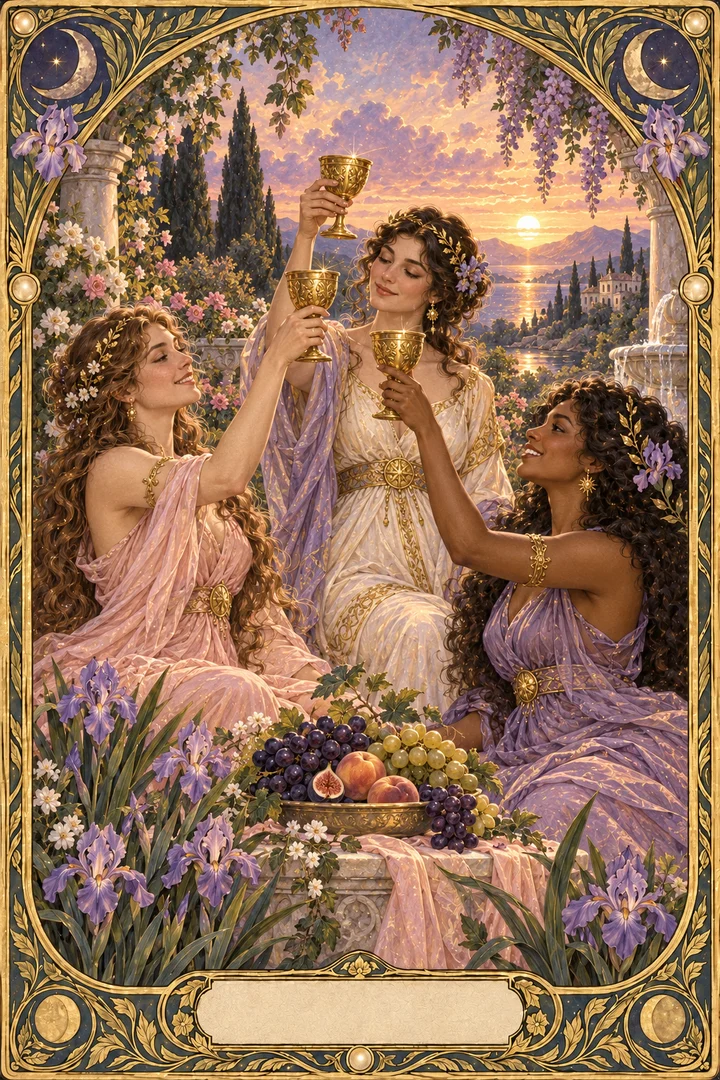 38 / SELFETTI
Three of Cups
With whom could I share a small piece of good news?
Explore this card
The traditional Three of Cups places three celebrating figures among harvest produce. Selfetti keeps three raised cups and a circle of adults in a flowering garden. The cups meet at a similar height, suggesting a shared moment rather than a single star of the scene. Our flowers and celestial setting are original additions to this familiar celebration.
- Upright, the Three of Cups is commonly read through friendship, celebration and support within a group. The scale can be small: tea after a difficult week, people noticing a finished task or a familiar table where you can be quiet. Ask whether there is room for everybody to contribute and receive attention. Shared pleasure can be part of ordinary life without a major achievement to justify it.
- In love, the Three can invite a wider view of affection: friendships, community and a shared world around a couple. Being single does not place you outside the theme. Reversed, check whether your social arrangements leave room for both people and for quieter forms of closeness.
Tell one person something you are pleased about. Let the sentence stand without immediately minimising it.
Read the full guide ↗ · One card. A little room for yourself. ↗ 39 / SELFETTI
Four of Cups
What kind of offer would feel welcome, if any, today?
Explore this card
The traditional Four of Cups shows a person seated beneath a tree, three cups on the ground and a fourth offered from a cloud. Selfetti keeps those four cups in an open, softly lit garden. The figure's quiet posture gives the offer room to remain unanswered for a moment. You can examine attention and readiness without assigning a moral judgment to the person.
- Upright, the Four of Cups is often associated with disengagement, dissatisfaction or attention turned inward while an offer is nearby. Ask what makes the offer difficult to receive. You may need rest, a different arrangement or time to understand what you want. Sometimes declining has become automatic and deserves another look. Distinguish an offer's apparent attractiveness from whether it actually fits your present needs.
- In love, use the Four to ask what kind of closeness feels possible today. An affectionate offer can miss the recipient's need even when it is well meant. Reversed, discuss whether readiness is changing. Avoid using the quiet figure to decide that someone no longer loves you; ask about their actual experience.
Choose one invitation or offer. Accept, decline or suggest a smaller arrangement in a sentence that reflects your actual capacity.
Read the full guide ↗ · One card. A little room for yourself. ↗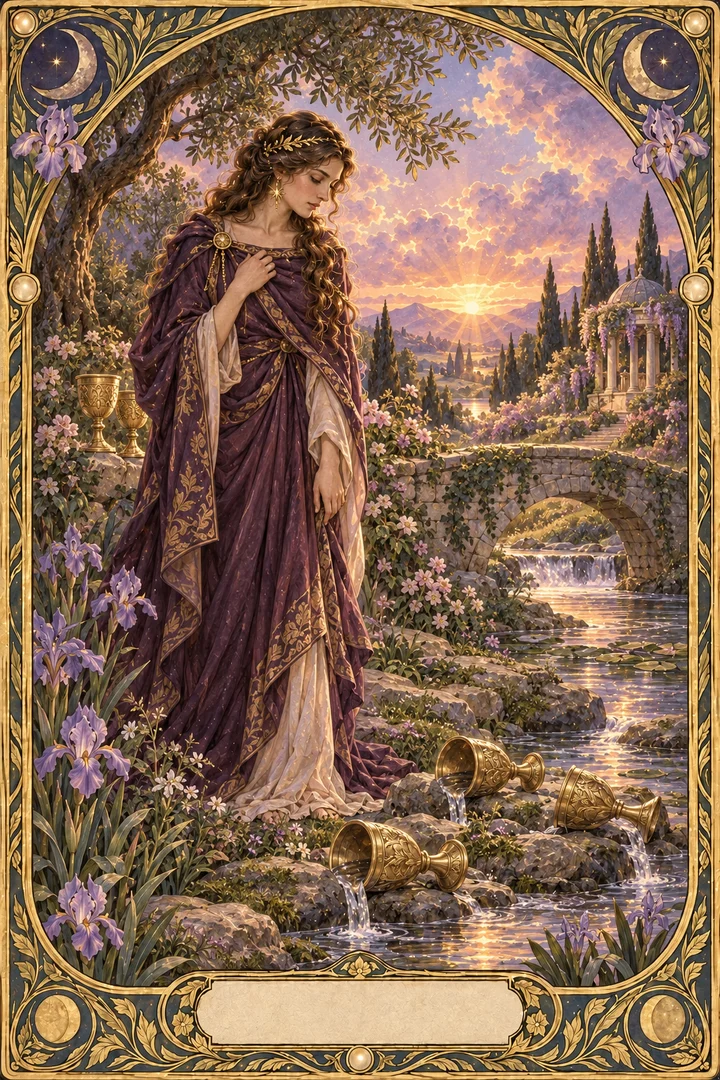 40 / SELFETTI
Five of Cups
What did I hope this would give me?
Explore this card
The traditional Five of Cups shows a cloaked figure facing three fallen cups, with two still upright behind. A stream, bridge and distant home are part of that historical scene. Selfetti keeps these details in a twilight garden with warm flowers. The two upright cups make something remaining visible; they do not tell us what support exists in a particular reader's life.
- Upright, the Five of Cups often describes disappointment and attention drawn toward what was lost. A plan can carry hope that other people never saw, so its cancellation may feel larger than the event appears. Begin by naming what mattered. Then, when useful, examine what remains available. You do not have to produce gratitude on demand. The fallen and upright cups give the reading two things to notice without requiring one to cancel the other.
- In love, the Five can frame an unmet hope, a missed plan or a loss in the relationship. Say what disappointed you before deciding what it means about the whole connection. Reversed, ask whether there is actual support, changed behaviour or willingness to talk. The card itself cannot establish that affection remains or that somebody will return.
Finish ‘This mattered because…’. If you want, name one available form of support without asking it to replace what was lost.
Read the full guide ↗ · One card. A little room for yourself. ↗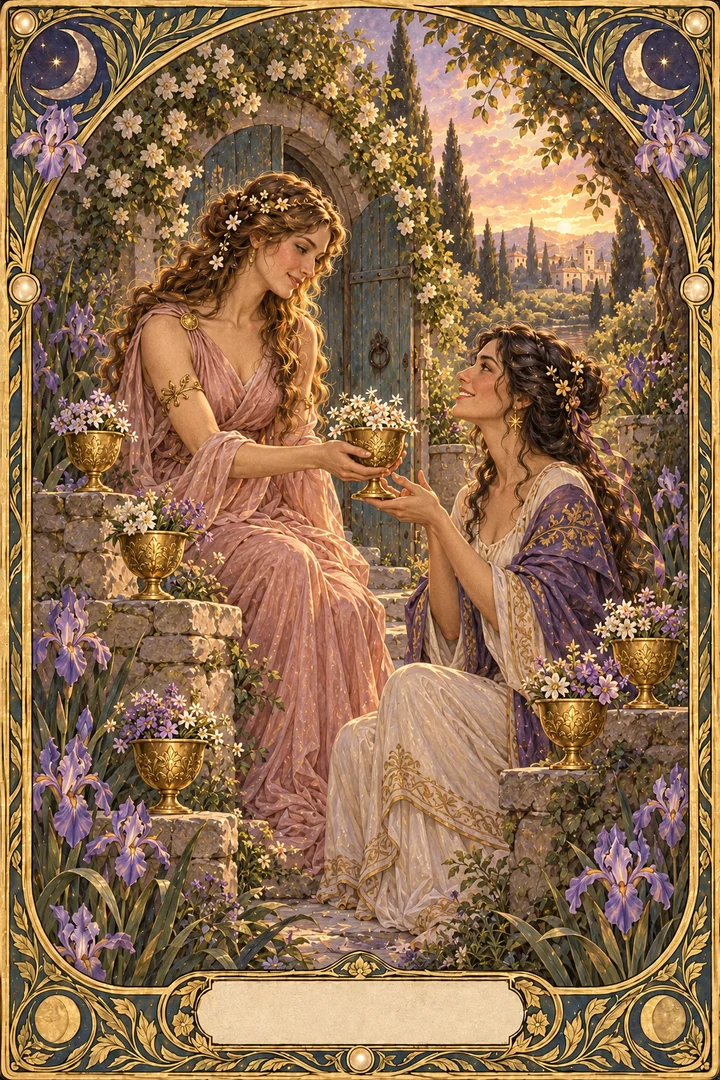 41 / SELFETTI
Six of Cups
What would I like to keep, and what needs room to change?
Explore this card
The traditional Six of Cups shows children in a sheltered garden with flower-filled cups. Selfetti adapts this into two adult childhood friends meeting again. One offers a flower cup and five others stand around the garden, making six. The adult reunion is our illustration's story; the floral cups and sheltered setting retain the historical image's familiar details.
- Upright, the Six of Cups is often read through memory, kindness and the comfort of something familiar. A person may remember how you take your tea, or an old activity may still offer pleasure. Let the memory be specific instead of declaring the whole past better. Familiarity can support a present exchange when both people have room to change. You can enjoy a remembered kindness and still notice what is different today.
- In love, the Six can frame familiar affection, shared history or nostalgia about a past connection. A memory is an experience you carry; it does not establish what the other person wants now. Reversed, notice whether you are comparing a present relationship with an edited version of the past or asking somebody to stay in an old role.
Choose one remembered kindness or activity. Adapt it to a small present-day gesture, with respect for everybody's current needs.
Read the full guide ↗ · One card. A little room for yourself. ↗ 42 / SELFETTI
Seven of Cups
Which imagined detail could I replace with experience?
Explore this card
The traditional Seven of Cups places fantastic objects in seven cups among clouds: a face, a veiled shape, a snake, a castle, jewels, a wreath and a dragon. Selfetti keeps these distinct possibilities against a luminous garden sky. Their variety gives imagination many places to go. The picture cannot tell us which attractive option is real or suitable in a particular situation.
- Upright, the Seven of Cups often concerns imagination and the difficulty of choosing among appealing possibilities. Each option may hold a feeling you want: freedom, admiration, closeness or room to create. Name that desire, then ask what the option would involve on an ordinary day. Imagination can begin useful exploration. It becomes harder to use when every idea stays polished and untested above the ground.
- In love, the Seven can invite a distinction between the person you know and the relationship you imagine. Enjoy hope while noticing what the actual exchange contains. Reversed, ask whether expectations are becoming clearer or whether you have narrowed your view to one reassuring story. The seven cups do not count possible partners or reveal private intentions.
Choose one option and one small representative task. Try it within a limit of time or money you can comfortably set.
Read the full guide ↗ · One card. A little room for yourself. ↗ 43 / SELFETTI
Eight of Cups
What no longer fits, and what would a careful transition require?
Explore this card
The traditional Eight of Cups shows a traveller leaving eight arranged cups under a moon. Selfetti places five cups below and three above, with a figure walking uphill through a twilight garden. The standing cups give the departure complexity: something can still look intact while the person seeks a different path. This is an image to examine, not an instruction to leave.
- Upright, the Eight of Cups is commonly read through departure and the recognition that something no longer feels fulfilling. The situation need not be visibly ruined. Ask what is missing, what still matters and whether a change within it could meet the need. If departure is a real option, include timing, obligations and support in the question. A feeling of mismatch deserves examination; it does not settle the practical decision by itself.
- In love, the Eight can invite attention to a persistent mismatch or unmet need. Speak about the actual experience before treating the image as a breakup instruction. Reversed, consider whether staying includes a real attempt at change or only the hope that somebody will become different. Their response and your circumstances matter more than the orientation.
Name one mismatch, one change worth trying and one practical condition that matters if you decide to leave.
Read the full guide ↗ · One card. A little room for yourself. ↗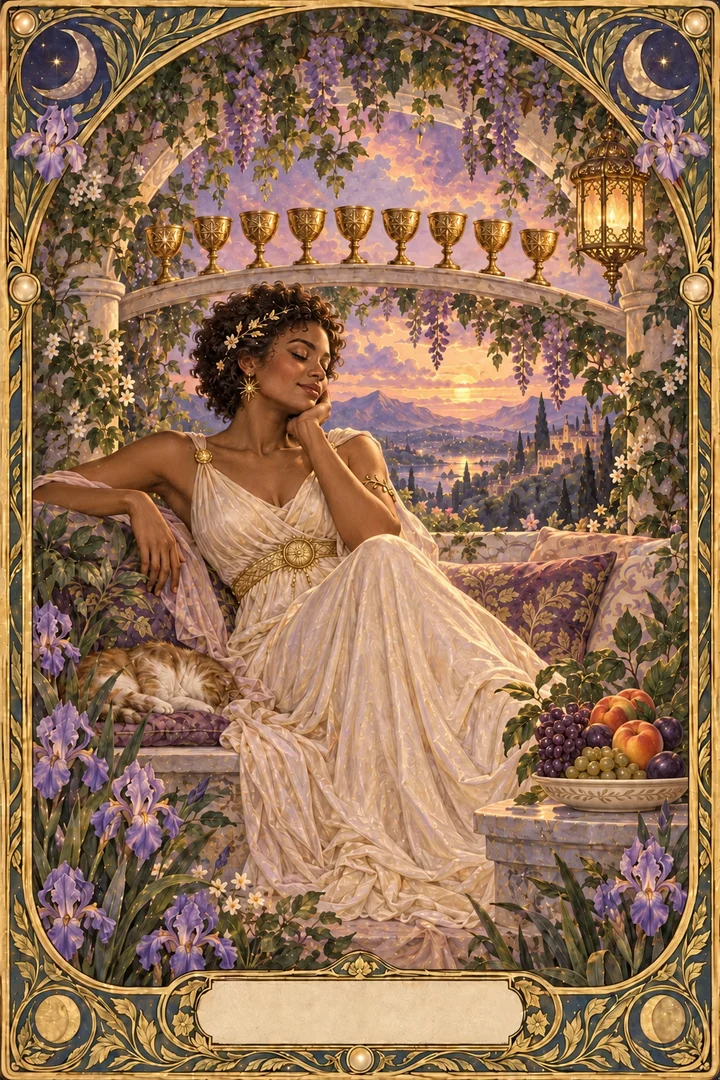 44 / SELFETTI
Nine of Cups
What feels quietly satisfying at its own scale?
Explore this card
The traditional Nine of Cups shows a seated figure with nine cups arranged behind. Selfetti keeps nine gold cups on a curved shelf and a person sitting comfortably among flowers, with tea and fruit nearby. These added details give satisfaction an everyday scale. The arranged cups are a historical motif; our meal and garden are an original interpretation of modest pleasure.
- Upright, the Nine of Cups is often associated with satisfaction, enjoyment and a wish fulfilled. Read that last phrase as a traditional association rather than a guarantee. Ask what feels welcome in an experience you already know. A comfortable meal or an unhurried evening can count. Enjoyment need not wait until every other part of life is settled or become proof that you made all the right choices.
- In love, the Nine can highlight enjoying company while keeping a sense of your own needs. Contentment alone does not establish mutual commitment. Reversed, ask whether the relationship looks pleasing while an important conversation remains missing, or whether you have been waiting for another person to make every part of life satisfying.
Name one detail you enjoy and give it a few unhurried minutes. Let it stay a pleasure rather than turning it into a task.
Read the full guide ↗ · One card. A little room for yourself. ↗ 45 / SELFETTI
Ten of Cups
Which ordinary agreement would make belonging easier?
Explore this card
The traditional Ten of Cups shows two adults and two children beneath an arc of ten cups, with a home and water nearby. Selfetti adapts the household into four adults as chosen family, with a dog and cat in a garden. Ten cups remain in the arc. The adult group is our original choice: shared belonging can be recognised in more than one family arrangement.
- Upright, the Ten of Cups is commonly read through shared happiness, emotional harmony and belonging. Look at the ordinary arrangements that make a place feel inhabitable: people keeping agreements, noticing needs and allowing somebody to have a quiet day. A beautiful shared moment can matter without proving that the group is perfect. Belonging is easier to examine through actual care than through whether a household resembles an ideal picture.
- In love, the Ten can frame building a shared life with room for each person's relationships and needs. Discuss the everyday meaning of home: time, tasks, money, privacy and company. Reversed, examine where the preferred picture has replaced an honest conversation. A ten-cup arc cannot establish marriage, children or a relationship's future.
Name one form of care you already value and one practical need worth discussing with the people involved.
Read the full guide ↗ · One card. A little room for yourself. ↗ 46 / SELFETTI
Page of Cups
What small expression would feel honest to offer?
Explore this card
The traditional Page of Cups holds a cup with a fish appearing inside, beside the sea. Selfetti keeps the fish, one cup and the waterside figure in a luminous floral setting. The unexpected visitor offers an image for curiosity and a surprising feeling. The Page is represented as an adult; the court theme is a way of attending that any adult can explore.
- Upright, the Page of Cups often brings a theme of fresh emotional expression and creative curiosity. A compliment, an unfinished sketch or a tentative invitation can give a feeling a visible form. Keep the expression proportionate to what you know. You can begin without asking the response to settle your worth or the entire future of the idea. A little surprise may deserve attention before you know what to do with it.
- In love, the Page can frame a modest gesture and the vulnerability of making it. Reversed, give awkwardness room while keeping the other person's comfort in view. The fish cannot predict a message, a proposal or another person's hidden feelings. Your own sincerity can be visible without making a response compulsory.
Write, make or say one modest thing that reflects your actual interest. Leave room for its response and for your own next revision.
Read the full guide ↗ · One card. A little room for yourself. ↗ 47 / SELFETTI
Knight of Cups
What would make this invitation comfortable to receive?
Explore this card
The traditional Knight of Cups approaches on a pale horse while holding one cup, with water in the landscape. Selfetti keeps a calm rider and horse beside a stream in the garden. The unhurried approach offers a visual contrast with the speed of the Knight of Swords. Our reading uses that pace to ask whether an invitation can be received comfortably.
- Upright, the Knight of Cups is often associated with an invitation, romance or pursuing an ideal with feeling. Make the theme useful by examining the action that carries the intention. A beautiful offer needs a real time, an appropriate scale and room to decline. Enthusiasm becomes more considerate when it includes attention to what the recipient wants, rather than only how you imagined giving.
- In love, the Knight can frame making an affectionate approach and keeping it connected to consistent behaviour. Reversed, compare the promise with follow-through rather than reading charm as certainty. The card cannot identify a future partner or certify anybody's sincerity. A caring intention should be able to hear the other person's preference.
Give one offer a realistic time and scope. Ask about the recipient's preference and leave a straightforward way to decline.
Read the full guide ↗ · One card. A little room for yourself. ↗ 48 / SELFETTI
Queen of Cups
What would help me give attention without disappearing from the conversation?
Explore this card
The traditional Queen of Cups sits beside water, attending to an ornate covered cup. Selfetti keeps that closed vessel, the shore and a shell-like throne in a flowering setting. The cup is held rather than overflowing. In our modern reading, its enclosure and the shore invite thoughtful attention with room for privacy and limits. The inherited Queen title is not a gender requirement.
- Upright, the Queen of Cups is often associated with receptive care and attention to feeling. Listening can involve asking, reflecting and leaving a person time to find words. It does not require knowing what they feel better than they do. Keep your own capacity in view too. A considered response can include both warmth and a clear account of the time or help you can offer.
- In love, the Queen can frame listening with enough curiosity to let another person speak for themselves. Reversed, examine whether understanding has become a reason never to say you are disappointed. Care should leave room for your experience as well as the explanation you can offer for somebody else's behaviour.
Before one conversation, name the time or help you can honestly offer. Consider who could listen to you in return.
Read the full guide ↗ · One card. A little room for yourself. ↗ 49 / SELFETTI
King of Cups
What feeling needs words before I decide how to respond?
Explore this card
The traditional King of Cups sits on a throne amid water, holding a cup and a separate sceptre, with a ship and a sea creature nearby. Selfetti keeps one cup and a slender sceptre in a flowering scene above the sea. The moving water offers a contrast with the seated figure. We use it to reflect on responding steadily while feelings remain present, not on being untouched by them.
- Upright, the King of Cups is often read through emotional steadiness and a considered response. The useful question is how feeling can be acknowledged without deciding every action in its first rush. You might name frustration, take a pause and return to a conversation with a clearer request. Composure can be honest about what is difficult. A reliable person need not keep everyone else comfortable at the cost of their own experience.
- In love, the King can frame making room for emotion while keeping agreements about how you speak and respond. Reversed, ask whether composure has become avoidance or whether an emotional appeal makes it hard for somebody to disagree. Respect includes the freedom to give an answer other than the one you hoped for.
Write one feeling, the decision in front of you and a response you can take responsibility for. Include a pause if you need one.
Read the full guide ↗ · One card. A little room for yourself. ↗ 50 / SELFETTI
Ace of Wands
What would I try if it only needed twenty minutes?
Explore this card
The traditional Ace of Wands shows a hand emerging from a cloud, holding a sprouting wooden staff. Selfetti keeps this single living wand above a flowering garden, with a winding path and a distant castle. The new leaves suggest a possibility worth trying; the path offers a way to give it a small beginning. Our golden frame, irises and sunset are part of the original illustration. There is no person standing in the garden and no promise about where that beginning will lead.
- The Ace of Wands is often read as a creative spark: an interest, an urge to begin or a possibility that has life in it. An Ace gives the beginning a place without describing the whole project that might follow. You may feel drawn to something and still be unable to explain why it matters. Let the first step be small and reversible. Initiative does not require a complete plan; it only asks you to give the spark a modest container before it fades.
- In love, the Ace of Wands brings a question about honest expression: can you share an interest or attraction without treating chemistry as compatibility? A spark invites a conversation; willingness and boundaries emerge in the reply. Reversed, notice whether a delayed start or scattered energy is keeping you from saying what you feel. The other person's feelings still belong to their own words and behaviour.
Make one small draft with what you already have. Afterwards, note whether the doing gave you energy or asked for more rest.
Read the full guide ↗ · One card. A little room for yourself. ↗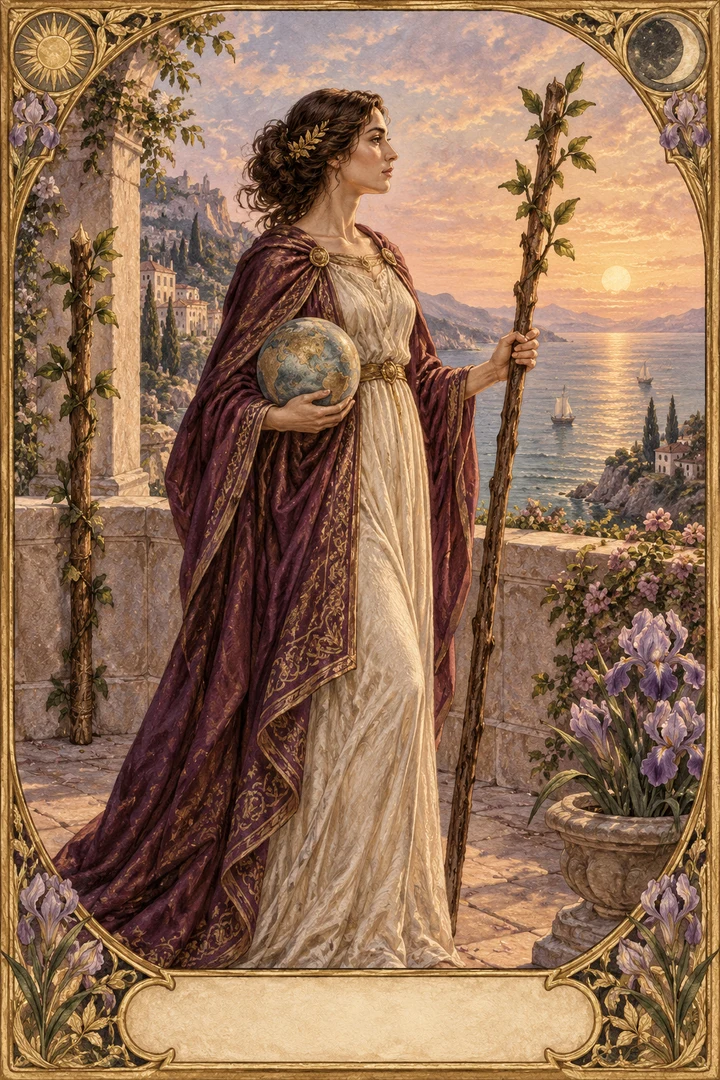 51 / SELFETTI
Two of Wands
Which possibility fits my own priorities, rather than someone else's picture of progress?
Explore this card
The traditional Two of Wands shows a figure on a castle wall holding a globe and a staff, with another staff fixed beside them, looking out over land and sea. Selfetti keeps those recognisable elements in a rose-stone garden terrace. We read the globe and the view beyond the wall as an invitation to consider possibility, while the two staffs mark a present position. The plum silk cloak, garden flowers and distant hills belong to our original setting; they do not add a separate prediction to the card.
- The Two of Wands is often read as a moment of planning and perspective: you can see more than one path ahead, and you have enough stability to consider them. The globe and the view beyond the wall make room for possibility, while the two staffs also mark a present position. Compare actual paths using your own values, time and obligations; you need not abandon everything to explore. Agency here is not about having all the answers, but about choosing a direction you can test.
- In love, the Two of Wands brings a question about direction and pace. Discuss the direction and pace each person wants. Imagining a shared future cannot substitute for hearing the other person's preference now. Upright, you may be considering how a relationship fits with your other commitments. Reversed, check whether you are planning around an imagined version of someone rather than their actual words and behaviour.
Compare two paths on three things that matter to you. Choose one reversible way to learn more this week.
Read the full guide ↗ · One card. A little room for yourself. ↗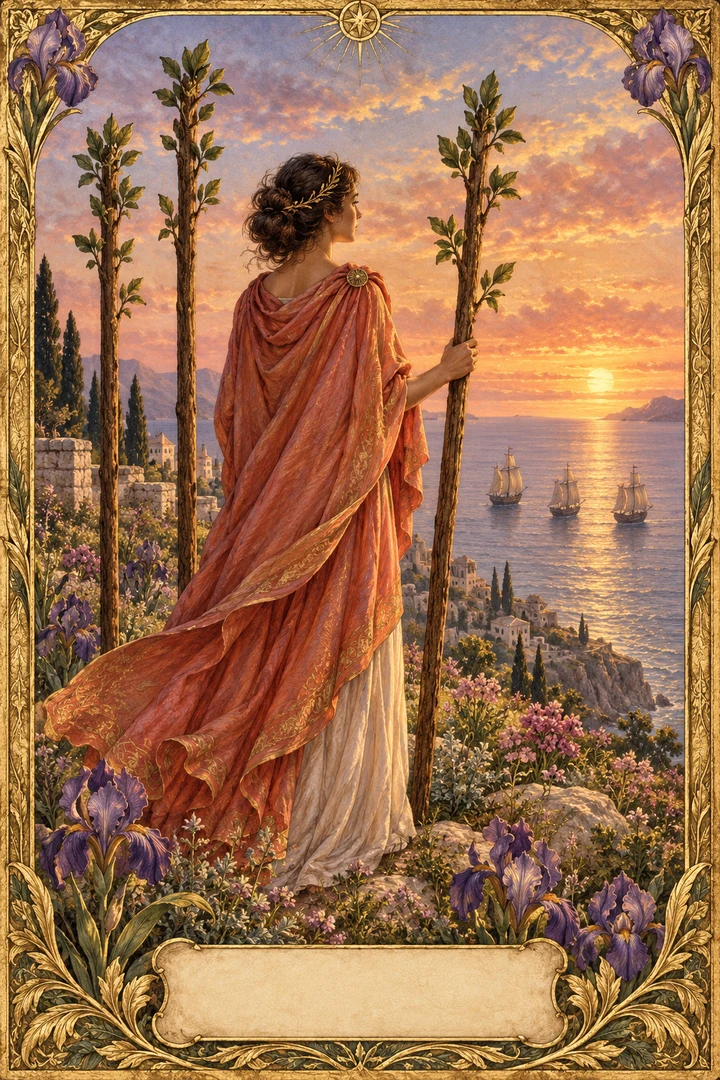 52 / SELFETTI
Three of Wands
What real response would help me decide the next step?
Explore this card
In the traditional image, a figure stands on a height with three wands and watches ships depart. Selfetti keeps the wands, the sea and the distant horizon, but places an adult woman in a flowing coral cloak on a flowering hill above the water. Three tall leafy wooden wands stand around her: two on one side, one held gently on the other. The golden sunset and flowers belong to our original garden setting. We read the ships as an outward effort already made, and the horizon as a place to look for real responses rather than a promise of return.
- The ships and distant horizon shift attention beyond the starting point. You have sent something out; now look for actual responses and what they teach. Expansion needs room, follow-through and a willingness to revise. This is not about waiting passively. It is about staying in contact with what you launched, noticing who replies and what they say, and letting that information shape your next move. The card often appears when an early effort is still small enough to adjust. You may feel exposed, but the horizon is wide enough to hold both hope and practical feedback.
- Make room for a connection to grow through real plans and answers. A distant horizon is not evidence that someone far away will return. In love, the Three of Wands can show an early effort to reach out, a first date, or a conversation about what you both want next. The card asks you to notice whether the other person is actually responding, not just whether you hope they will. Reversed, it may point to mixed signals or a plan that needs a more honest conversation.
Follow up on one thing you have already sent out. Ask one answerable question and choose a date to review what you learn.
Read the full guide ↗ · One card. A little room for yourself. ↗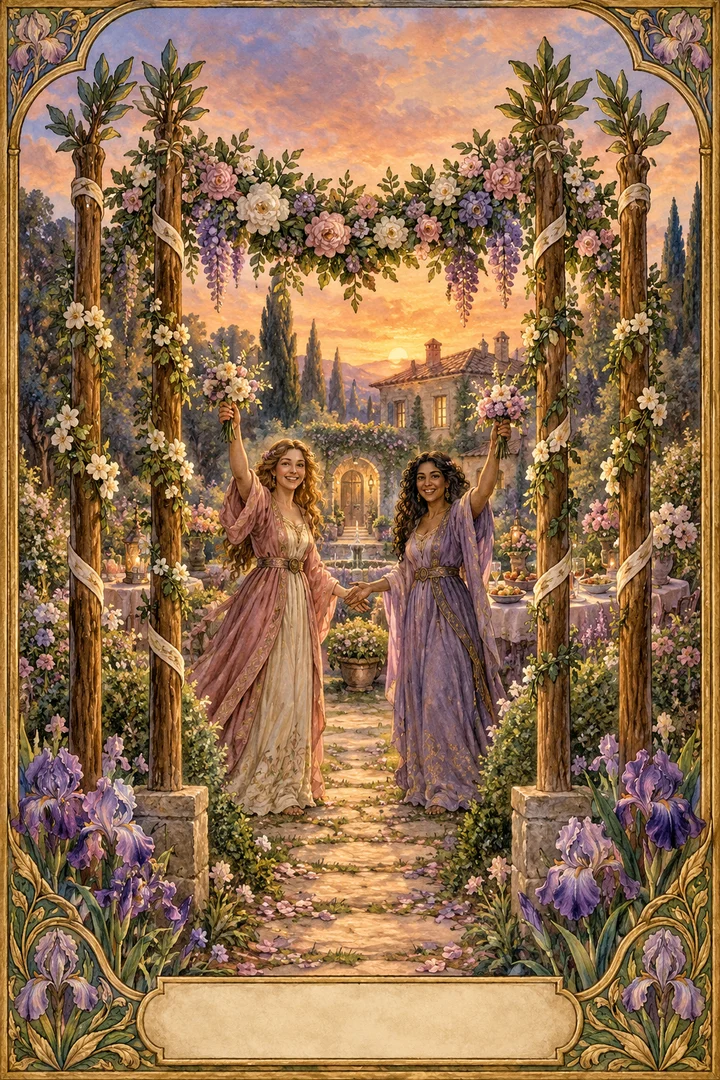 53 / SELFETTI
Four of Wands
What small milestone would I like to acknowledge, and with whom?
Explore this card
The traditional Four of Wands shows four upright staffs topped with a garland of flowers, often with two figures celebrating beneath it. Selfetti keeps the four leafy wooden wands and the abundant floral garland, but sets them in a garden where two adult friends raise small bouquets in a warm homecoming welcome. A distant garden house suggests celebration without wedding symbolism. The open floral gateway is a threshold you can step through, not a barrier. The flowers and garden belong to our original setting; they do not add a separate prediction to the card.
- Four staffs and a garland make an open threshold. A milestone can be small: finishing a shared task, finding a rhythm at home or making someone welcome. Pause to recognise the support behind it. The card often points to a stable base you have built together, whether that is a household, a friendship or a team. It does not require a grand event. A quiet acknowledgment can be enough. Notice who helped you get here, and let yourself enjoy the welcome too.
- Ask what home and shared occasions mean to each person. A joyful meeting does not itself establish commitment, marriage or safety; notice the everyday agreement behind it. In love, the Four of Wands can highlight a sense of belonging or a milestone you want to celebrate together. It may also reveal different expectations about what home looks like. The card does not guarantee a wedding or reunion. It invites you to talk about the small rituals that make a relationship feel like a base.
Mark one completed step with a small ritual. Thank someone specifically, and choose a form of celebration that fits your energy.
Read the full guide ↗ · One card. A little room for yourself. ↗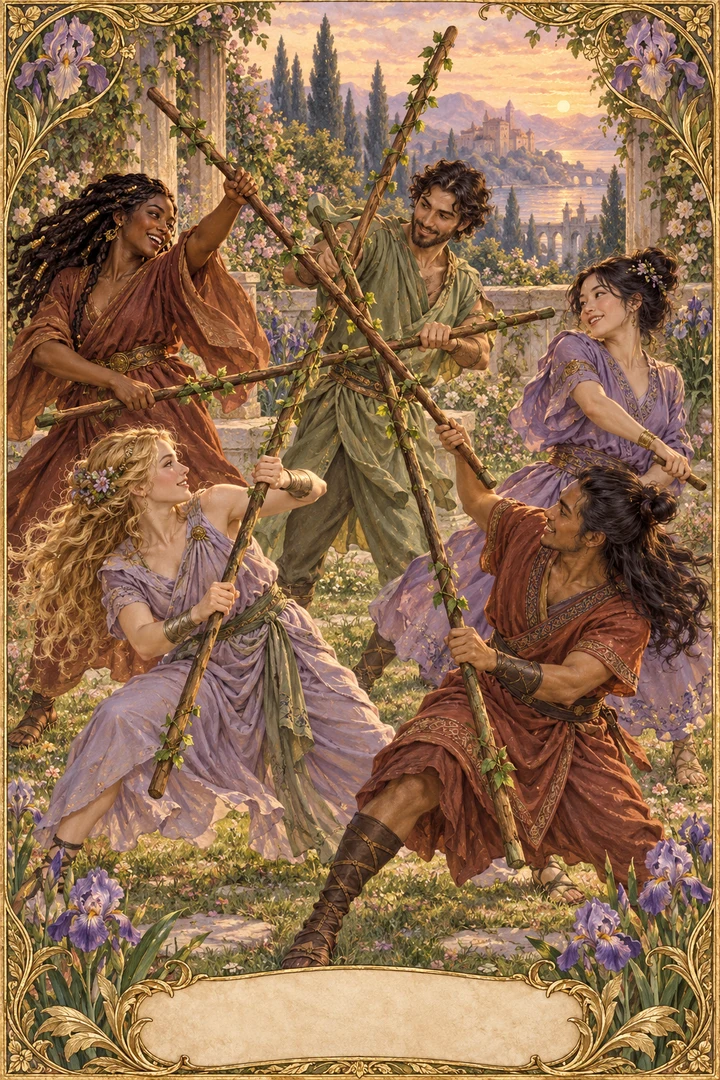 54 / SELFETTI
Five of Wands
What shared rule would make this disagreement easier to work with?
Explore this card
The traditional Five of Wands shows five figures raising staffs in a chaotic clash, often read as competition or conflict. Selfetti keeps the five crossing staffs but sets them in a garden clearing, where five diverse adult friends in russet, sage and lilac tunics hold their own leafy staffs in a playful coordinated practice. The crossed angles show different approaches meeting; the animated faces stay friendly. No battle or injury. The garden, flowers and dignity of choice belong to our adaptation, not the original card.
- The staffs cross without a settled pattern. Several people may be trying to contribute in different ways, and the friction is not automatically hostile. First distinguish useful debate from a situation that leaves someone unsafe or silenced. Lively disagreement can sharpen an idea, reveal a blind spot or show where coordination is missing. The task is not to eliminate every clash but to give the different energies a fair way to meet. A shared rule, a clear decision and a turn for each voice can turn scattered effort into something workable.
- Compare the actual disagreement: time, attention, plans or how decisions are made. A difference is not proof of betrayal. Both people need a chance to speak without intimidation. In love, the Five of Wands can show two people with different rhythms or preferences trying to find a shared way forward. The friction may be about logistics, energy or how much togetherness feels right. Name the specific issue rather than turning it into a verdict on the relationship. A fair conversation includes room for both voices and a willingness to adjust.
Name the decision and one fair criterion. Give each person a turn before choosing the next step.
Read the full guide ↗ · One card. A little room for yourself. ↗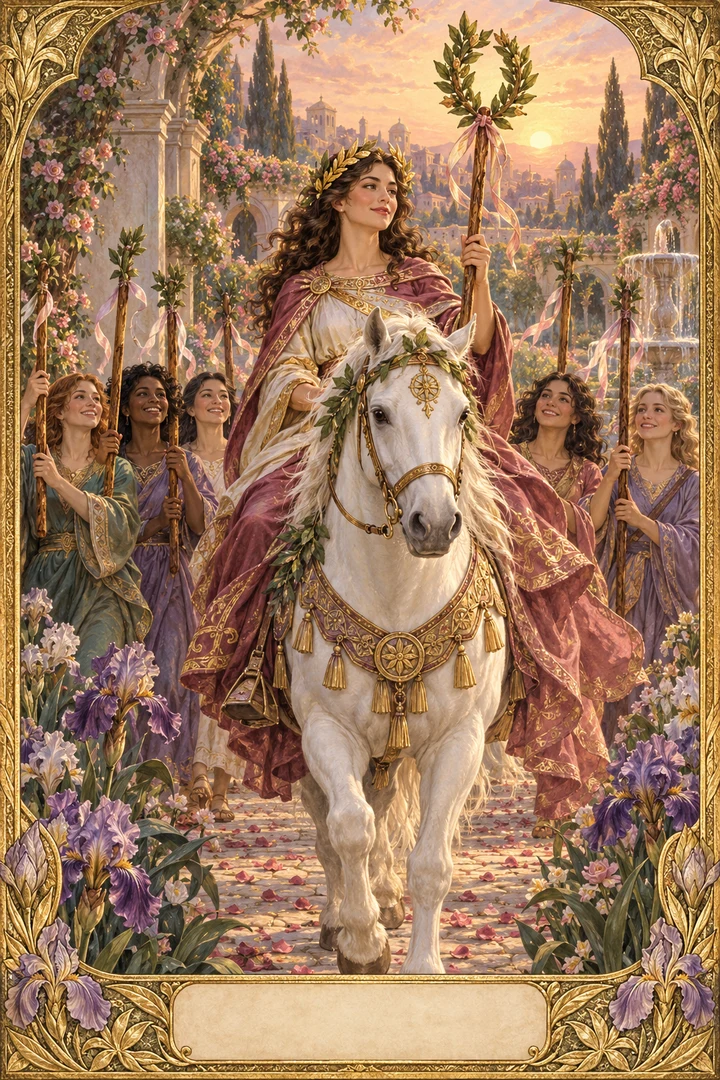 55 / SELFETTI
Six of Wands
What contribution can I acknowledge without comparing it with anyone else's?
Explore this card
The traditional Six of Wands shows a rider with a laurel wreath on a wand, greeted by supporters. Selfetti keeps that scene in a garden courtyard: an adult woman in a modest laurel crown rides a calm white horse, carrying one wooden wand with a wreath near its top. Five supporters each hold a separate wand behind her, all five shafts visible. The rose-gold late afternoon light and the welcoming garden belong to our original setting. We read the wreath as a moment of acknowledgement, not a promise of victory. The supporters remind us that visible work has support behind it.
- A rider with a wreath is met by supporters. Take in a specific acknowledgement without turning it into a requirement to remain impressive. The people around the rider remind us that visible work has support behind it. You might notice the wreath near the top of the wand and the five separate wands held by others. Those details frame a human tension: the wish to be seen and the quiet truth that no one arrives alone. Let one kind word land before you explain it away. You can receive credit and still be generous.
- Appreciation matters when it names something real. Public admiration cannot replace private respect, and a compliment is not proof of lasting commitment. In love, the Six can show a moment when your effort or presence is acknowledged. Let that be pleasant without making it the whole measure of the relationship. If recognition is uneven, say what you noticed and what you would value hearing. The other person's feelings still belong to their own words and behaviour.
Write one completed contribution and one person who supported it. Accept or offer a specific thank-you.
Read the full guide ↗ · One card. A little room for yourself. ↗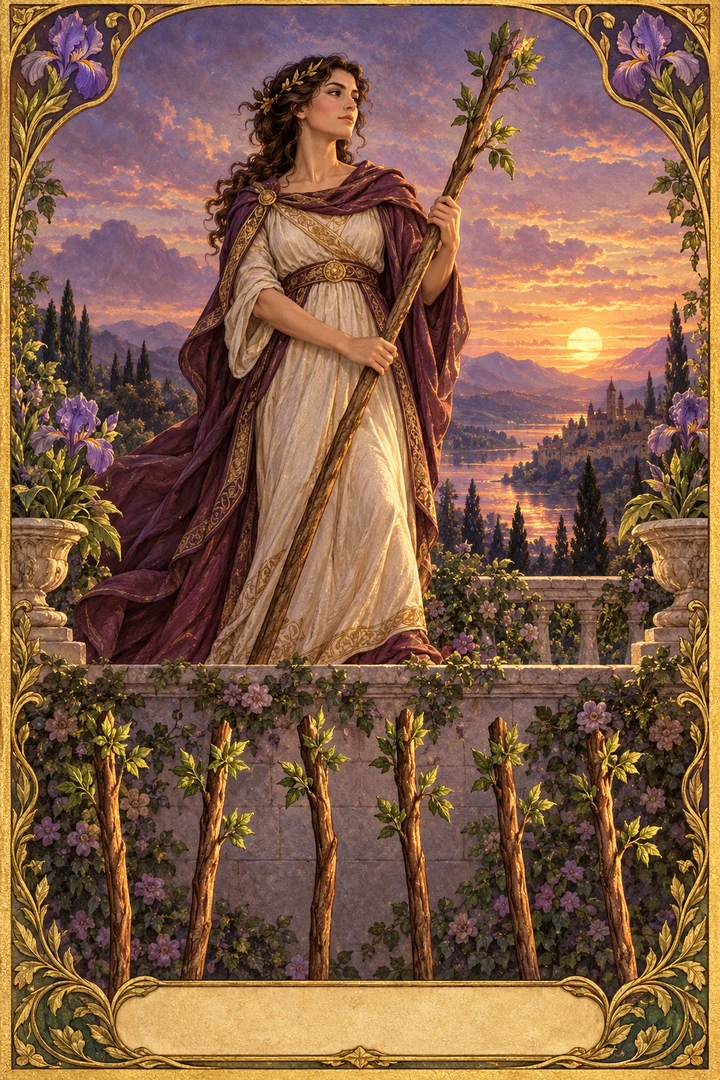 56 / SELFETTI
Seven of Wands
Which limit matters enough to hold, and which argument can I leave?
Explore this card
The traditional Seven of Wands shows a figure on high ground, one staff held above six others rising from below. Selfetti keeps that recognisable tension in an original scene: an adult woman stands steadily on a raised flower-lined terrace, holding one long wooden staff diagonally across her body. Exactly six other staffs rise from the lower edge, no owners visible. The aubergine and gold dusk, garden and flowers belong to our setting. We read the single staff as a chosen boundary and the six below as pressures or questions that do not all require the same answer. The image does not show attackers; it shows a position being held.
- The Seven of Wands is often read as standing by a position you have chosen: a limit, a value or the time a task actually needs. One staff is held above six others, which suggests discernment rather than endless defence. You do not have to answer every challenge or win every disagreement. Holding a boundary can be quiet, specific and kind. The card asks what genuinely needs protecting now, and what can be left unanswered. Firmness here is not hostility; it is knowing which conversation matters and which one you can release.
- In love, the Seven asks you to state the limit and the behaviour involved. A relationship can include both warmth and a no. You might protect time alone, a need for honesty or a pace that feels sustainable. The card cannot identify an enemy or decide whether the other person respects you. Reversed, notice if you are defending every preference or if a boundary needs a kinder, clearer form. The other person's feelings remain theirs to name.
State one limit in one or two sentences. Offer only the alternative you can actually keep.
Read the full guide ↗ · One card. A little room for yourself. ↗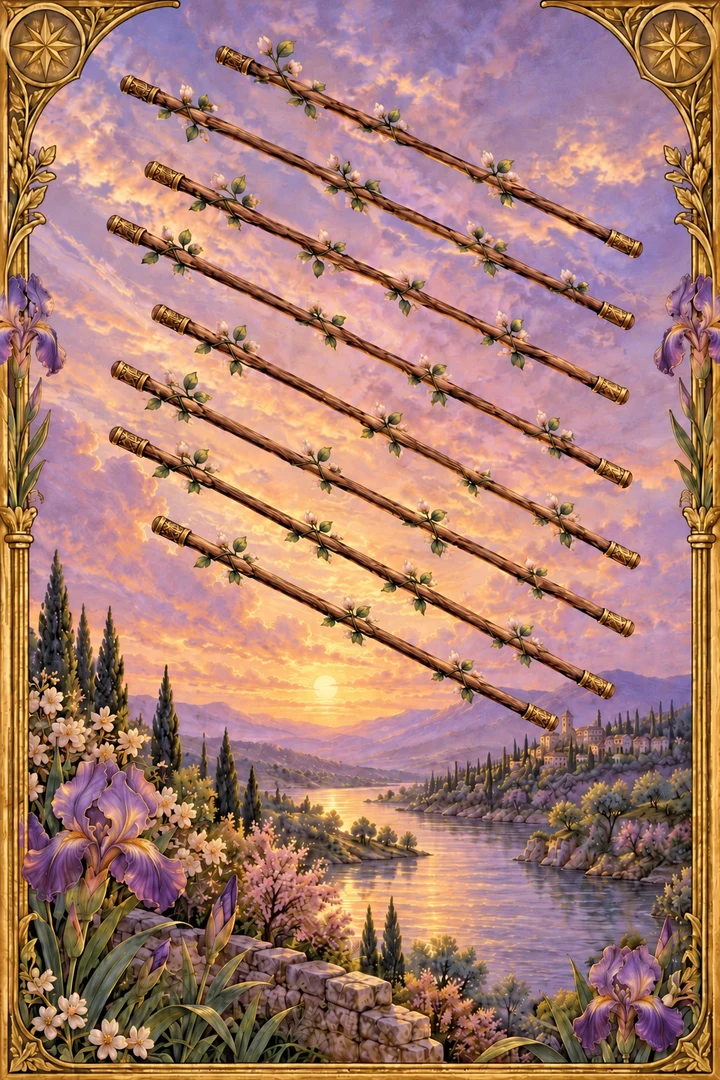 57 / SELFETTI
Eight of Wands
What needs a timely response, and what only feels urgent?
Explore this card
The traditional Eight of Wands shows eight parallel staffs flying through open sky, with no person holding them. Selfetti keeps that sense of momentum in an original scene: eight long wooden wands, each with tiny budding leaves, travel diagonally above a flowing river and a peaceful flowering landscape. The lavender-gold sky and garden belong to our setting. We read the space between the staffs as a reminder that speed still needs direction and a recipient.
- Eight parallel staffs cross open sky without a person holding them. A sequence may now move quickly. Keep your next response clear; speed becomes useful when the direction and recipient are understood. You might feel pulled to answer every notification at once, but momentum does not require you to abandon your own pace. A single clear message can coordinate more than a flurry of rushed replies. Notice what actually needs to move today and what can wait without harm.
- A timely, direct message may help, but repeated contact cannot create another person's willingness. Give a clear invitation room to receive a response. In love, the Eight of Wands can describe a quick exchange, a plan coming together or the impulse to say something before you have thought it through. You can be honest without demanding an immediate answer. If you are waiting to hear back, notice whether you are filling the silence with assumptions. The other person's feelings remain theirs to share or not.
Check one message or handoff. Send one concise next step with the information the recipient needs.
Read the full guide ↗ · One card. A little room for yourself. ↗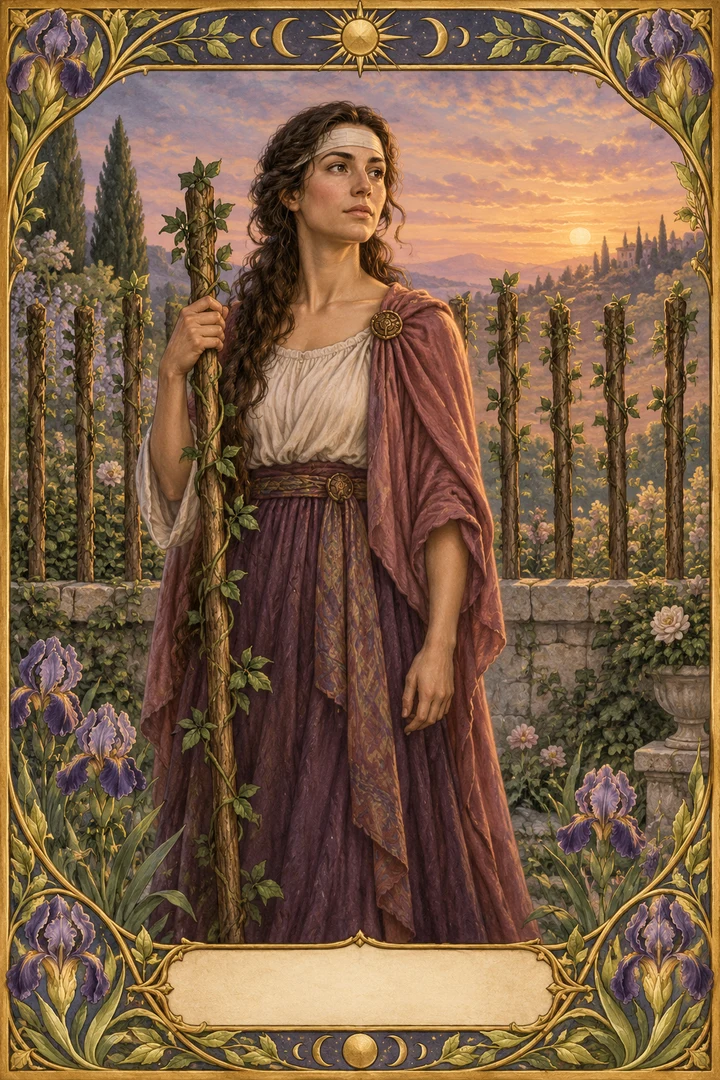 58 / SELFETTI
Nine of Wands
What support would make continuing more humane?
Explore this card
The traditional Nine of Wands shows a bandaged figure holding one staff before a fence of eight. In Selfetti's evening garden, an adult woman with a forehead bandage holds one leafy staff while eight upright staffs stand behind her. The bandage and fence are recognisable traditional details. The flowers, warm twilight and dignified pose are our own adaptation. We read the guarded stance as caution shaped by experience, without inventing a past event or predicting another hardship. The visible scene leaves room to consider rest and support.
- A bandaged figure holds one staff before a fence of eight. You may have reasons to be careful. Check what this situation actually asks for now, rather than preparing for every difficulty you have met before. Experience can protect you, and it can also leave you braced for a fight that is not happening. Notice the difference between a real limit and an old habit of defence. Remaining capacity is not infinite; it is something you can measure and protect. Persistence works better when it includes support and a place to set the staff down.
- Past disappointment may explain caution without proving that a new person will repeat it. Choose a pace with room for real observations and a conversation about what helps you feel comfortable. The bandage is not a verdict on anyone new; it is a signal that you have learned to protect yourself. In an established relationship, the Nine can show up as guardedness after a hard season. Say what would make closeness feel safer, and let the other person respond with their own words and behaviour. You do not have to earn care by being endlessly steady.
Name one remaining demand, one limit and one specific request for help. Reconsider the commitment if that support is unavailable.
Read the full guide ↗ · One card. A little room for yourself. ↗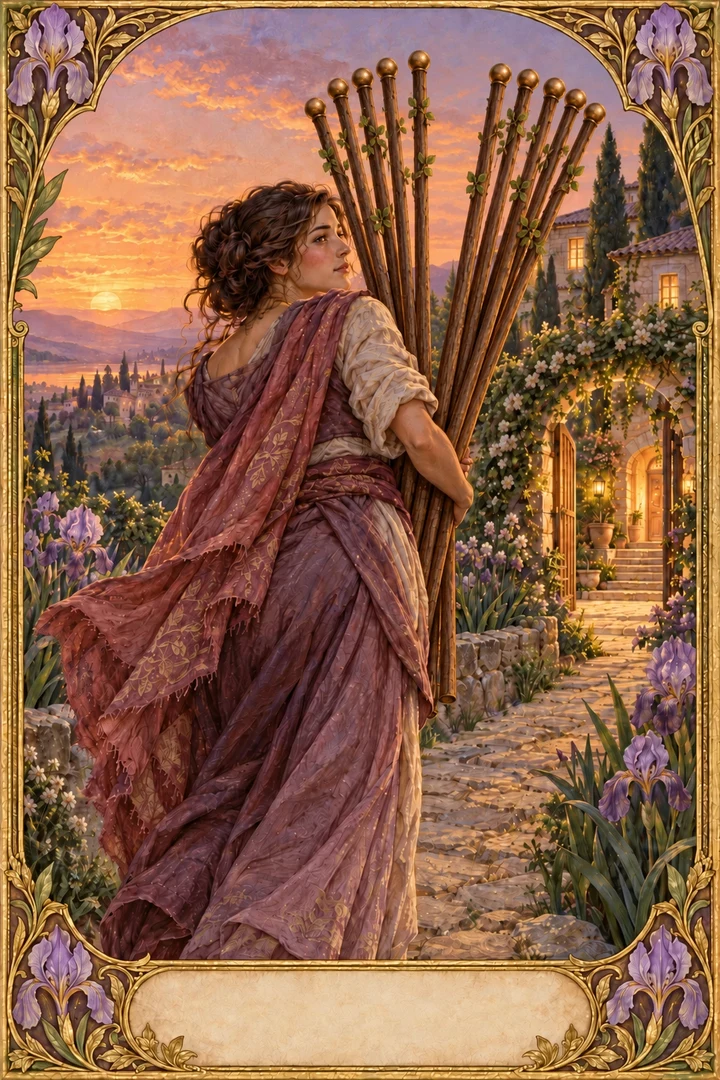 59 / SELFETTI
Ten of Wands
Which part of this load does not need to be mine?
Explore this card
The traditional Ten of Wands shows a figure carrying ten heavy staffs toward a distant town, the bundle obscuring the path ahead. Selfetti keeps the countable staffs and the visible effort, but sets the scene at dusk in a celestial garden. An adult woman walks toward a welcoming garden home, her face partly visible as she looks for a place to put the bundle down. The ten separated tips and shafts remain countable. Tired effort is shown with dignity, not exaggerated suffering. The garden, flowers and home belong to our original setting; they do not add a separate prediction to the card.
- Ten bundled staffs narrow the carrier's view of the destination. This card often points to overload, responsibility and hidden labour — the remembering, organising and anticipating that rarely appear on a shared list. List the work you are carrying, including the invisible parts. A task's importance does not establish that all of it belongs to you. Near completion, the temptation is to push through alone. Redistribution is not failure; it is how a load becomes sustainable.
- Talk about invisible work as well as visible chores. Being indispensable can make you tired and lonely; an agreement must be shared through action, not only appreciation. In love, the Ten of Wands can show up as one person carrying the emotional logistics — remembering birthdays, planning time together, noticing when something is off. Name what you are holding and ask what your partner can own. Reversed, notice whether you are releasing a burden or quietly resenting a load you never named.
List your commitments. Hand off, reduce or decline one item, naming who owns the next step and when.
Read the full guide ↗ · One card. A little room for yourself. ↗ 60 / SELFETTI
Page of Wands
What would I like to learn by trying, rather than by proving myself?
Explore this card
The traditional Page holds a staff and studies its budding leaves, a young figure in a barren landscape. Selfetti keeps the single upright staff and the salamander motif on the tunic, but sets the scene in a sunlit garden beside warm sandy hills. The figure is a young adult woman, not a child, and her embroidered coral tunic and attentive expression frame curiosity as a dignified adult choice. The garden and flowers belong to our original setting; they do not add a separate prediction to the card.
- The Page studies the living staff instead of directing a whole journey. Notice what you want to learn through doing. A first experiment can be honest, unfinished and worth your attention. You do not need a five-year plan to justify one beginner class or a single afternoon of trying something new. The Page's courage is not mastery; it is the willingness to be seen as a learner. Let your curiosity have a small, real place in your week, and let that be enough for now.
- Express curiosity without performing certainty. A playful invitation should leave the other person free to choose, and cannot supply their private feelings. You might be interested in someone and want to learn more about them through honest conversation rather than assumption. Reversed, check whether you are scattering attention or hiding your beginner's uncertainty behind a confident act. The other person's feelings still belong to their own words and behaviour.
Choose a short beginner experiment. Record one thing you noticed, without grading your whole ability.
Read the full guide ↗ · One card. A little room for yourself. ↗ 61 / SELFETTI
Knight of Wands
What would help this enthusiasm become a promise I can honour?
Explore this card
The traditional Knight of Wands rides a rearing horse and holds a living staff, a figure of motion and initiative. Selfetti keeps the horse and the single upright staff but sets the scene in a flower-lined garden path. Our rider is an adult woman in light engraved armour with a flowing russet cape, calm and purposeful rather than combative. The small salamander embroidery and warm distant hills belong to our original setting; they do not add a separate prediction. We read the raised foreleg as energy that is ready to move, and the upright staff as a direction chosen rather than merely inherited.
- The Knight of Wands is often read as active, adventurous energy: the impulse to begin, to try something bold, to move before every detail is settled. The horse and living staff give the Knight momentum, but momentum is not the same as a plan. You may feel a genuine spark of courage and still need to choose where it is going. Boldness can sit beside a check of the route, the cost and other people's consent. A purposeful trial is different from a blind leap: it has a boundary, a first attempt and a way to notice what happens next.
- In love, the Knight brings lively contact, attraction and the pleasure of someone who makes plans. That energy can be enjoyable while reliability is still unknown. State the pace you want and notice whether plans are kept over time. The card cannot label someone a player or prove their intention; it describes a style of approach, not a verdict on a person. Reversed, watch for haste in you as much as in them. If you have promised more contact than you can sustain, say so before the gap becomes a silence.
Choose one bounded action and one follow-up. Check the practical details before inviting someone else into the plan.
Read the full guide ↗ · One card. A little room for yourself. ↗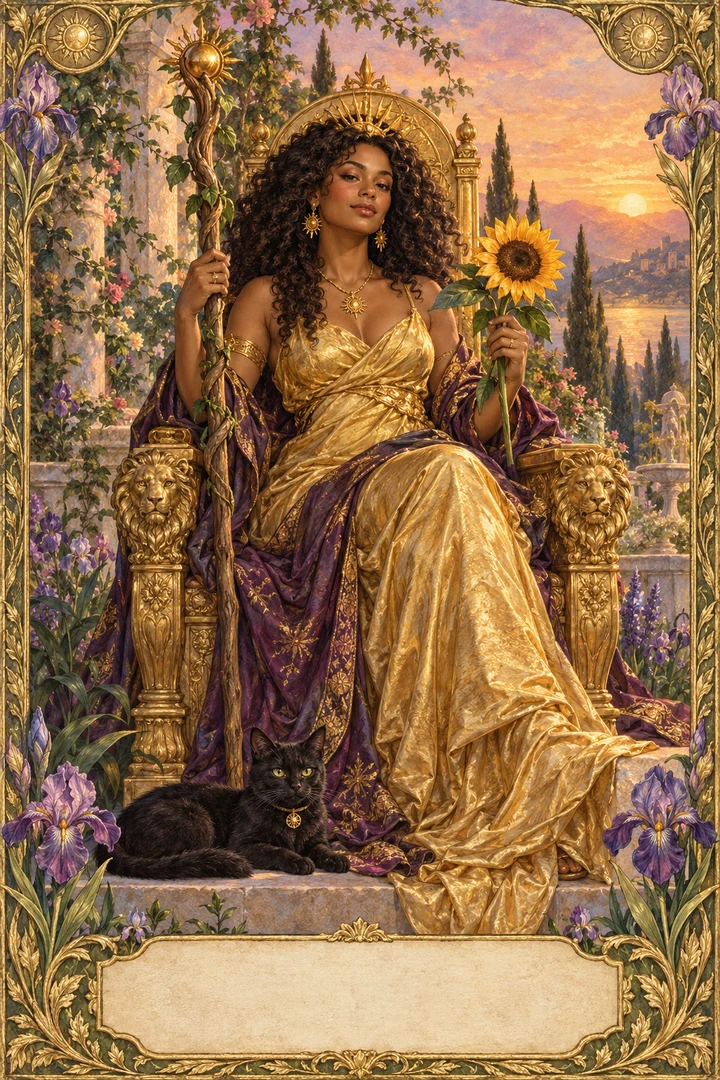 62 / SELFETTI
Queen of Wands
What would I express if I did not need everyone's approval first?
Explore this card
The traditional Queen of Wands sits on a throne decorated with lions and sunflowers, holding a wand, with a black cat nearby. Selfetti keeps the lions, sunflower, one living staff and black cat in a luminous flowering garden. The sunflower turns toward the light, while the steady staff gives creative energy a direction. The golden frame, sunset and richly painted fabrics belong to our original illustration. The figure's ease and presence offer a way to reflect on confidence without treating the cat as proof of magic or hidden events.
- A sunflower, living staff and relaxed throne place vitality beside grounded presence. Let a preference or idea be visible without requiring everyone to approve. Confidence can include warmth and an ordinary limit. You do not have to perform certainty or hide your humour to be taken seriously. The Queen's generosity comes from fullness, not from making herself smaller. Notice where you already take up space naturally, and let that be enough.
- Bring warmth without auditioning for a place in the relationship. Express what you want and notice mutual respect; attractiveness cannot guarantee reciprocity. The Queen of Wands in love asks you to show up as yourself, not as a more convenient version. If you are single, this can mean enjoying your own company and letting connection find you. If partnered, it can mean speaking a desire plainly and letting your partner respond.
Make one preference or contribution visible. Keep one limit around the time or care you offer afterwards.
Read the full guide ↗ · One card. A little room for yourself. ↗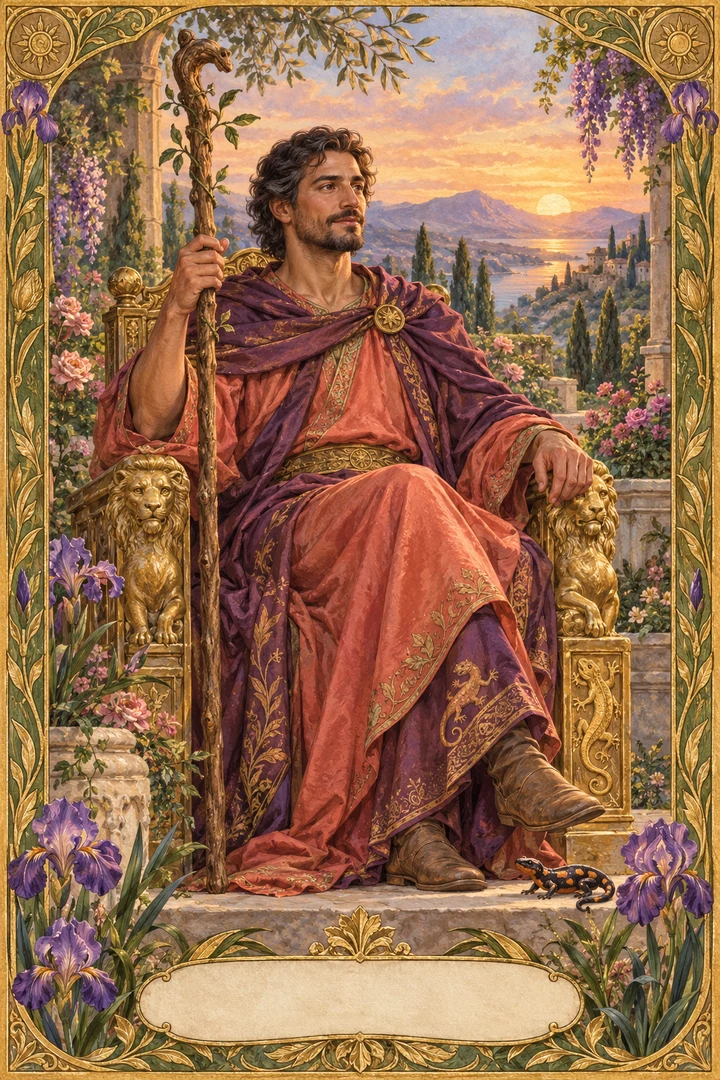 63 / SELFETTI
King of Wands
Who needs a real say in the direction I am setting?
Explore this card
The traditional King of Wands sits on a throne carved with lions and salamanders, holding a living staff. In Selfetti's garden, an adult man with a kind, thoughtful face rests on an antique golden throne, coral and plum robes around him, a small salamander near his feet. The flowering garden and distant hills belong to our setting. We read the upright staff as a direction that stays alive because someone tends it, not because it dominates.
- The King holds a living staff from a settled seat. Directing energy means making the aim clear, hearing the people involved and following through. A strong vision need not make others smaller. This card often appears when you are the one others look to for a way forward, or when you are ready to take that role yourself. The question is not whether you have confidence, but whether your confidence leaves room for other people's knowledge, timing and consent. Leadership here is a practice of holding a direction while staying reachable.
- Initiative is useful when decisions remain shared. One person's certainty does not establish the right pace or future for both people. The King of Wands in a love reading can point to someone who brings warmth, direction and generous energy to a relationship. It can also ask whether one person's plans are leaving little room for the other's preferences. A shared direction is built through conversation, not announced. If you are the one with a clear idea, check that your partner has a real say in the pace and shape of things.
State one aim and its practical limits. Ask one affected person what would make the plan workable for them.
Read the full guide ↗ · One card. A little room for yourself. ↗ 64 / SELFETTI
Ace of Pentacles
What usable support is already within reach?
Explore this card
The traditional Ace of Pentacles shows a hand from a cloud holding one golden five-pointed-star coin, with a garden path, an arch and mountains below. Selfetti keeps the single coin and the path through a flower-covered arch toward the landscape beyond. The coin suggests a resource you can actually use; the path invites attention to the ordinary conditions that make a beginning possible. The irises, sunset and golden frame are part of our original illustration. No person stands in the garden, and the coin does not promise wealth or a financial outcome.
- A coin is offered above a garden path. Notice a resource you can actually use: time, a tool, a useful introduction or a place to practise. An opening is not the same as a result; it needs care and workable conditions. The hand does not place the coin in your palm. You decide whether to reach for it, and what ordinary support would let it become something real rather than a hopeful idea.
- A small reliable gesture can make care tangible. Discuss what you can offer in everyday life; the coin cannot prove commitment, pregnancy or a relationship's future. Upright, this might be a shared routine, a practical favour or a clear agreement about time. Reversed, check whether one person is carrying the practical weight while the other only talks about intentions. The other person's feelings still belong to their own words and behaviour.
Choose one available resource and one task it can support. Check the practical conditions before setting a small first step.
Read the full guide ↗ · One card. A little room for yourself. ↗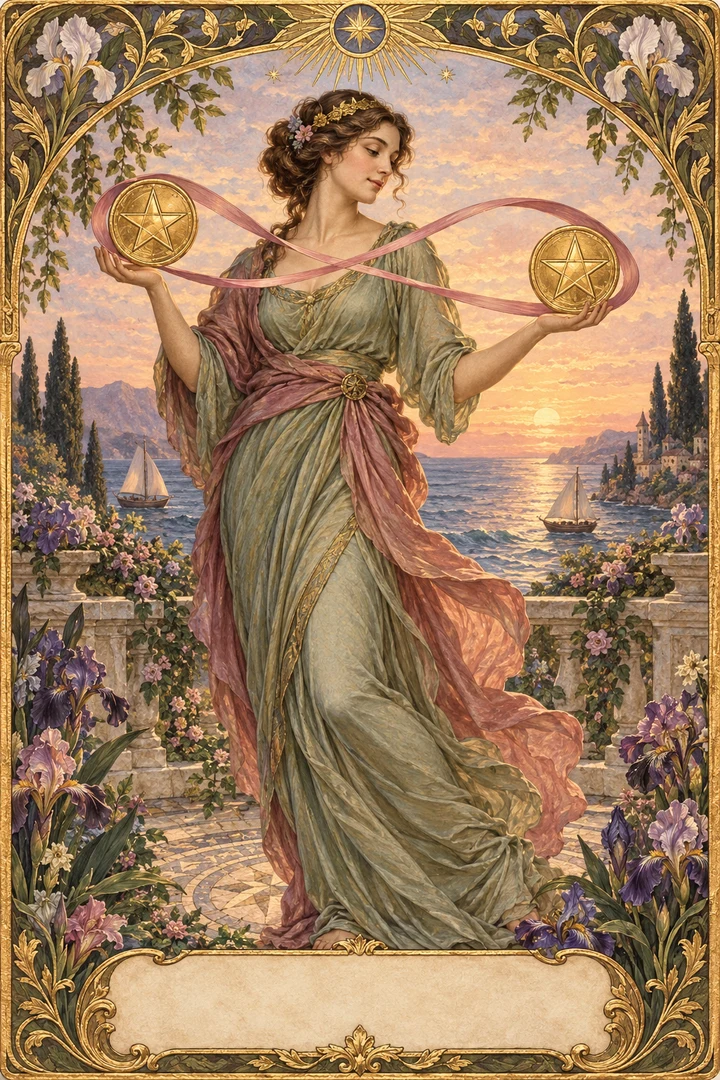 65 / SELFETTI
Two of Pentacles
What could I reduce before trying to juggle better?
Explore this card
The traditional Two of Pentacles shows a figure juggling two coins within an infinity loop, ships riding waves behind. Selfetti keeps that recognisable loop and the rising and falling boats, but sets the scene in a garden terrace with an adult woman in a sage and rose dress. The two golden star coins and the single flowing ribbon are our adaptation; they show balance as an active, graceful adjustment rather than a static pose. The garden and flowers belong to our original setting and do not add hidden symbols or predictions.
- Two coins move within a continuous loop while boats rise and fall behind. Flexibility helps with recurring demands, but balance is an adjustment rather than a permanent pose. Include rest and the work of keeping track. You may be managing several real responsibilities, and the card recognises that effort. It does not ask you to juggle more elegantly; it asks you to notice what the rhythm actually costs and whether it can hold your finite capacity.
- Discuss availability plainly. Caring about someone and being able to respond constantly are different things; an agreed rhythm is more useful than guessing how much contact means love. You might name when you are free and when you are not, without turning the conversation into a test. Reversed, uneven attention or missed practical needs can strain a bond. A smaller, honest agreement about time and energy can protect the connection better than promising more than you can give.
Map two recurring demands with their real time costs. Reduce or move one, and leave a margin for rest or change.
Read the full guide ↗ · One card. A little room for yourself. ↗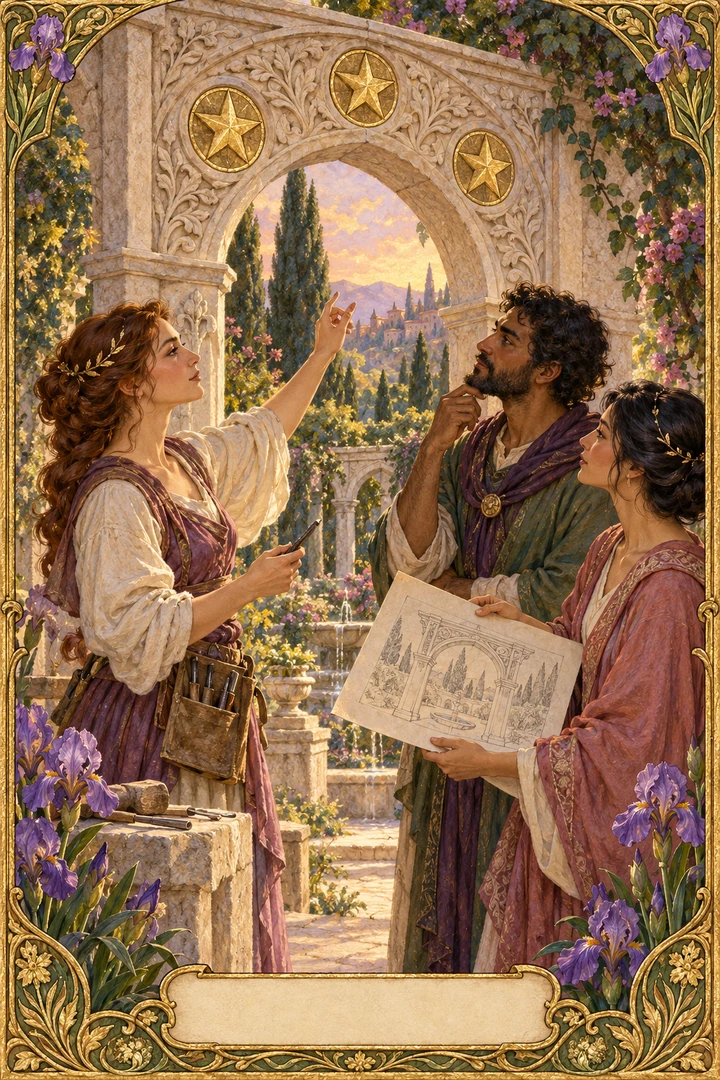 66 / SELFETTI
Three of Pentacles
What part of this work needs another person's perspective?
Explore this card
The traditional Three of Pentacles shows a craftsperson at work in a stone arch, with two figures holding plans and three pentacles set into the stone. Selfetti keeps the arch, the tool and the unlettered drawing, and sets the scene in a garden with three adult collaborators. We read the three coins as separate contributions that are countable and visible. The garden and the diverse figures belong to our adaptation; they do not add a hidden symbol or a separate prediction.
- The Three of Pentacles is often read as a working collaboration: different skills meeting around a shared task, with room for questions and review. A craftsperson and two companions discuss an unfinished arch, and each brings something the others do not. The card does not promise that teamwork will be smooth. It asks whether roles, standards and credit are clear enough for expertise to be heard. Include planning and feedback in the agreement, not only at the end.
- In love, the Three asks about practical cooperation. Shared life includes concrete tasks, and affection does not automatically make coordination easy. Discuss one real responsibility and what each person will own, rather than assuming the other will notice what needs doing. Reversed, check whether one person's effort or knowledge is being overlooked. A fair arrangement can be talked about without turning it into a scoreboard.
Show one unfinished piece to an appropriate collaborator. Ask one specific question, and agree who owns the next revision.
Read the full guide ↗ · One card. A little room for yourself. ↗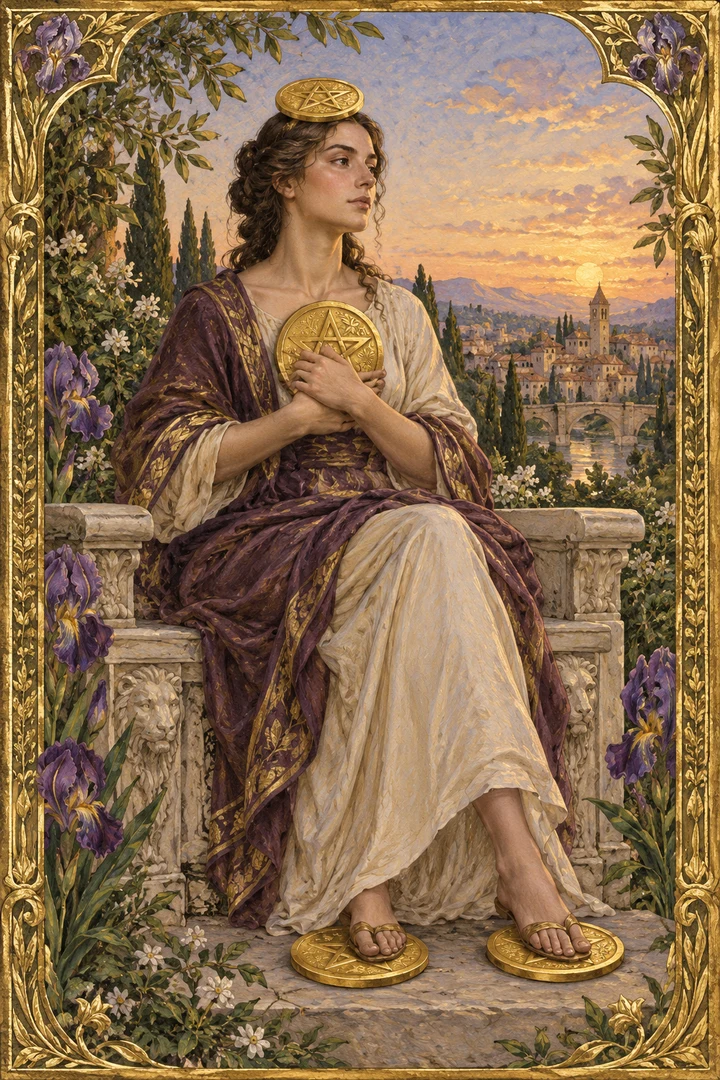 67 / SELFETTI
Four of Pentacles
What is this boundary protecting, and what is it costing?
Explore this card
The traditional Four of Pentacles shows a figure clutching one coin to the chest, one balanced on the head and two beneath the feet, often seated against a city skyline. Selfetti keeps that recognisable posture in an original garden scene: an adult woman on a carved seat, a small town in the distance, four gold five-pointed-star coins placed as described. The garden, flowers and her thoughtful expression belong to our adaptation, which values dignity and choice rather than a greedy caricature. The coins mark what she protects; the open space around her asks whether protection still leaves room to breathe.
- The Four of Pentacles often speaks to the instinct to hold on: saving, keeping private, setting a limit or guarding something that took effort to build. That impulse can be wise. A boundary around time, money or personal information may protect real needs. The question is what the boundary supports and what it costs. Does it create enough stability to live from, or has protection become the whole posture? Notice whether you can still enjoy ordinary things, share what matters or exchange support without feeling diminished. Security is not the same as rigidity.
- In love, the Four asks you to discuss privacy, time and material boundaries without using control as evidence of care. Wanting space or keeping some things private can be healthy. It becomes a problem when a boundary is enforced over another person rather than agreed with them. Nobody's attention, body or independence is a resource another person owns. Reversed, notice whether fear of loss is tightening your grip or whether you are finally loosening a limit that no longer fits. Speak about the boundary directly.
Name one resource boundary and its purpose. Keep, adjust or explain it using the situation you can actually observe.
Read the full guide ↗ · One card. A little room for yourself. ↗ 68 / SELFETTI
Five of Pentacles
What immediate need could I name plainly, and who could realistically help?
Explore this card
The traditional Five of Pentacles shows two figures walking through snow past a lit stained-glass window, one on crutches, both seemingly unnoticed. Selfetti keeps the cold evening, the glowing building and the five golden star-coins, but places the pair in a garden setting. Our adaptation gives them dignity and companionship: they walk together, one with simple wooden crutches, the other in a warm plum cloak. A visible nearby doorway suggests that support may be closer than it appears. The five star-coins are clearly separated and countable in the arched window. We read the scene as a moment of practical need and exclusion, not a prediction of poverty or illness.
- The Five of Pentacles often speaks to a period when something essential is missing: money, warmth, health, belonging or a sense of being seen. The traditional image of two figures in snow outside a lit window can frame that experience without turning it into a forecast. The card does not say your difficulty is permanent or deserved. It asks you to identify the immediate need and look for what assistance is genuinely available. Companionship matters here: you do not have to carry the whole weight alone, and help may come from a person, a service or a small practical step.
- Loneliness can occur inside or outside a relationship. The Five of Pentacles asks you to name a concrete form of support and notice the reply. It cannot establish abandonment or reveal another person's feelings. If you are partnered, you might say, ‘I have been feeling far away from you lately. Could we spend an hour together without distractions?’ If you are single, the card can point to the need for companionship rather than a verdict on your desirability. The focus stays on what you can ask for and what is actually offered.
Name one practical need and one accessible support route. Check what it offers and make a specific request if it fits.
Read the full guide ↗ · One card. A little room for yourself. ↗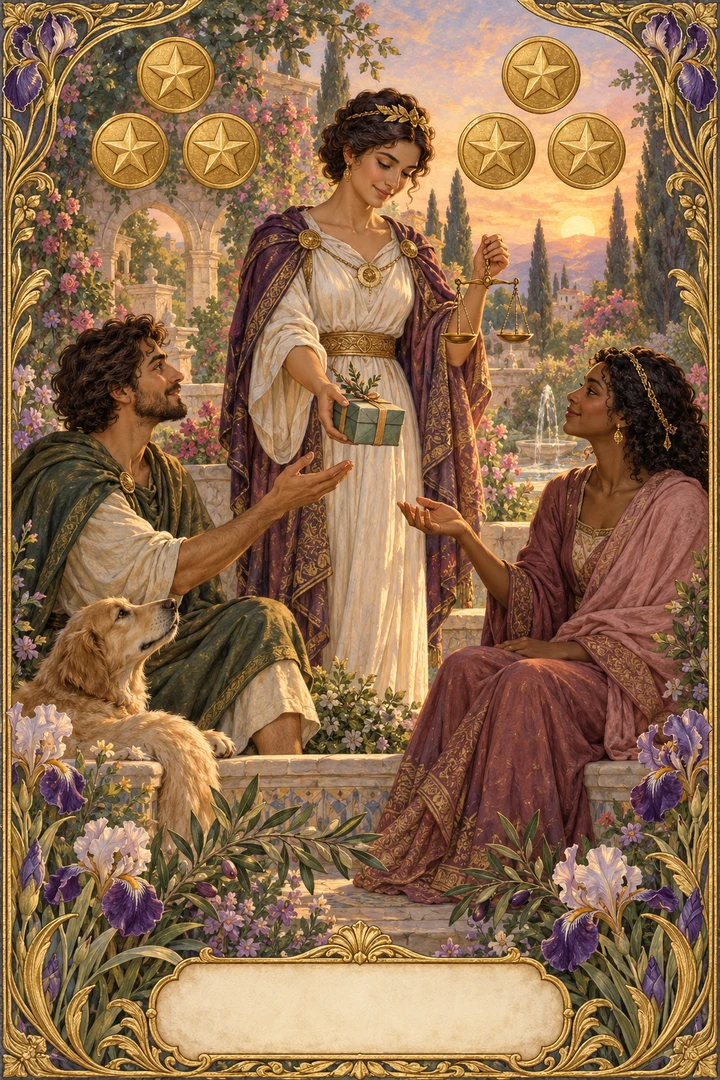 69 / SELFETTI
Six of Pentacles
Are the terms of this exchange clear and freely chosen?
Explore this card
The traditional Six shows a merchant with scales, giving coins to two kneeling figures. Selfetti keeps the scales and the exchange but sets it in a flowering garden courtyard. Three adults meet respectfully: one standing holds the scales and offers a useful gift to two seated comfortably. Six golden star coins float above in two groups of three. We read the scales as a question about fair terms, not a verdict. The garden, flowers and warm eye contact belong to our original setting; they add dignity and choice rather than a hidden symbol.
- The Six of Pentacles often points to an exchange of resources: time, money, help, attention or skill. The scales ask who can choose the terms, who can say no and who can name a need without fear. Giving can be kind without requiring gratitude on demand. Receiving need not create unlimited obligation. This card invites you to look at the practical shape of care, not just its warm feeling. Fairness here is not identical shares; it is clear terms that both people can freely accept or decline.
- In love, notice whether both people can ask, receive and decline. Gifts do not compensate for disrespect, and care should not be used to control someone else's decisions. The Six asks you to look at the practical balance of giving and receiving in the relationship. Are needs named openly? Can either person say no without punishment? Reversed, watch for hidden conditions or overgiving that leaves you resentful. Fairness in love is not a ledger; it is a shared willingness to keep the exchange honest.
Clarify one offer: what is being given, its limits and any expectations. Make room for either person to decline.
Read the full guide ↗ · One card. A little room for yourself. ↗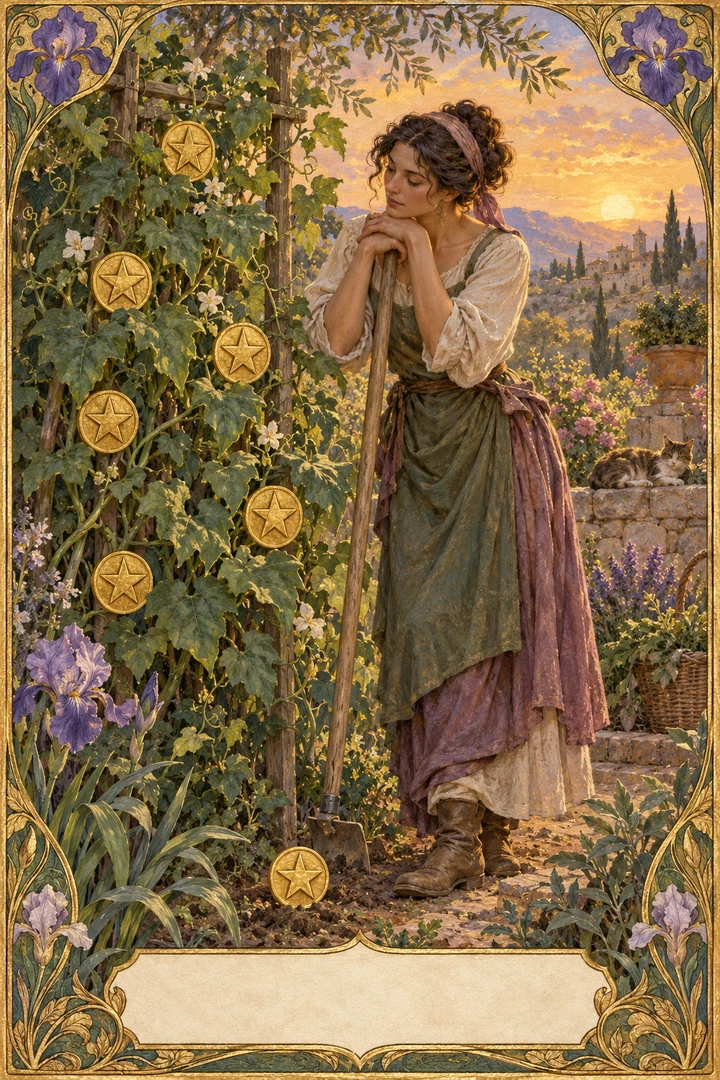 70 / SELFETTI
Seven of Pentacles
What has changed, and what evidence would justify another round of effort?
Explore this card
The traditional Seven shows a gardener leaning on a hoe, gazing at a vine where coins grow among the leaves. Selfetti keeps that pause in an original garden scene: an adult gardener rests on a plain wooden hoe beside a healthy leafy vine, with six golden star-coins growing among the leaves and one resting low near their foot. The golden quiet afternoon and the gardener's thoughtful posture belong to our adaptation. We read the scene as a deliberate checkpoint rather than a promise of harvest. The seven coins are clearly countable, and no other round gold ornaments appear.
- The Seven of Pentacles is often read as a pause to look at what your effort is actually growing. You may have tended something for a while and now want to know whether it is worth continuing. Patience here is not passive waiting; it is deliberate when you know what you are observing and when you will review it again. The gardener rests on the hoe, not because the work is finished, but because looking clearly is part of the work. You can value what you have done and still adjust the plan.
- In love, the Seven asks you to consider whether effort leads to a more workable exchange. Patience cannot create another person's willingness. You might notice a pattern of you initiating and them responding vaguely, or of both of you trying without a shared direction. Discuss an observable pattern and listen to what they want. The card does not tell you what they feel; it asks you to review what is actually happening between you.
Review one ongoing effort using two observable signs. Choose to continue, change or stop, and name a next checkpoint if you continue.
Read the full guide ↗ · One card. A little room for yourself. ↗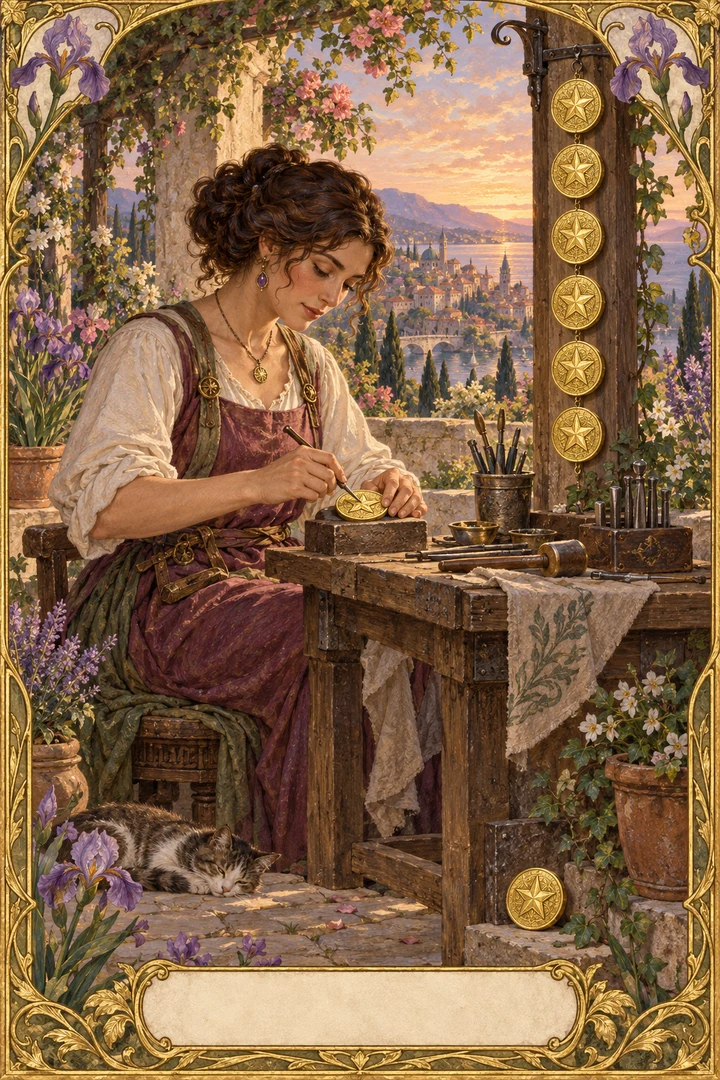 71 / SELFETTI
Eight of Pentacles
Which small part of this skill would benefit from attention today?
Explore this card
The traditional Eight shows a craftsman engraving a coin while finished coins hang nearby. Selfetti keeps that focused work in a garden, where an adult craftswoman engraves one golden five-pointed-star coin at a wooden workbench. Six finished star coins hang clearly spaced in a vertical display beside her, and one finished coin leans near the bench foot. The garden, flowers and warm light belong to our original setting; they do not add a separate prediction to the card.
- The Eight of Pentacles is often read as the patient work of getting better at something. A craftsperson works on one coin beside completed pieces, giving attention to a particular part of the task. Quality grows through repetition, but also through feedback and recovery. You may be quietly building competence that nobody sees yet. Let the work be specific and unfinished rather than a verdict on your worth.
- In love, the Eight asks you to practise a specific habit, such as listening through an answer or keeping an agreement. A relationship cannot be earned through flawless effort by one person alone. Notice whether your care is reciprocal or whether you are polishing a dynamic that needs a real conversation. Small, consistent attention matters more than a perfect performance.
Practise one specific part for a short set time. Ask for one piece of useful feedback, then stop or rest.
Read the full guide ↗ · One card. A little room for yourself. ↗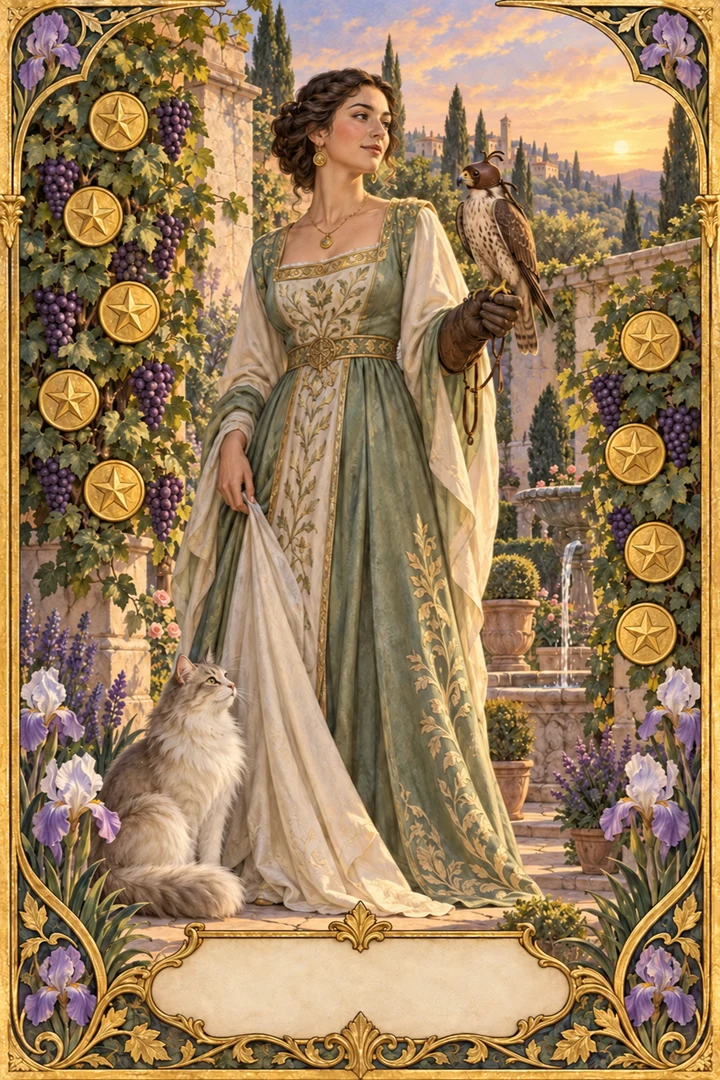 72 / SELFETTI
Nine of Pentacles
What ordinary pleasure could I enjoy without improving or displaying it?
Explore this card
The traditional Nine of Pentacles shows a woman standing at ease in a walled garden, a hooded falcon on her gloved hand, with nine pentacles arranged among the vines. Selfetti keeps those recognisable elements in a flourishing garden. We read the falcon as trained independence and the garden as a space that has been tended over time. Our adaptation places a diverse adult figure in an elegant sage and ivory gown, with exactly nine golden five-pointed-star coin disks across the grape vines, five on one side and four on the other. The flowers and golden frame belong to our original setting; they do not add a separate prediction to the card.
- The Nine of Pentacles often speaks of a life you have helped shape: a corner that is yours, a skill you have practised, a rhythm that fits. The figure stands at ease in a cultivated garden with a trained falcon, suggesting independence that is not isolation. Notice something that supports your autonomy and lets you enjoy ordinary beauty. Autonomy can include relationships and support; it does not require doing everything alone. The card asks you to recognise sufficiency without turning every pleasure into another task to complete.
- In love, the Nine of Pentacles asks you to keep personal interests and boundaries alongside connection. Independence is not emotional coldness; neither does an attractive lifestyle reveal what a person wants in a relationship. You can enjoy your own space and still welcome closeness. If you are single, this card does not mean you must be alone; it can reflect a season of self-respect. If you are partnered, it can support a balance where both people have room to be themselves.
Spend a little time with a comfort you already have. Notice the work and support that made it possible, without adding a new task.
Read the full guide ↗ · One card. A little room for yourself. ↗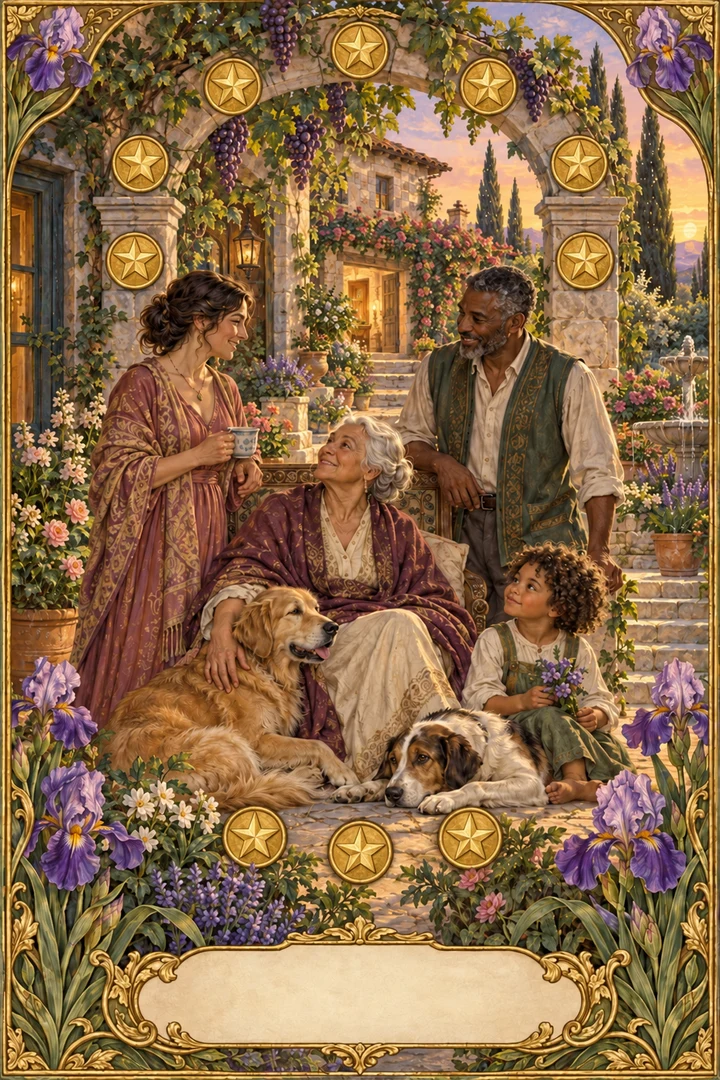 73 / SELFETTI
Ten of Pentacles
Who is supported by this arrangement, and whose needs have not been heard?
Explore this card
The traditional Ten of Pentacles shows an older figure, a couple, a child and dogs beneath an arch, with ten coins arranged in a tree-like pattern. Selfetti keeps those recognisable elements in a flowering stone courtyard. We read the arch and the gathered figures as a question about who belongs and who decides. The garden, vines and golden frame belong to our original setting; they do not add a separate prediction to the card.
- The Ten of Pentacles is often read as a shared foundation: the practical arrangements, habits and resources that hold a household or community together over time. Several generations, dogs and an arch widen the image from one person to a household. Ask what practical foundations help people belong and who is included in decisions. A lasting arrangement can be built with chosen family as well as relatives. Stewardship here means tending what you have inherited or built, while leaving room for others to shape it too.
- Discuss everyday foundations and long-term wishes without assuming a single model of family. A warm image cannot guarantee marriage, children, inheritance or relationship security. In love, the Ten asks what kind of shared life you are actually building, and whether both people have a say in it. Reversed, notice if one person's needs are treated as optional while the other's expectations set the terms.
Review one shared household or team agreement. Invite a specific affected person to name one change that would make it more workable.
Read the full guide ↗ · One card. A little room for yourself. ↗ 74 / SELFETTI
Page of Pentacles
What small skill would make an ordinary part of my life more workable?
Explore this card
The traditional Page stands in a field, holding a single pentacle and studying it closely. Selfetti keeps that focused attention but sets it in a flowering meadow with a small cultivated field and gentle hills. Our adult woman in an embroidered sage tunic holds one golden five-pointed-star coin with both hands. The garden and flowers belong to our original setting; they frame learning as something that grows from ground you tend, not a promise of wealth.
- The Page of Pentacles is often read as a practical beginning: learning a skill, starting a small project or giving steady attention to something concrete. The Page studies the coin with both hands near cultivated ground, suggesting that curiosity becomes useful when it meets a patch of real life. You do not need a complete plan or a grand transformation. A modest commitment—one lesson, one practice slot, one repair—can be serious without becoming your whole identity. The card invites you to choose something tangible to learn and a place to try it.
- In love, the Page of Pentacles suggests making an ordinary intention visible through a small kept agreement. Learning to discuss a practical need—time, space, a shared task—can matter more than performing certainty about the future. A modest, consistent gesture often speaks louder than a grand promise. Reversed, check whether you are planning the relationship instead of participating in it, or whether your routine leaves no room for the connection you say you want. The other person's feelings remain their own to express.
Choose one small learning outcome and a short practice slot. Use one suitable resource and note the question your attempt raises.
Read the full guide ↗ · One card. A little room for yourself. ↗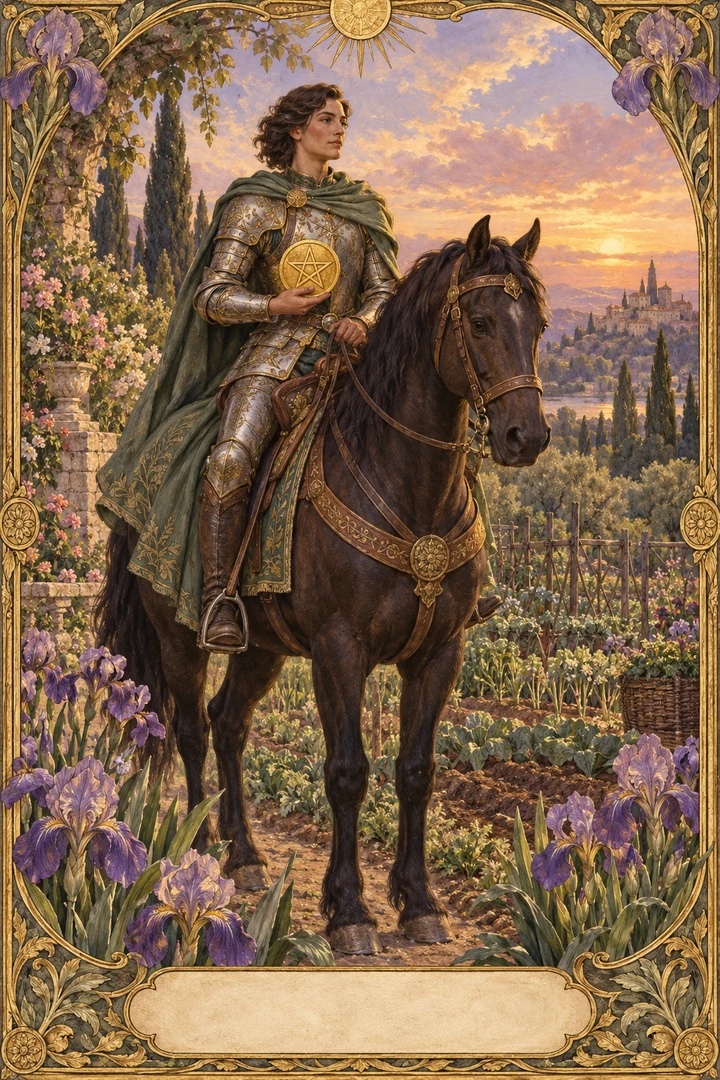 75 / SELFETTI
Knight of Pentacles
Which routine supports my life, and which needs a small change?
Explore this card
The traditional Knight of Pentacles shows a rider on a still horse, holding a single gold coin. In Selfetti's adaptation, an adult rider in finely engraved light armour sits upright on a calm dark horse beside a cultivated garden field. The rider holds exactly one golden five-pointed-star coin, clearly visible. A sage cape and patient, purposeful expression replace the armour's severity. Richly textured soil and irises frame the scene. This is steady care rather than charging speed; no extra coins or weapons appear. The garden and flowers belong to our original setting, emphasising dignity and choice in how care is offered.
- The Knight of Pentacles is often read as steady, patient care that shows up in repeated actions. A still horse and a held coin emphasise attention before movement. This knight does not rush; he checks the ground, keeps a modest promise, and returns to it. In your life, this can look like a routine that supports what matters, or a practical responsibility you carry without fanfare. The invitation is to keep the routine useful, not to let it replace the life it serves. Reliability here is a form of care, and it can be flexible enough to keep living.
- In love, reliability appears in ordinary kept agreements: remembering what you said you would do, showing up when you said you would. A slower pace is not proof of commitment or disinterest; it is simply a pace. Discuss expectations and notice actual follow-through rather than reading meaning into stillness. If you are the one who keeps things steady, check that you also have room to receive care. If you are waiting for someone else's steadiness, ask for clarity instead of guessing.
Review one repeated commitment. Keep its useful purpose, adjust one unnecessary cost and define when it is done.
Read the full guide ↗ · One card. A little room for yourself. ↗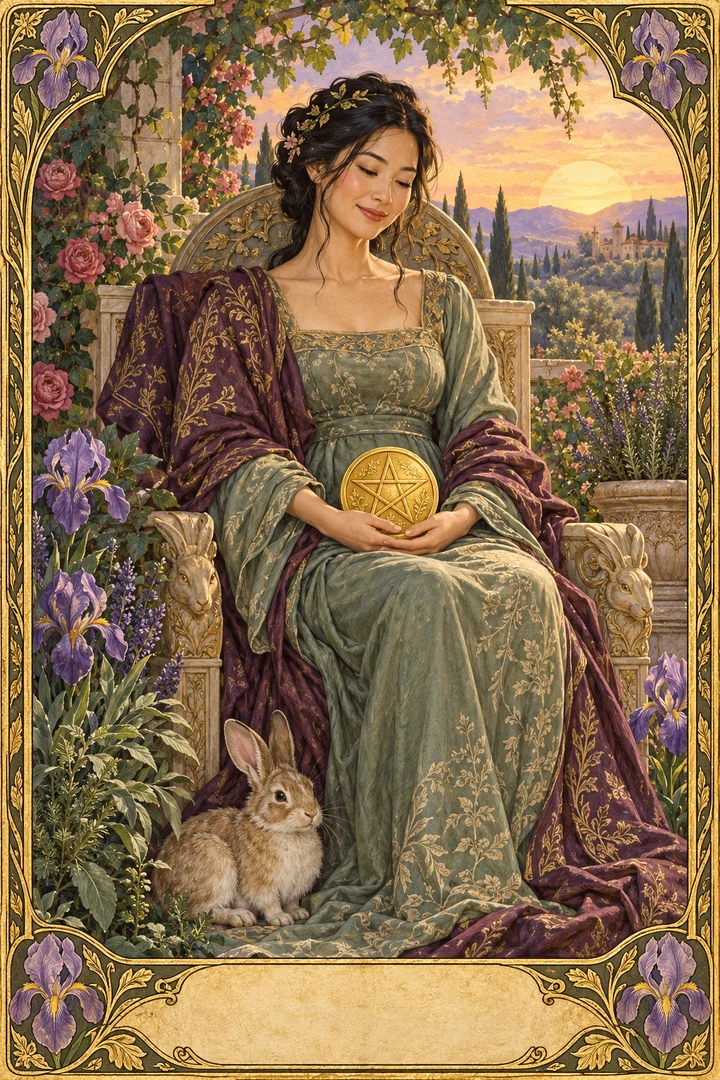 76 / SELFETTI
Queen of Pentacles
What would practical care look like if my own needs were included?
Explore this card
The traditional Queen of Pentacles sits on a throne carved with plants and animals, holding a single coin and looking at it calmly. In Selfetti's garden adaptation, an adult woman with East Asian features rests in an ornate throne among roses, irises and greenery, one golden five-pointed-star coin held gently in her lap. A small rabbit rests near her feet. Sage and plum fabrics frame a caring face. The garden and flowers belong to our setting; they do not add a separate prediction. The coin and the rabbit are recognisable traditional details, and we read them as symbols of practical care and quiet watchfulness rather than literal wealth or fertility.
- The Queen of Pentacles is often read as practical warmth: care that takes form through food, comfort, attention and arrangements that fit real needs. She holds a coin gently within a living garden, suggesting that resources and tenderness can belong together. This is not about doing everything for everyone. It is about making a space where people can rest, including you. Your own time, rest and pleasure belong in the circle of care you offer. The card invites you to notice how you sustain others and whether you are also sustained.
- In love, the Queen of Pentacles asks whether care reaches both people through actions and attention. Domestic competence does not create an obligation to carry all the work or to prove that somebody will commit. Practical love can be beautiful, but it needs to be mutual. Notice who remembers the small things and who assumes they will be done. A healthy bond includes room for your needs, not just your reliability. The card does not promise a particular outcome; it invites you to look at the balance of giving and receiving.
Choose one small act of care and simplify or share its work. Include one comfort, meal or rest you can receive yourself.
Read the full guide ↗ · One card. A little room for yourself. ↗ 77 / SELFETTI
King of Pentacles
What would make this arrangement dependable and fair for everyone involved?
Explore this card
The traditional King of Pentacles sits on a throne carved with bulls and vines, holding a coin and sceptre, with a castle and lush garden behind him. Selfetti keeps those recognisable elements in a flourishing garden. We read the coin as responsibility for what sustains a life, and the garden as the visible result of care. The warm brown skin, sage and aubergine robes, and distant welcoming house belong to our original setting; they do not add a separate prediction to the card.
- A settled throne, coin and cultivated garden suggest responsibility for what sustains a life. Check what makes an arrangement reliable: clear terms, maintained resources and room for people to ask for what they need. Stewardship here is not about hoarding but about tending the conditions that let others flourish. You may be the person who keeps ordinary life working, and that reliability can be generous without requiring you to be invulnerable. Fair access means the terms are understandable and open to question.
- Practical reliability can support a relationship when both people retain agency. Providing resources does not grant ownership of another person's time or choices. Upright, this card may show a partner who shows care through dependable actions, shared planning and making room for your needs. Reversed, watch for a dynamic where money, housing or status becomes a way to avoid questions or demand obedience. The health of the arrangement depends on whether both people can speak honestly about what they give and receive.
Check one shared practical agreement using real information. Clarify one responsibility or review date with the people affected.
Read the full guide ↗ · One card. A little room for yourself. ↗